Tokyo Skytree BBQ Beer Garden 2026: World Beer Museum Rooftop with 100 Craft Beers and American or Korean BBQ Courses

Tokyo Skytree BBQ Beer Garden 2026: World Beer Museum Rooftop with 100 Craft Beers and American or Korean BBQ Courses

BBQ Garden Overlooking Tokyo Skytree(R) / World Beer Museum

Choose from two courses: American BBQ or Korean BBQ! An open-air beer restaurant on a rooftop overlooking Tokyo Skytree, where you can enjoy empty-handed BBQ and 100 types of draft beers from around the world.


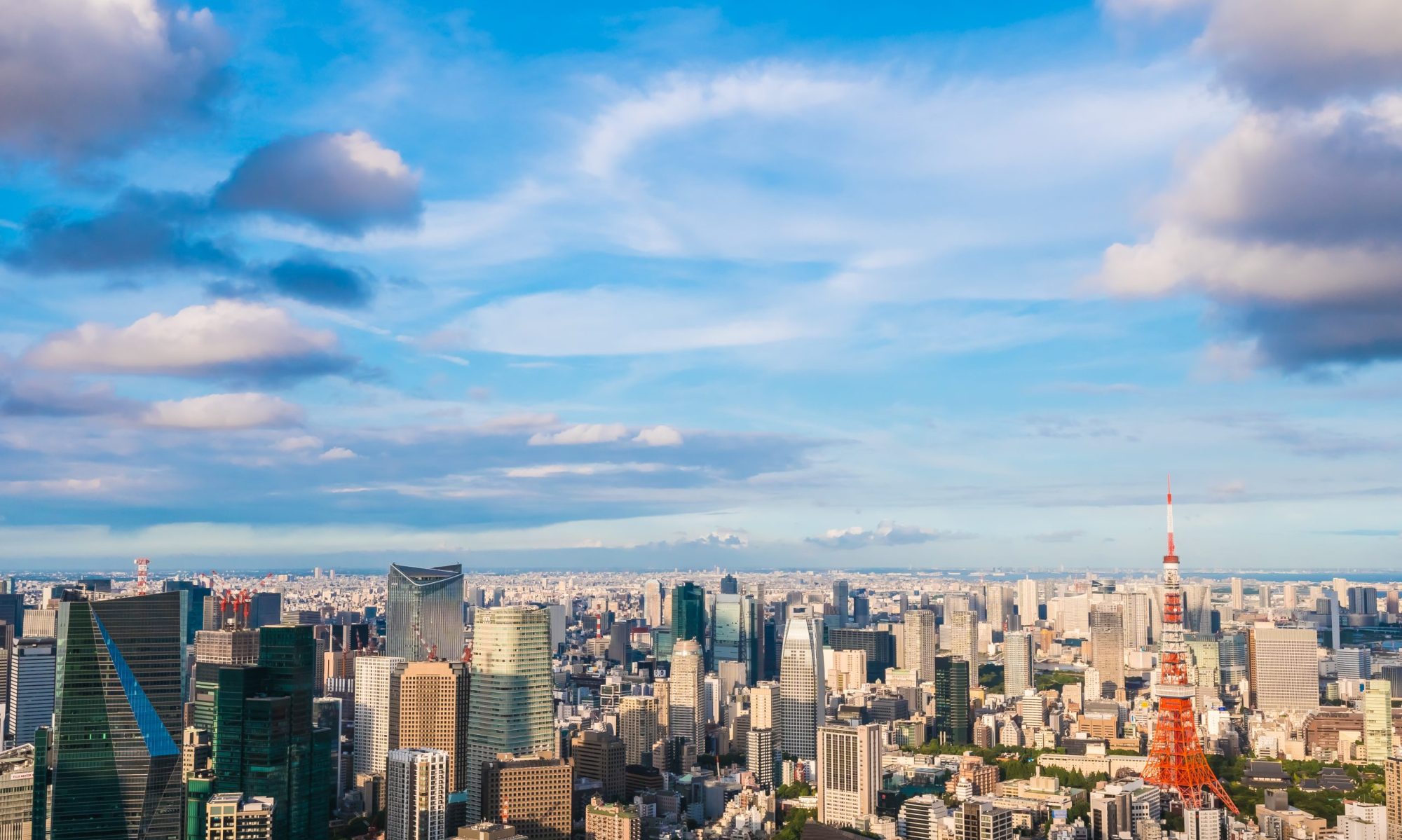
Perched on the 7th floor rooftop of Tokyo Skytree Town Solamachi, this beer restaurant delivers what few venues in the capital can match: direct sightlines to the 634-meter Tokyo Skytree while you eat. The terrace seating puts the tower overhead during daylight hours, then shifts to a panoramic cityscape as evening falls and the urban landscape lights up. The space has been designed with photography in mind—designated Instagrammable seats and photo spots are integrated throughout, and the overall aesthetic leans toward stylish rather than casual.

The operational concept centers on removing friction from outdoor dining. Guests arrive without equipment—the kitchen handles all grilling—while heat management comes via large fans and outdoor spot coolers that keep the terrace functional through Tokyo’s humid summers.

Beer selection represents the venue’s other primary draw. The restaurant ranks among Japan’s largest dedicated beer establishments, with 100 draft varieties sourced internationally. Domestic options from Asahi, Kirin, Suntory, and Sapporo anchor the list, supplemented by 100 types of overseas craft beers. This breadth allows for progression through styles over the course of an evening, or direct comparison between regional brewing traditions.

Two distinct BBQ courses structure the food offering:

  • American BBQ Course: Grilled steaks and specialty hamburgers, calibrated for pairing with fuller-bodied beers
  • Korean BBQ Course: Samgyeopsal, UFO chicken, and specialty cold noodles, served alongside Korean beer selections

The split format lets groups align their meal with specific occasions or preferences without leaving the venue.

Additional service elements include all-you-can-eat BBQ options, dedicated kids’ menus, and indoor contingency seating—when weather turns, operations either move inside or continue under the rooftop’s permanent roof structure.


Practical Information

Category Details
BBQ Style Empty-handed (equipment provided, no preparation required)
Heat Countermeasures Large fans, outdoor spot coolers
Beer Range 100 types of overseas craft draft beers; plus Asahi, Kirin, Suntory, Sapporo
Total Capacity 320 seats (150 outdoor terrace seats)
Group Maximum 300 people
Reservations Web reservations available
Payment Methods Credit card, QR code, electronic money, cash
Rain Response Move indoors, or continue outdoors under roof coverage

Access & Location

Venue: World Beer Museum Tokyo Skytree Solamachi Store

Nearest Stations: Tokyo Skytree Station / Honjo-Azumabashi Station / Oshiage <Skytree-mae> Station

Address: 〒131-0045 Tokyo-to, Sumida-ku, Oshiage 1-1-2 Tokyo Skytree Town Solamachi 7F

MAP


Operating Schedule

Event Period March 1, 2026 (Sun) – October 31, 2026 (Sat)
Hours 11:00 – 23:00
Last Order Food 22:00 / Drinks 22:30
Regular Holiday None

Contact

Phone: 03-5610-2648 (11:00–23:00)

Official Website: https://www.zato.co.jp/restaurant/worldbeermuseum/worldbeermuseum_tokyo/

The published content may be subject to change. Please check the official website of the venue or organizer for the latest information.

🛏️ See hotels near Tokyo


Gallery

東京スカイツリー(R)を見上げるBBQガーデン/世界のビール博物館_1
東京スカイツリー(R)を見上げるBBQガーデン/世界のビール博物館_2
東京スカイツリー(R)を見上げるBBQガーデン/世界のビール博物館_3
東京スカイツリー(R)を見上げるBBQガーデン/世界のビール博物館_4
東京スカイツリー(R)を見上げるBBQガーデン/世界のビール博物館_5
東京スカイツリー(R)を見上げるBBQガーデン/世界のビール博物館_6
東京スカイツリー(R)を見上げるBBQガーデン/世界のビール博物館_7
可愛いオットセイに会いに行こう!すみだ水族館で「すみだオットセイファン感謝祭」開催中

What is Tokyo Skytree?

Tokyo Skytree is a broadcasting tower and landmark in Sumida City, Tokyo. At 634 meters, it is the tallest structure in Japan. Completed in 2012, it took over primary broadcast duties for the greater Tokyo region from the older Tokyo Tower.

The tower has two observation decks: one at 350 meters and another at 450 meters. On clear days, visitors can see Mount Fuji in the distance. The lower deck features a glass floor section and a restaurant; the upper deck, called the “Tembo Galleria,” has a sloping ramp that spirals upward to the 451.2-meter summit.

At ground level, Tokyo Skytree Town houses shops, restaurants, an aquarium, and a planetarium. The complex connects directly to Oshiage Station, making it accessible by train, subway, and bus lines. The area draws roughly 30 million visitors annually.

The tower’s design has practical roots. Its height was chosen to clear nearby buildings for broadcast signals, and its tripod base and central shaft are engineered to withstand earthquakes and typhoons common to the region. The exterior lighting changes seasonally—white for winter, blue for summer—based on traditional Japanese color schemes.

Tokyo Skytree operates as a commercial facility managed by Tobu Railway Group and Tobu Tower Skytree. Broadcast equipment occupies the upper sections; the remainder supports tourism, retail, and observation functions.

Visit Nagoya Sword World’s 2026 Summer Festival with Lord Hideyoshi and Lord Toshiie: A Family-Friendly Guide to History and Fun

Visit Nagoya Sword World's 2026 Summer Festival with Lord Hideyoshi and Lord Toshiie: A Family-Friendly Guide to History and Fun

Step Back to the Sengoku Period: Summer Festival with Lord Hideyoshi and Lord Toshiie at Nagoya Sword World

On Friday, July 24, 2026, the Nagoya Sword Museum—known as “Nagoya Sword World”—transforms its Main Building 2nd Floor lobby into a spirited summer festival ground where history and family entertainment converge. This single-day event, titled “Summer Festival with Lord Hideyoshi and Lord Toshiie,” offers visitors the rare opportunity to interact with two of Japan’s most pivotal historical figures while experiencing traditional festival culture within the context of one of the nation’s premier sword collections.

The afternoon brings together Lord Toyotomi Hideyoshi—the warlord who completed the unification of Japan—and Lord Maeda Toshiie, the distinguished warrior and founder of the Kaga domain, both portrayed by members of the Nagoya Omotenashi Bushotai®. Adding to the spectacle, the Jingasa-tai Odori-mai will perform traditional dances in conical war hats, creating an atmosphere that bridges the museum’s martial artifacts with the lively entertainment of the Sengoku period.

What distinguishes this festival from standard summer matsuri is its integration with the museum’s unique identity. While visitors explore the blade collections that define Nagoya Sword World, they can also participate in classic carnival activities including target shooting (shateki), ring toss (wanage), and capsule toy vending machines—each offering substantial prizes. The program extends beyond games to include a formal tea ceremony demonstration, curated photo opportunities with the warlord reenactors, and informative gallery talks that contextualize the weapons within Japan’s festival traditions.

For families considering attendance, July 24 presents a significant financial incentive: admission is free for children of elementary school age and younger exclusively on this date. This represents a departure from standard pricing, which typically charges junior high and elementary students at the door. To accommodate this offer, parents should notify the staffed reception at the museum shop on the 1st floor of the North Building upon arrival, as admission tickets will be issued for eligible children.

Event Details

Date and Time
Friday, July 24, 2026, from 10:00 to 17:00 (final admission at 16:30)

Venue
Nagoya Sword Museum “Nagoya Sword World”
Summer Festival Venue: Main Building 2nd Floor, Lobby in front of the entrance gate

Admission Fees

  • General: 1,200 yen
  • Seniors (65 and older): 1,000 yen
  • University/High school students: 500 yen
  • Junior high/Elementary school students: Free admission only on Friday, July 24
  • Preschool children: Free
  • Persons with disabilities (including one companion): Free *Please present your disability certificate.
  • Groups (20 or more people): 300 yen discount for General admission / 100 yen discount for non-General categories

Note: Since admission tickets will be issued for children of elementary school age and younger, please notify the staffed reception at the museum shop on the 1st floor of the North Building.

Access

  • 10-minute walk from Yabacho Station on the Nagoya City Subway Meijo Line
  • 9-minute walk from Osu Kannon Station on the Nagoya City Subway Tsurumai Line
  • 12-minute walk from Fushimi Station on the Nagoya City Subway Higashiyama Line

Contact
Nagoya Sword Museum “Nagoya Sword World”
Email: [email protected]
Homepage: https://prtimes.jp/main/html/rd/p/000000077.000023091.html

🛏️ See hotels near the event

Nagoya Sword World is a historical theme park and museum located in Aichi Prefecture, exploring Japanese sword craftsmanship and Sengoku period military history. The facility centers on a reconstructed Edo-period castle town, where timber-framed buildings house both permanent exhibitions and working forges. Smiths demonstrate traditional folding and tempering techniques using the same grades of tamahagane steel and pine charcoal that defined the era’s metallurgy.

The collection features authenticated nihontō historically linked to Central Japan’s warlords, including several blades attributed to the region’s major clans. Rather than presenting these weapons in isolation, the park examines their physical construction within the context of 16th-century warfare. Visitors can observe the differential hardening process that produces the hamon (temper line), examine the grain structure of traditional steel, and discuss with artisans how smiths balanced hardness against brittleness when forging weapons intended for battlefield use.

The programming particularly investigates the military alliance between Toyotomi Hideyoshi and Maeda Toshiie, two figures who established their power bases in this region. Historical reenactments and seasonal performances analyze the political strategies and logistical challenges that defined this relationship. The annual Summer Festival expands these themes through extended theatrical programming and temporary exhibitions drawn from private collections.

Educational offerings range from wood sword training for younger visitors to advanced seminars on metallurgical analysis and blade appraisal. The facility accommodates various levels of prior knowledge, providing structured entry points for newcomers while maintaining the technical precision required by serious researchers. This approach allows direct engagement with martial traditions without compromising the historical accuracy of the demonstrations or the safety of the participants.

Bakushokuonsai GG 2026 in Grand Green Osaka: Experience Global Craft Beer, Cuisine, and Arts for Free

Bakushokuonsai GG 2026 in Grand Green Osaka: Experience Global Craft Beer, Cuisine, and Arts for Free

As the Osaka-Kansai Expo concludes, the cultural momentum shifts north to Umekita, where Grand Green Osaka emerges as the new focal point for international exchange. Bakushokuonsai GG—translated as the Wheat Eating Sound Festival—represents one of the most significant “After Expo” events to inherit the exposition’s spirit of global connection, channeling the Expo’s international focus into a three-day celebration of craft beer, world cuisine, and performing arts.

This third iteration of the festival distinguishes itself through scale and specificity. While previous editions established the template of combining craft beer with multicultural programming, the 2026 installment expands to encompass food and cultural contributions from over fifty participating countries and regions. The result is not merely a food festival with background music, nor a concert with catering, but a deliberate integration of gastronomy and performance where craft beer stalls sit adjacent to stages featuring representative musicians, DJs, dance troupes, and theatrical performers from across the globe.

The programming engages multiple senses simultaneously. With contributions from over fifty nations and regions, visitors encounter combinations of sound, taste, and movement designed to transcend cultural barriers through immediate, sensory experience rather than passive observation. This approach reflects the Expo’s legacy of international dialogue, compressed into an accessible, park-based format that requires no admission fee—an intentional contrast to the Expo’s ticketing complexity.

Event Details

Set within the newly developed Umekita district, the festival occupies Grand Green Osaka at Umekita Park, a modern urban green space designed to host precisely this scale of international gathering.

  • Dates: Friday, July 10 – Sunday, July 12, 2026
  • Hours: 9:30 – 17:00 daily
  • Location: Grand Green Osaka, Umekita Park (5 Ofukacho, Kita-ku, Osaka City)
  • Admission: Free
  • Website: https://www.instagram.com/bakushoku_afterexpo

🛏️ View hotels near the event

What is Grand Green Osaka?

Grand Green Osaka (グラングリーン大阪), abbreviated as “GG”, is a 4.5-hectare urban development occupying the former Umeda Freight Yard north of Osaka Station. Completed in phases during 2024 and 2025, the project replaces a century of industrial rail infrastructure with public space, commercial facilities, and pedestrian infrastructure that finally integrates the previously isolated northern Umeda district into the station area.

The development centers on Ume-Kita Park (うめきた公園), built on a deck approximately four meters above street level. This elevation separates the park’s lawn and plaza areas from the traffic and pedestrian congestion below, accessible via stairways, escalators, and elevators from the surrounding streets. The raised design allows the space to function as both a neighborhood park and a venue for substantial events without disrupting the flow of commuters through the district.

Surrounding the park are mixed-use towers containing offices, hotels, and retail. The South Tower and North Tower complexes frame the green space on two sides, with retail podiums at ground level and hotel entrances opening directly onto the plaza. The buildings house approximately ninety commercial tenants along with hotel accommodations. The architectural massing maintains sight lines across the park while providing the density and foot traffic necessary to support the site’s public infrastructure.

For Bakushokuonsai GG 2026, the venue offers specific logistical advantages. The main lawn accommodates standing crowds of several thousand, while adjacent covered civic plazas provide weather-protected areas for vendors, stages, and seating. The site connects directly to Osaka Station via the Ume-Kita underground passage, which allows visitors to walk from the main concourse to the festival grounds without navigating Umeda’s complex, grade-separated street intersections or crossing surface traffic.

The festival operates under an open admission policy; there are no gates or ticket barriers separating the park from the surrounding commercial areas. Visitors can move freely between the event grounds, the adjacent retail spaces, and the station, treating the festival as part of the district’s normal pedestrian circulation rather than a sealed destination. This arrangement reflects the site’s intended function as public thoroughfare as much as programmed event space.

The 1st Nagoya International Film Festival 2027: Experience World-Class Cinema and Meet Leading Filmmakers

The 1st Nagoya International Film Festival 2027: Experience World-Class Cinema and Meet Leading Filmmakers

The 1st Nagoya International Film Festival

“Creating the entertainment culture of a hundred years from now”

The Nagoya International Film Festival distinguishes itself from the typical film festival model. Rather than operating as a closed venue for criticism intended only for a limited number of enthusiasts and industry insiders, it positions itself as an open, urban-style entertainment festival where filmmakers, business people, and citizens converge. Set against the backdrop of the Meieki and Midland Square area, the event creates space for these groups to resonate and unite around shared cultural passion.

What does this mean for attendees? The festival offers proximity to filmmakers active on the world’s front lines, providing direct exposure to contemporary cinema at its most ambitious. It also functions as a launch point for creators who will lead the next generation. The organizing principle is clear: connecting chains of “emotion” and “discovery” from Nagoya toward the future.

Event Details

Dates April 3 (Sat) – 4 (Sun), 2027
Time 13:00–15:00 (Red carpet implementation time)
Location Midland Square (Public roads around the Meieki south side plaza, B1F Atrium, 5F Midland Hall, 5F Midland Square Cinema, etc.)
Fees Only movie tickets are paid
Contact Nagoya International Film Festival Executive Committee — [email protected]
Website https://niff.or.jp/

🛏️ View hotels near the event

Access

By train:

  • Approximately 5 minutes walk from the Sakura-dori Exit of “JR Nagoya Station”
  • Approximately 3 minutes walk from the Central Ticket Gate of “Meitetsu Nagoya Station”
  • Approximately 3 minutes walk from the Front Ticket Gate of “Kintetsu Nagoya Station”
  • Approximately 1 minute walk from the Higashiyama Line South Ticket Gate of “Subway Nagoya Station”

By bus:

  • Approximately 0 minutes walk after getting off at the Nagoya City Bus “Nagoya Station (Platform 21)”
  • Immediately upon getting off the Aoi Kotsu Highway Bus at “Nagoya Station (In front of Midland Square)”

Nagoya houses the Toho Chukyo Studio in Midori Ward, one of Japan’s three major film production facilities outside Tokyo. Built in the post-war era on industrial land south of the city center, the lot includes soundstages large enough for kaiju films and standing water tanks for marine sequences—resources that remain scarce in Tokyo’s dense studio districts. Toho used the location to shoot tokusatsu effects sequences when productions outgrew their Tokyo backlots, capitalizing on the available warehouse space for miniature construction and wire-work rigs.

The Eizo Film Studio maintains a separate facility nearby, where crews have built and maintained period architecture for historical drama since the 1950s. Rather than dismantling sets after each production, Eizo kept its Edo-period street facades and castle walls standing, allowing directors to return for location shooting without reconstruction delays. This established Nagoya as a fabrication center rather than simply an exhibition market—a city that builds sets and weaves costumes rather than just projecting finished work.

The Aichi Film Commission coordinates location shooting across the prefecture, matching productions to specific sites from the preserved tie-dyeing district of Arimatsu to the crystalline towers of Nagoya Station. The commission maintains databases of industrial corridors, coastal ports, and mountain villages within driving distance of the studio lots, allowing crews to return to editing suites without overnight travel. This logistical infrastructure reflects the region’s manufacturing base, where precision coordination and technical labor already defined the industrial culture.

Hosting an international festival here places visitors within a working production environment. Theaters sit near active soundstages where crews still build miniatures and rig practical effects; local hotels regularly house location scouts and armorers alongside actors. While many festival cities import cinema as a finished commodity, Nagoya maintains the equipment rental houses, prop workshops, and technical schools that produce the work. The event accordingly emphasizes craft—offering workshops in special effects and set construction alongside premieres—acknowledging that the physical labor of filmmaking remains visible here in ways it is not in cities devoted primarily to exhibition.

2026 Incheon Pentaport Rock Festival Guide: How to Get Blind Tickets and Plan Your Visit to Songdo Moonlight Festival Park

2026 Incheon Pentaport Rock Festival Guide: How to Get Blind Tickets and Plan Your Visit to Songdo Moonlight Festival Park

2026 Incheon Pentaport Rock Festival

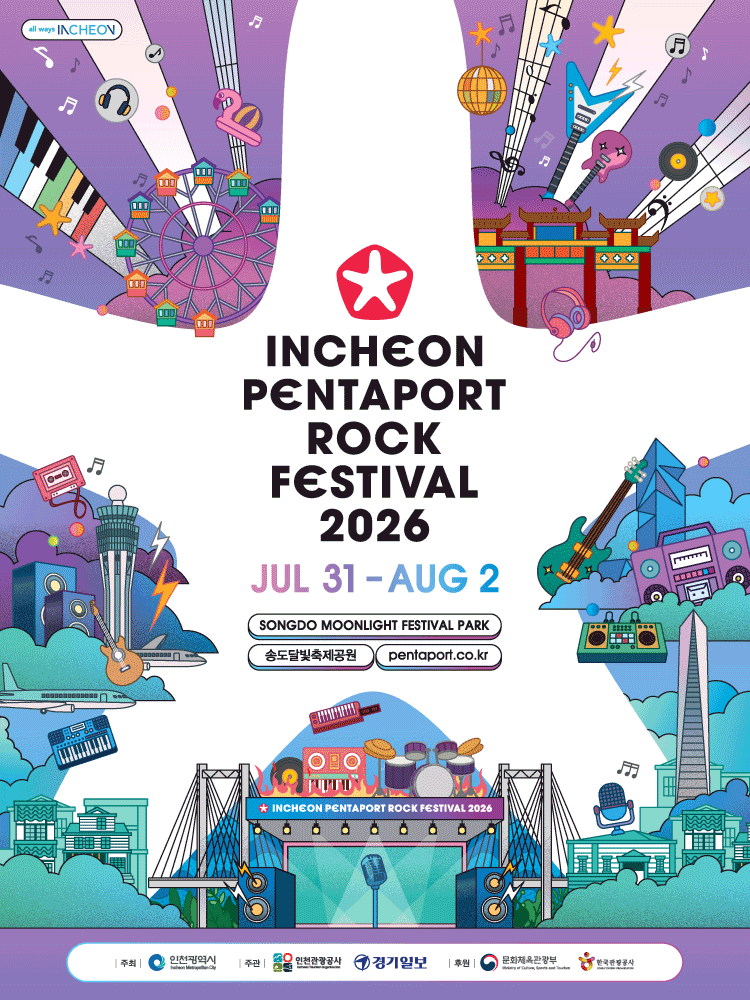
Poster

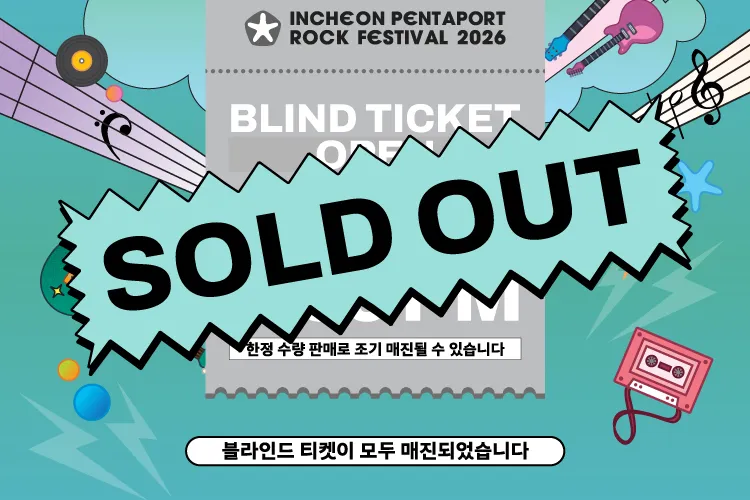
The 2026 Incheon Pentaport Rock Festival will occupy Songdo Moonlight Festival Park from July 31 through August 2, offering three days of rock music programming from 11:00 AM to 10:00 PM daily. The event distinguishes its ticketing approach through a blind sale mechanism—a limited window opening April 24, 2026, at 2:00 PM—that reduces the three-day pass cost by 30 percent (from 240,000 KRW to 168,000 KRW) for purchasers buying before the artist lineup announcement.

Event Information

  • 🗓️ Date: 2026-07-31 ~ 2026-08-02
  • 📍 Venue: Songdo Moonlight Festival Park
  • Address: 350 Central-ro, Yeonsu-gu, Incheon (Songdo-dong)
  • Age Limit: All ages permitted

Located in Incheon’s Songdo International Business District, the Moonlight Festival Park provides an open-air setting for the festival. The all-ages admission policy permits entry for attendees of any age group, though parents and guardians should note the implications of large crowd environments and sustained high-volume music exposure for young children.

Schedule

The festival operates on identical hours across all three days:

  • Friday, July 31, 2026: 11:00 AM ~ 10:00 PM (KST)
  • Saturday, August 1, 2026: 11:00 AM ~ 10:00 PM (KST)
  • Sunday, August 2, 2026: 11:00 AM ~ 10:00 PM (KST)

Ticket Information

Blind Ticket Sale

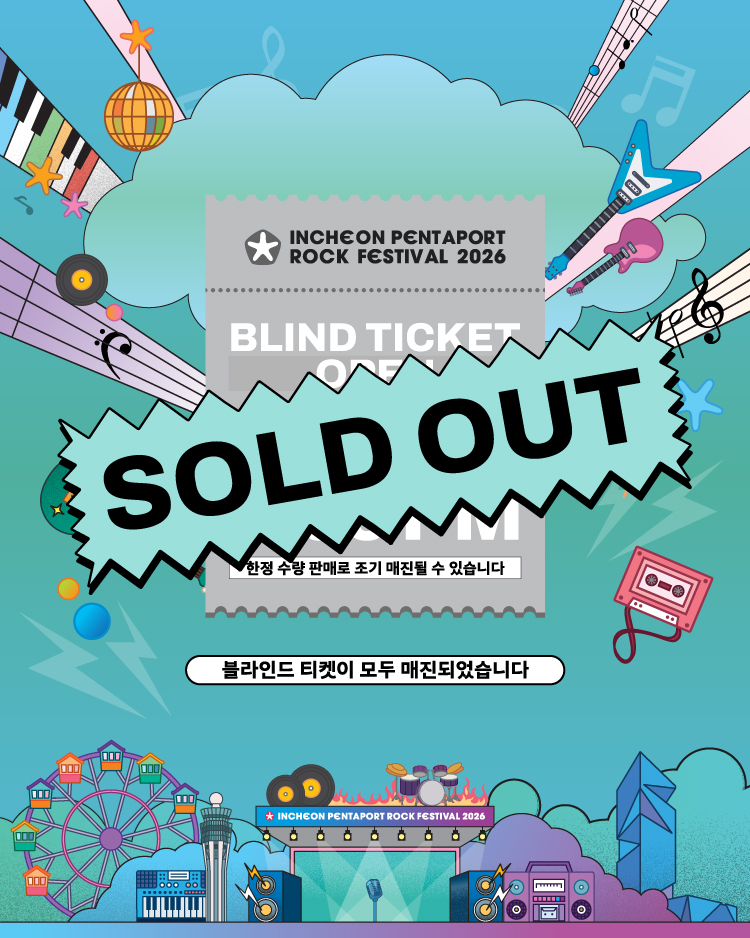
The blind ticket window opens on Friday, April 24, 2026, at 2:00 PM and closes upon sell-out. This limited-release tranche offers the three-day pass at 168,000 KRW—a reduction from the standard price of 240,000 KRW—available strictly on a first-come, first-served basis. Purchasers are limited to four tickets per ID, and sales terminate automatically once the allocated inventory depletes.

Ticketing Protocol and Restrictions

By completing a ticket purchase, attendees agree to the festival’s performance guidelines, which organizers may modify depending on operational requirements. All tickets are distributed exclusively through a mobile ticket service; physical tickets are not issued, eliminating options for delivery or on-site pickup. The mobile ticket gifting function is disabled for this event.

Mobile tickets require exchange for physical wristbands at the venue entrance. Once obtained, these wristbands permit free re-entry to the festival grounds. Attendees must wear their 3-day pass wristbands continuously throughout the entire viewing schedule, from initial entry through the conclusion of the final day’s programming.

Important constraints regarding wristbands: Entry wristbands cannot be reissued under any circumstances if lost, stolen, or damaged, so attendees should exercise particular care in securing them. Transfer, resale, and name changes are strictly prohibited. The organizers, hosts, and partners assume no responsibility for damages resulting from illegal ticket transactions, which remain entirely the responsibility of the transacting parties.

Performance and Refund Policies

Performing artists and scheduled performance times are subject to change due to unavoidable circumstances. As a matter of policy, refunds are not issued in response to lineup or schedule modifications. Same-day refunds are also unavailable for entry delays caused by venue congestion. Attendees should arrive in advance to accommodate potential queuing at entry points and booths.

Depending on real-time conditions on the event dates, entry may require waiting in organized queues; attendees should follow staff instructions to facilitate smooth ingress.

Accommodations and Equipment

For attendees traveling from outside Incheon, the above link provides access to nearby lodging options within the Songdo area and surrounding districts. Those requiring seating equipment can access festival chair options through the provided affiliate link.

Festival Guidelines

The guidelines referenced in this article and exposed within the official work description are designed to ensure safe, enjoyable festival attendance while minimizing operational inconveniences. Attendees should review the complete festival guidelines provided in the detailed images below before completing their purchase:

이 포스팅은 쿠팡 파트너스 활동의 일환으로, 이에 따른 일정액의 수수료를 제공받습니다.

Waterbomb Seoul 2026 Guide: Tickets, Dates, and Everything You Need to Know for the Ultimate Summer Experience

Waterbomb Seoul 2026 Guide: Tickets, Dates, and Everything You Need to Know for the Ultimate Summer Experience

Waterbomb Seoul 2026

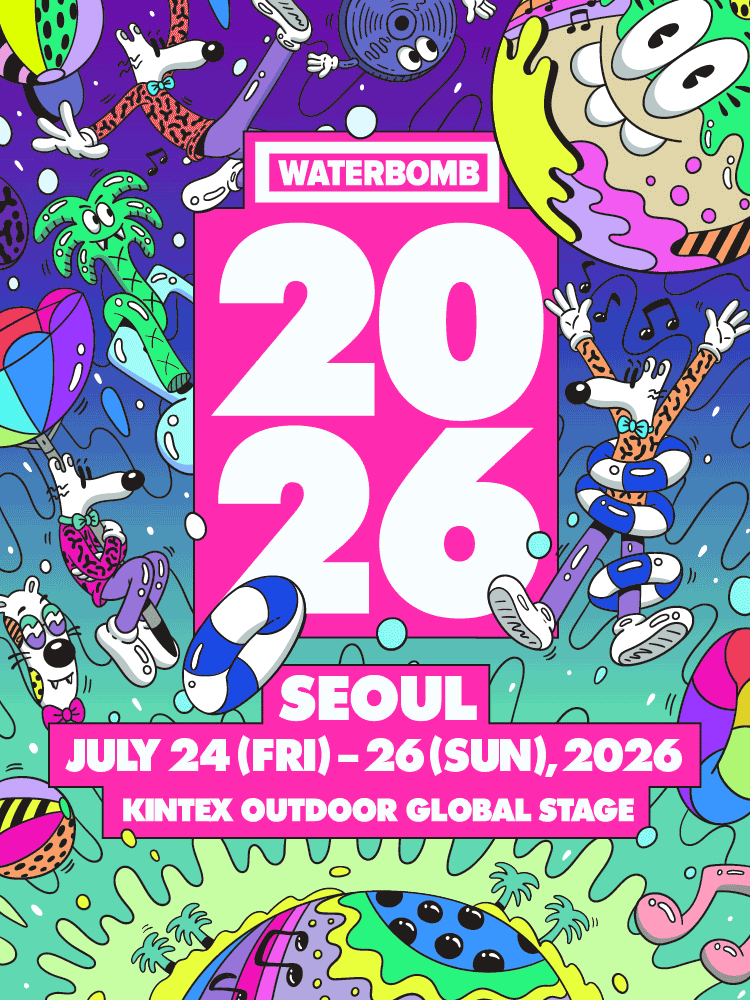
Poster

South Korea’s annual Waterbomb festival returns to Seoul in 2026, offering a distinct alternative to traditional summer concerts through its integration of high-energy EDM and hip-hop performances with large-scale water combat. Unlike conventional music events where audiences remain spectators, Waterbomb operates on a team-based battle system—Green versus Yellow—where attendees, equipped with water guns, engage in playful warfare while artists perform on stage. This format converts the venue into an immersive summer arena where remaining dry is neither expected nor particularly desirable, making waterproof phone cases and quick-dry clothing advisable preparations rather than afterthoughts.

Event Information

The festival takes place at the KINTEX Outdoor Global Stage, located within the Korea International Exhibition Center in Ilsan, Goyang—a northern suburb of Seoul accessible via the Seoul Metropolitan Subway system. This dedicated outdoor space accommodates the event’s unique combination of concert staging and water-based activities, providing sufficient area for the team zones and water artillery deployment that characterize the Waterbomb experience.

Schedule

Detailed operating hours and timetable will be announced later.

Ticket Prices

Admission is structured by day and team affiliation, with Saturday commanding a premium pricing tier:

  • Friday, July 24:

    • (Fri) 2nd Ticket_Green Team (Admission): 110,000 KRW
    • (Fri) 2nd Ticket_Yellow Team (Admission): 110,000 KRW
  • Saturday, July 25:

    • (Sat) 3rd Ticket_Green Team (Admission): 121,000 KRW
    • (Sat) 3rd Ticket_Yellow Team (Admission): 121,000 KRW
  • Sunday, July 26:

    • (Sun) 3rd Ticket_Green Team (Admission): 110,000 KRW
    • (Sun) 3rd Ticket_Yellow Team (Admission): 110,000 KRW

Team selection—Green or Yellow—determines which faction you will join during the water battles, though pricing remains consistent across both teams for any given day.

Festival Information and Reservation Guidelines

Waterbomb Seoul 2026 Reservation Notice

Tickets for this event utilize a QR code system; physical tickets are not shipped separately. Instead, QR codes are transmitted collectively to the mobile phone number provided during reservation exactly ten days prior to the event date. The accuracy of the entered mobile number is therefore critical—errors in contact information may result in non-delivery of admission credentials without possibility of same-day resolution.

Ticketing operates on a tiered release system: quantities are limited for each session, and when tickets for a specific session sell out, the subsequent session opens for purchase. Buyers should verify their eligibility against the age restriction; the event is strictly limited to attendees aged 19 and above, defined as those born on or before December 31, 2007 (based on 2026 calendar year).

Entry requires presentation of physical identification for adult verification; entry will be refused without proper ID, and same-day refunds are not granted for admission denials based on identification failures. The detailed performance timetable will be announced through official channels at a later date. All performance-related information—including potential schedule changes and safety protocols—is disseminated exclusively through the official Instagram account and website. Reservation of tickets constitutes agreement to all terms regarding reservation procedures, entry protocols, refund policies, and viewing guidelines.

이 포스팅은 쿠팡 파트너스 활동의 일환으로, 이에 따른 일정액의 수수료를 제공받습니다.

Busan Fireworks Festival Guide: Best Viewing Locations, Transportation Tips, and Visitor Advice

<-2> Busan Fireworks Festival

| Location | Gwangalli Beach area |
| Host | Busan Metropolitan City |
| Organizer | Busan Culture & Tourism Festival Organizing Committee |
| Homepage | |

Overview

The Busan Fireworks Festival represents not merely a pyrotechnic display but a comprehensive multimedia maritime show that has become the largest of its kind in Asia, drawing over one million spectators annually to the southern port city. Hosted by Busan Metropolitan City and organized by the Busan Culture & Tourism Festival Organizing Committee, this event stands alongside the Busan International Film Festival as one of the metropolis’s signature cultural products.

What distinguishes this festival from its counterpart in Seoul—specifically the Seoul International Fireworks Festival, with which it shares recognition as one of Korea’s two major fireworks celebrations—is its maritime setting. Whereas Seoul’s event unfolds along the narrow Han River, necessitating strict safety limitations that constrain production scale, Busan’s festival launches from the open sea, allowing for unrestricted pyrotechnic creativity and larger explosive displays. The festival integrates laser shows with precisely choreographed musical accompaniment, featuring unique firework shapes and giant shells that transform the night sky above Gwangalli Beach into a synchronized canvas of light and sound.

Venue and Timing

The festival occurs annually on the last Saturday of October, a scheduling choice designed to maximize attendance while preserving Sunday for recovery from the inevitable logistical challenges. This Saturday tradition mirrors the Seoul International Fireworks Festival’s approach, though since 2019 the event has shifted to the first Saturday of November.

The primary stage encompasses the waters fronting Gwangalli Beach and the iconic Gwangandaegyo Bridge, where barges position themselves to launch fireworks from both sea and bridge structures. The maritime location effectively eliminates fire concerns; indeed, during the 14th festival in 2018, when a fire broke out on a barge, many attendees remained oblivious to the incident.

Since the 11th festival in 2015, the production has expanded to a “3-Point” system, launching fireworks simultaneously from Marine City and Igidae in addition to Gwangalli Beach. However, this creates a tiered viewing experience: the “Overseas Invited Fireworks Show” remains visible exclusively from Gwangalli Beach, while the “Busan Multi Fireworks Show” can be viewed from all three locations. Certain central areas of Gwangalli sandy beach have been designated as premium tourist seating since 2015.

Historical Evolution

The festival’s origins trace to November 16, 2005, when an Advanced Multimedia Maritime Show celebrated the APEC Summit with an investment of 1.3 billion won, attracting one million spectators and creating what locals described as a “hell gate” scene on Busan Metro Line 2. Inspired by this success, the city rebranded the event as the Busan World Fireworks Festival on November 10, 2006, expanding the scale to accommodate 1.1 million attendees; from 2007 onward, pre-festival events accompanied the main celebration.

By the 6th festival in 2010, attendance had surged to 2.6 million—establishing the event as Busan’s representative tourism product and prompting the city to specifically target Japanese tourists residing in Tsushima. The 2011 festival proceeded despite rain, while the 2012 edition, originally scheduled for October 26–27, was postponed to 8:00 PM on October 28 due to inclement weather. The 2013 festival ran from Friday, October 25 to Saturday, October 26 under the theme “50 Years of Love, Busan!” and included a public proposal event during the 2012 festival for a couple selected through open recruitment.

The 10th festival in 2014 featured narration by Bae Chul-soo, while 2015 marked a significant operational change: the introduction of paid seating on the beach (S seats at 70,000 won and R seats with tables at 100,000 won), the implementation of the 3-Point production, and narration by Yang Hee-eun alongside KNN announcer Jeong Hee-jeong and stadium announcer Ragio of the Busan kt Sonicboom. The 2016 edition abolished the pre-festival, scheduling colorful smoke bombs from 18:00–20:00 by China’s Sunny Co. (2011 competition winner), an Overseas Invited Fireworks Show from 20:00–20:15, an LED Water Board Maritime Show from 20:15–20:25, and the main Busan Multi Fireworks Show from 20:25–21:00, with Bae Chul-soo returning as narrator.

The 2017 festival featured Italy’s Paraent Co. for the overseas segment with narration by Yoon Do-hyun, while 2018 hosted Japan’s Marutama Co. with Bae Chul-soo narrating—the latter event notable for a fire on a barge that fortunately did not spread to remaining gunpowder. The 2019 festival, held on Saturday, November 2 with narration by actor Jo Jin-woong, featured OSTs from Japanese animations including Mazinger Z, Cowboy Bebop, and Howl’s Moving Castle during the Japanese team’s performance. The 16th festival, scheduled for November 7, 2020, was canceled due to COVID-19—a fate shared by the Seoul International Fireworks Festival that year.

Viewing Locations

The festival offers a spectrum of viewing experiences ranging from immersive beachfront participation to distant, contemplative observation from mountain peaks. Truly, every kind of place is listed among the options, each presenting distinct advantages and compromises regarding sound synchronization, crowd density, and visual perspective.

Primary Beachfront

Gwangalli Beach serves as the epicenter, where over one million people crowd the sandy beach to experience the full multimedia presentation. From this vantage point, fireworks explode in precise synchronization with music including “Busan Seagull,” pop songs, K-pop, and orchestral arrangements—a cohesion of sound and light unavailable elsewhere. High-rise hotels, condominiums, and restaurants behind the beach offer festival products with extreme overcharging, yet the beach remains optimal for the complete experience. Based on experience, the exodus is said to be a parade of zombies, with Gwang-an Station, Suyeong Station, and Millak Station becoming gathering places for these exhausted crowds.

Millak-dong Waterfront Park ranks as the third most popular viewing spot, located right next to Gwangalli near the Raw Fish Center harbor. While access to the breakwater is completely restricted due to dangerous drop-offs into deep water, and music cannot be heard clearly, spectators flock here when the beach interior becomes impossibly crowded.

Namcheon-dong Samick Beach Apartments on the opposite side ranks as the second-best prime spot alongside Gwangalli Beach proper, offering clear views of the Gwangandaegyo Bridge—though this popularity means the “hell gate” of congestion opens here as well.

Alternative Coastal Perspectives

Marine City offers a diagonal rear view of the Gwangandaegyo Bridge from a distance actually closer than Gwangalli Beach. Since 2015, fireworks launch from waters in front of Marine City as part of the 3-Point production. Residents of coastal mixed-use apartments here enjoy premium views—units facing the bridge command higher prices—though they suffer greatly from noise pollution.

Yongho Bay (Yongho 1-dong) encompasses the reclaimed land area featuring apartment complexes such as LG Metro City, GS Heights Xi, and W, facing Marine City across the water. This location has attracted huge crowds since becoming known as a viable alternative.

Igidae Park in Yongho-dong offers viewing near Dongsaengmal and Seopjari—the filming location for the movie Haeund—with well-equipped Gwangandaegyo Bridge viewing facilities. Unlike mountain alternatives, this location requires no hiking, and since recent years, audio systems, organizing staff, and police presence have enhanced both atmosphere and safety, albeit with smaller sound volume.

The Bay 101, opened mid-2014 as a complex marina facility with yachts, restaurants, and accommodation, provides an alternative to Marine City or Dongbaekseom, particularly for those wishing to view fireworks launched before Dongbaekseom alongside Marine City’s night view—though comfort here requires payment.

Cheongsapo, located along the abandoned Donghae Nambu Line site in Haeundae, presents a surprisingly less-known option with clear Gwangandaegyo Bridge visibility. The Cheongsapo Daritdol Observatory offers daytime sightseeing with nighttime fireworks viewing potential.

Mountain Vantage Points

For those willing to sacrifice musical synchronization to avoid crowds, nearby mountains offer panoramic perspectives.

Mt. Hwangnyeong and Mt. Geumnyeong provide elevated views, with the beacon tower at Mt. Hwangnyeong’s summit offering the best overlook of Gwangalli. However, this location has itself become a “hell gate,” particularly around the Geumnyeong Mountain Youth Training Center, with vehicle entry completely restricted and blocked roads necessitating walking up.

Mt. Jangsan (638m altitude) features the Ganbiosan beacon tower, built during the Joseon Dynasty to observe enemy ships, offering panoramic views of the entire Gwangandaegyo Bridge and surroundings. The significant hike required—coupled with dangerous descent paths in darkness—deters all but avid hikers, and the fireworks, arranged for beach viewing, lose emotional impact from this distance.

Mt. Baesan in Yeonje-gu (260m) offers comfortable viewing precisely because its distance discourages crowds, though the hiking pressure remains a bonus consideration for those seeking exercise with their pyrotechnics.

Bonglaesan in Yeongdo-gu and Mt. Cheonma in Seo-gu provide views from the old city center and western Busan respectively, with the latter’s observatory offering clear bridge visibility—though the distance between these locations and Haeundae-gu remains considerable.

Geumjeongsan offers multiple viewing points including Sanggyebong (reached via bus 33 to Guman-deok terminal then hiking), and the 3rd/4th Watchtowers, Godangbong, Gyemyeongam, and Gyemyeongbong Observatory Rock (reached via bus 203 to Geumjeongsanseong East Gate, followed by 40 minutes to 2 hours of hiking). These areas exceed 640m altitude and present dangers after dark, attracting almost exclusively hikers. Gyemyeongam, a subsidiary hermitage of Beomeosa Temple, offers a concrete path—steep but safer than general trails—for descent.

Distant and Unique Locations

Dongbaekseom Nurimaru in Haeundae, reached via a 10-minute walk from Dongbaek Station, serves East Busan residents primarily from Haeundae-gu. Professional photographers and amateurs deploy tripods and chairs early to claim prime photo positions.

Dalmaji Hill (Mipo Moontan Road) beyond Dongbaekseom provides clear bridge visibility, drawing crowds seeking alternatives to the main beach.

LCT (Landmark Tower) allows viewing from the 98th to 100th-floor observatories of this super high-rise before Haeundae Beach—access restricted to authorized persons only.

Lotte Mall Gwangbok Branch offers rooftop observatory views of the bridge from the Busan Tower side, though distance limits visibility from this old city center location.

Busan Tower permits viewing but prohibits photography due to glass reflections.

Busan International Finance Center (BIFC) allows viewing from its high-rise observatory, though distance and access restrictions apply.

Pusan National University Main Stadium provides distant views from the top of the stands, while various campuses of Pukyong National University (Yongdang and Daeyeon dormitories/College of Humanities and Social Sciences) offer emergency options when all else fails.

Tsushima Island, Japan (49.5km distant) presents perhaps the most unique viewing experience, where the festival serves as an international tourism product despite the significant sound delay and light scattering that biases colors toward red, orange, and yellow. Japan actively promotes this cross-border viewing opportunity.

Technical Production and Broadcast

The festival’s musical curation has evolved from simple background tracks to sophisticated thematic selections encompassing not only traditional fireworks accompaniment (classical and new age) but trending songs, past hits, and broadly relatable tracks—with the finale invariably remaining classical. As scale increased, famous DJs and celebrity narrators were incorporated, while Gwangandaegyo Bridge LED upgrades enabled subtitle displays for romantic atmosphere. Speakers are installed at major viewing points including Gwangalli Beach, Yongho-dong pier, Igidae City Nature Park, and Dongbaekseom.

For those unable to attend, KNN provides terrestrial DMB and radio broadcasts—though these typically cut off around 8:50 PM for regular programming, just before the finale. Busan MBC DMB broadcast the complete event in 2016. T-broad utilizes multiple cameras for dynamic coverage, while CJ HelloVision broadcasts in Full HD. Nevertheless, the limitations of broadcast media are significant: the super-giant fireworks and bridge explosions vary in size, launch angle, altitude, and distance, requiring constant camera switching that interrupts the experience, and large fireworks cannot be fully captured on screen—reducing the experience to less than a quarter of its in-person impact.

Practical Considerations

Transportation Logistics

The festival creates maximum demand across all transport modes, accompanied by what can only be described as severely overcrowded conditions. Busan Metro extends operating hours, with Line 2’s Geumnyeonsan Station and Gwang-an Station, plus Line 3’s Suyeong Station, serving the area. Bus 38 records its highest annual transport revenue on this day, while buses 1006 and 1011—despite not passing nearby—detour through Suyeong Intersection due to their Gwangandaegyo Bridge routes.

From Busan Station, bus 41 provides direct service, with buses 40, 1001, and 1003 as alternatives—though traffic delays are inevitable. The metro route requires taking Line 1 to Seomyeon, transferring to Line 2, and alighting at Geumnyeonsan Station. From Bujeon Station, bus 83 offers the most convenient access. From Busan Central Bus Terminal, bus 51 travels directly to Gwangalli Beach in approximately 90 minutes (longer with traffic), though the metro alternative via Seomyeon also exceeds one hour. From Busan Western Intercity Bus Terminal, Line 2 from Sasang Station provides immediate access.

Critical logistical realities include the complete closure of Gwangnam-ro, Gwang-an-ro, and Gwang-an Beach Road to general vehicles, with only city buses permitted on some routes. The lower deck of Gwangandaegyo Bridge closes entirely, forcing detours via Suyeong Intersection, the 2nd Mandeok Tunnel, or the Busan Outer Ring Expressway. City tour buses suspend operations, while Haeundae–Nam-masan intercity buses occasionally cancel last services when Gwangalli proves impossible to enter.

The scale of attendance—2.6 million representing over half Busan’s 3.5 million population—creates a uniquely challenging environment. In Seoul terms, this equates to eight million people converging on Yeouido. Communication failures are severe, with A-GPS often failing to function, and the crush of humanity at Suyeong, Gwang-an, and Millak Stations requires police and railway social service agents to control crowds from the station stairs themselves. Paradoxically, walking to Millak Station or Centum City Station may prove faster than attempting to board at the immediate vicinity.

Indeed, walking often outpaces vehicular transport: the Marine City area via Centum City requires approximately one hour on foot, Haeundae New Town two hours, and Seomyeon similarly two hours. Residents prepared to walk should note that bicycles—including folding models—are strictly prohibited on city buses and metro trains on festival day, with station employees and railway social service agents enforcing this restriction.

For those unable to navigate the post-festival exodus, spending the night at Gwangalli Beach or nearby PC cafes until the first morning train presents a viable alternative.

Safety and Etiquette

The convergence of millions in limited space creates genuine safety concerns, with transport capacity at bus stops and subway stations easily exceeded. Spectators must exercise patience and yield to one another to prevent disasters. Families with infants or young children face particular risks during the exodus, when falls could result in crushing injuries. Two return strategies are recommended: leaving slightly before the finale concludes, or preparing refreshments to extend the beach stay by 1–2 hours post-event, allowing crowds to dissipate naturally.

First-time attendees must prepare for significant temperature drops; despite Busan’s southern location, October nights by the sea are extremely cold with biting winds. Parkas, knee blankets, and scarves are essential regardless of daytime warmth. Snacks and drinks are advisable given the difficulty of procurement amidst crowds, and restroom use should be completed by 6:00 PM at the latest—women face particularly cumbersome queues, despite increased mobile toilet facilities and agreements allowing beachside merchants to open restrooms to the public.

Manners expectations include removing shoes when entering the sandy beach, avoiding foods with excessive moisture that might spill on neighboring spectators, maintaining queue discipline, and remaining seated during the performance to preserve sightlines for those behind.

Economic and Environmental Impact

The festival’s economic reality includes extreme overcharging across accommodation and dining, with beachfront cafe window seats commanding 100,000 to 150,000 won for reservations including minimal refreshments—a practice nearly universal among major franchises except for directly managed S Cafe locations.

Environmental management remains challenging despite the distribution of 50,000 trash bags in 2014 (continuing through 2017), with local residents citing light pollution, noise, and illegal dumping as grounds for petitions to abolish the event. Attendees must take personal responsibility for their waste.

Capturing the Experience

For those determined to film, the advice is paradoxical: abandon the attempt to capture the climax. Fireworks are moving fluids that defy fixed capture, and the emotion created by sea breeze, music, and spectacle cannot be preserved even one-tenth by camera. Moderate photography followed by complete immersion in the experience—which can never be repeated—is the recommended approach.

Video Archives

2018 Busan Fireworks Festival Video

2019 Busan Fireworks Festival Video

As the organizers note: if watched from a high place, it becomes merely a fireworks festival; if watched from the beach, it becomes a multimedia maritime show. The choice remains with each individual spectator.

What is Busan famous for?

Busan sits on Korea’s southeastern coast, where the Nakdong River delta meets the Sea of Japan. Mountains crowd the city from the west and north, leaving limited flat land that has built upward into dense residential towers. As the country’s second-largest city, it developed around a protected natural harbor that remains one of East Asia’s busiest container ports.

Haeundae Beach occupies the eastern curve of the coastline, a 1.5-kilometer strip of sand backed by high-rise hotels and apartment blocks. Further west, Gwangalli Beach offers a narrower but longer arch with direct views across the bay to Gwangan Bridge. These two beaches host the annual Busan Fireworks Festival each October, when spectators gather on the sand to watch displays launched from the bridge deck and from barges anchored offshore.

The port drives the local economy, handling international shipping routes and passenger ferries to Japan. At Jagalchi Fish Market, vendors sell live seafood from tanks that line the lower level, while the upper floors house restaurants where buyers eat fish cleaned and prepared on the spot. The industry shapes daily routines here more than in inland cities; mornings start before dawn at the auction halls.

Gwangan Bridge spans 7.4 kilometers across the bay, connecting the central districts with Haeundae. The cable-stayed design features LED lighting that changes color after dark. During the fireworks festival, crews mount launch tubes on the bridge itself, using the structure as a firing platform that stretches horizontally across the water.

In October, the Busan International Film Festival brings directors and distributors to the city for ten days of screenings at venues including the Busan Cinema Center, where an outdoor theater seats four thousand. Elsewhere, Gamcheon Culture Village covers a steep slope with houses painted in blues, pinks, and yellows, arranged in tiers that follow the contour lines and connected by staircases that replace streets too narrow for cars.

The festival works because of this geography. Viewers can spread along both beaches with clear sightlines to the bridge, while the bay contains the debris and reflects the light. The subway connects both beach areas, the port’s logistics experience helps manage the temporary infrastructure, and the density of hotels accommodates the overflow crowds. Using the bridge as a launch platform creates a horizontal line of fire that is visible from multiple angles across the city.
2026 G2A at KINTEX: Tickets, Lineup, and Complete Event Guide for October 9

2026 G2A at KINTEX: Tickets, Lineup, and Complete Event Guide for October 9

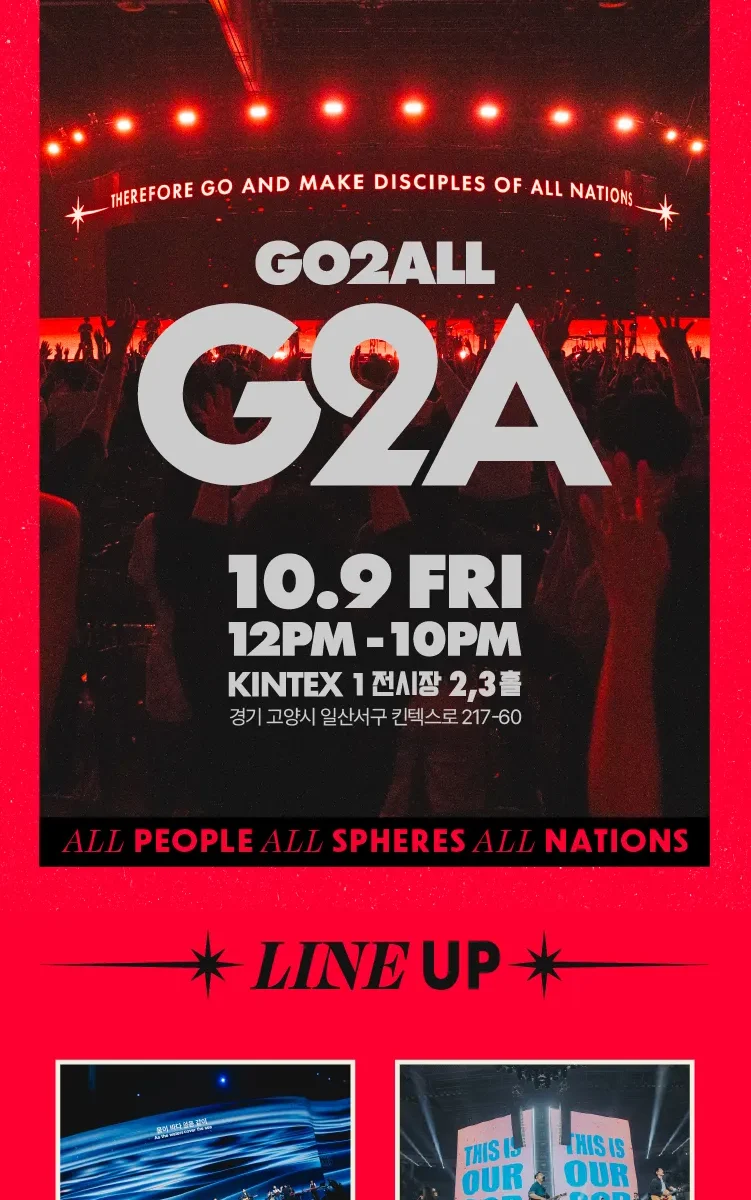
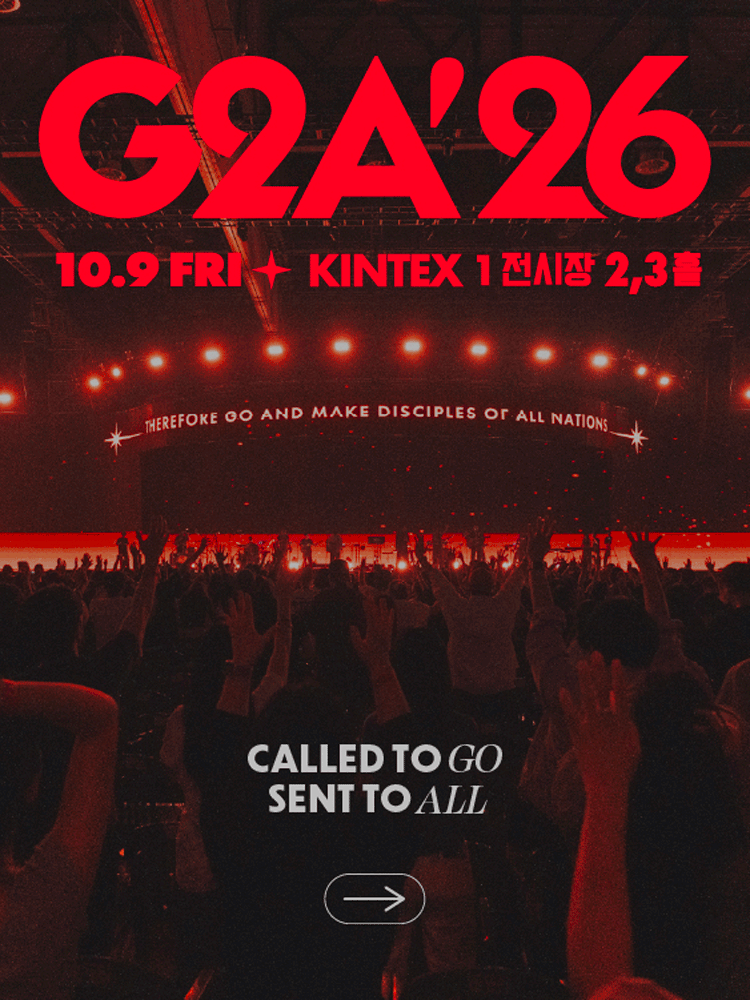
〈2026 G2A〉 at KINTEX

Poster

Event Overview

〈2026 G2A〉 is a single-day Christian worship gathering taking place at KINTEX in Goyang, combining live performances from multiple worship collectives with a communal atmosphere open to attendees of all ages. The event centers on contemporary worship music, with seven distinct teams scheduled to perform across the afternoon.

Event Information

  • 🗓️ Date: 2026-10-09 (Friday)
  • 📍 Venue: KINTEX Exhibition Center 1, Halls 2 & 3
  • 🛏️ Accommodation near the concert
  • 💡 Lightstick
  • Address: Exhibition Center 1, Halls 2 & 3, 217-60 Kintex-ro, Ilsanseo-gu, Goyang-si, Gyeonggi-do (Daehwa-dong)
  • Age Limit: All ages admitted

Schedule

Date Time
October 9th (Fri) 12:00 PM

Lineup

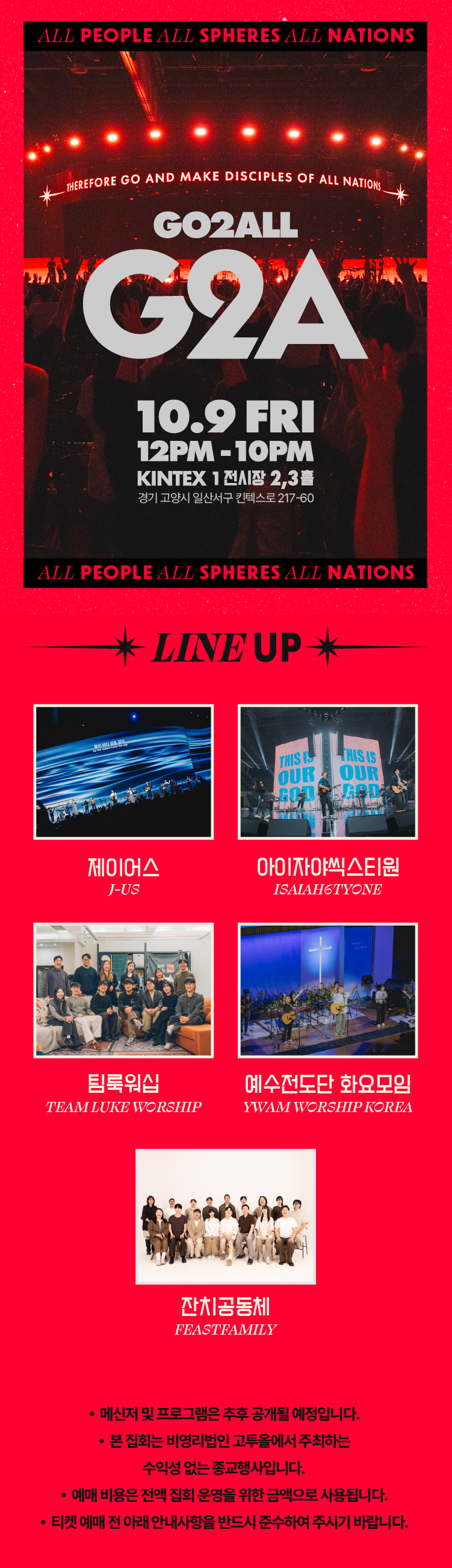
The 2026 edition features seven worship teams, each bringing distinct approaches to contemporary Christian music:

  • J-US
  • THIS 19 OUR GOD
  • THIS IS OUR
  • ISAIAH6TYONE
  • TEAM LUKE WORSHIP
  • YWAM WORSHIP KOREA
  • FEASTFAMILY

Ticket Information

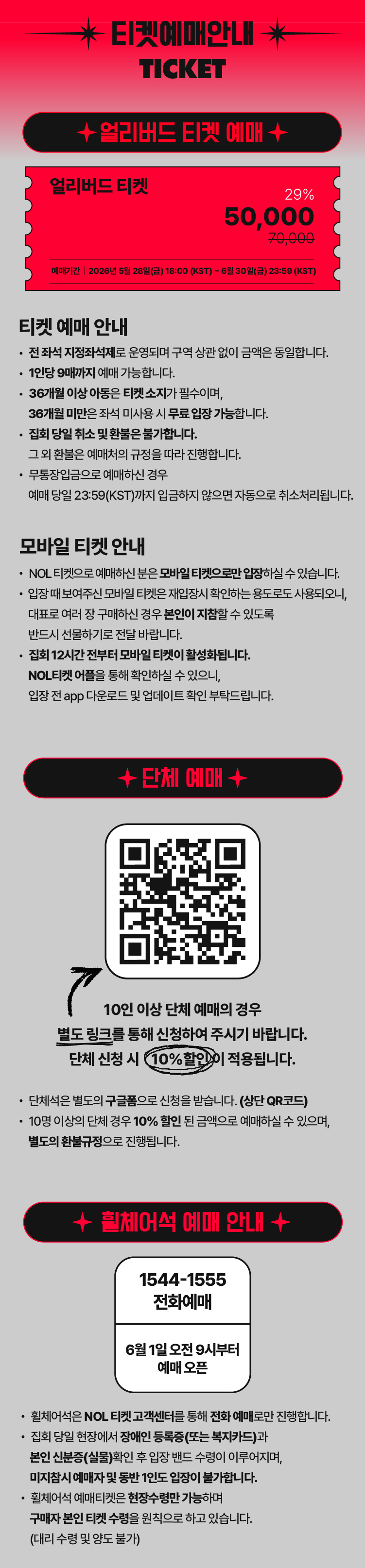
Ticket Type Price
General Seat (Early Bird) 50,000 KRW

Early Bird Sales Period

Thursday, May 28, 2026, 18:00 (KST) ~ Tuesday, June 30, 23:59 (KST)

Reservation Guidelines

  • Ticket limit: 9 tickets per person
  • Group discount: 10% reduction available for group reservations (application required via separate link)

Wheelchair Seat Reservations

Wheelchair seating is available exclusively through telephone reservation via the NOL Ticket Customer Center (1544-1555), beginning June 1st at 9:00 AM (KST). Customer Center hours are 9:00 AM to 6:00 PM.

On the event day, reservees must present both a disabled registration card (or welfare card) and matching physical ID to receive entry bands for themselves and one accompanying person. Failure to produce these documents will result in denial of entry. Wheelchair seat tickets must be collected on-site by the purchaser personally; proxy pickup and ticket transfers are prohibited.

Mobile Entry

This gathering operates on a mobile-only ticket system. Physical tickets are not issued, and neither delivery nor on-site pickup services are provided.

Official Channels

Event image 1
Event image 2
Event image 3

A bit about 예수전도단 화요모임 YWAM WORSHIP KOREA

Emerging from the heart of a global missions movement, YWAM WORSHIP KOREA (예수전도단 화요모임) is not just a musical act, but the creative expression of a community. Formally known as the Tuesday Gathering of Youth With A Mission Korea, this collective has been a foundational pillar in the landscape of modern Korean worship music since the 1990s. Their sound, deeply characterized by passionate intercession and a prophetic spirit, played a crucial role in shaping the “Korean-style” worship that swept through Asia and the global missions field. With an extensive discography that includes influential live-recorded albums like Lord of All Nations, they are revered for their raw, prayer-saturated anthems that often transcend musical performance, functioning instead as an engine for spiritual revival and a soundtrack for a generation devoted to the Great Commission.

이 포스팅은 쿠팡 파트너스 활동의 일환으로, 이에 따른 일정액의 수수료를 제공받습니다.

AFTERNOON TEA with “SIROCCO” “Peach” 2026 at The Royal Park Hotel Iconic Tokyo Shiodome: Menu, Prices & How to Book

AFTERNOON TEA with "SIROCCO" "Peach" 2026 at The Royal Park Hotel Iconic Tokyo Shiodome: Menu, Prices & How to Book

AFTERNOON TEA with “SIROCCO” “Peach” [The Royal Park Hotel Iconic Tokyo Shiodome]

A summer afternoon tea featuring a parfait crowned with a whole white peach.

The Royal Park Hotel Iconic Tokyo Shiodome welcomes back its celebrated AFTERNOON TEA with “SIROCCO” “Peach”—an event that proved so popular in its previous iteration that it returns with thoughtful refinements rather than radical reinvention. The centerpiece remains unchanged in its visual ambition: a white peach parfait topped with an entire white peach, prepared through a labor-intensive process where the pastry chef hand-peels each fruit in hot water before slow-simmering it into a delicate compote. What distinguishes this year’s offering is the addition of jasmine and almond jelly (annin), introducing aromatic complexity that complements the peach’s natural sweetness without overwhelming it.

The menu extends beyond this signature creation. Peach appears throughout the savory selections—most notably in a chilled peach and tomato potage that balances the fruit’s sugars against the tomato’s acidity, and in an ensemble pairing peach with prosciutto and Camembert atop pancake. Weekday visitors receive an additional benefit: a welcome iced tea prepared with SIROCCO TEA.


AFTERNOON TEA with “SIROCCO” “Peach” Menu

WELCOME TEA

Luxury Swiss SIROCCO TEA (black tea) served in the “Butterfly Bloom” series of tea ware by Wedgwood.

SAVORY

  • Chilled peach and tomato potage
  • Ensemble of peach and prosciutto with rich Camembert on a pancake
  • Steamed chicken and watermelon “cool” salad
  • Corn and soy milk royale-style with scallops and consommé gelée
  • Spicy ratatouille sandwich using summer vegetables

SWEETS

  • White peach and almond jelly parfait with a scent of jasmine
  • White peach pudding
  • White peach roll cake
  • Peach mousse
  • Peach cheese pie

DRINK

Two service tiers are available:

“Cafe Free” — Unlimited coffee and black tea

“Cafe & SIROCCO TEA Free” — Unlimited coffee, black tea, plus a selection of SIROCCO teas, green tea, herb teas, and fruit teas


Weekday Only Welcome Tea “Summer Jewelry”

The weekday experience includes a theatrical preparation: a two-layered separate tea created tableside by pouring a mixture of SIROCCO TEA’s “Lemon Beach” and “Pigna Moringa” into blue syrup containing silver dragees. Rosemary garnish adds aromatic dimension. The visual effect—cool blues and silvers—functions as a straightforward seasonal marker.

Please check the official website for detailed contents.


Basic Information

Location The Royal Park Hotel Iconic Tokyo Shiodome — 1-6-3 Higashi-Shinbashi, Minato-ku, Tokyo 〒105-8333
Nearest Stations Shiodome Station / Shimbashi Station
Venue 24F Bar Lounge “THE BAR” and All-Day Dining “Harmony”
Period Wednesday, July 1, 2026 — Monday, August 31, 2026
Hours “THE BAR”: 13:00–15:00 daily<br>”Harmony”: Weekdays 13:00–14:00; Sat/Sun/Holidays 14:00–14:30
Capacity Weekdays: Limited to 15 servings per day<br>Sat/Sun/Holidays: Limited to 30 servings per day
Pricing Cafe Free: ¥8,500<br>Cafe & SIROCCO TEA Free: ¥12,700<br><br>Each seating limited to 120 minutes<br>Online booking reduces “Cafe & SIROCCO TEA Free” to ¥7,000
Official Website https://www.royalparkhotels.co.jp/ic/tokyoshiodome/news/0p1jfwdzu6/

The listed content may have changed. Please check the official website of the venue or organizer for the latest information.

🛏️ See hotels near Tokyo

What is “SIROCCO”?

SIROCCO is the restaurant and lounge at The Royal Park Hotel Iconic Tokyo Shiodome, on the 24th floor with views of Tokyo Bay and the city skyline. The name references the warm wind that blows from the Sahara across the Mediterranean. The space makes deliberate use of this idea—large windows, natural light, and a layout that shifts easily between day and evening use.

The afternoon tea program has become a particular focus. Pastry chefs work with seasonal ingredients, treating them with techniques and presentations that reflect both international and Japanese approaches. The “Peach” 2026 edition follows this pattern: a single ingredient, in this case stone fruit at its summer peak, explored across multiple courses and preparations.

TOKYO Matcha Time at SKYTREE 2026: First-Ever Matcha Event with Gion Tsujiri – Menu, Workshop Tickets & How to Visit

TOKYO Matcha Time at SKYTREE 2026: First-Ever Matcha Event with Gion Tsujiri – Menu, Workshop Tickets & How to Visit

TOKYO Matcha Time at SKYTREE(R) ~Savoring Japanese Harmony in the Sky~

First-ever event to enjoy “Matcha” at Tokyo Skytree(R)

Tokyo Skytree(R) hosts its inaugural matcha-focused event, bringing together panoramic city views with the refined traditions of Japanese tea culture. In collaboration with Gion Tsujiri—the venerable Kyoto tea house established in Gion’s historic district—the observation deck transforms into a space where visitors can experience matcha in multiple dimensions: through taste, sight, and atmosphere.

The program extends beyond themed cafe menus. Exclusive photo spots and decorations introduce Japanese tea culture to the Tembo Deck for the first time. A new special lighting installation, “Kissa-ko,” reinterprets the meditative movements of tea preparation as flowing illumination. Sorakara-chan, the tower’s beloved mascot, will appear in a newly designed costume evoking the fresh green of shincha (new tea). For those seeking deeper immersion, “Savoring the New Tea Season ~Tokyo Sora-cha-kai~” offers private morning access to the Tembo Deck, where participants can learn tea ceremony fundamentals from a Sumida Ward instructor.

Whether you are a resident of Japan or visiting from abroad, the combination of Tokyo’s skyline and the contemplative traditions of matcha offers something genuinely difficult to replicate elsewhere: elevation in both the literal and figurative sense.

Event-Exclusive Cafe Menu at SKYTREE CAFE (Tembo Deck Floor 350)

Gion Tsujiri’s Uji matcha—cultivated in the region most celebrated for its tea—forms the foundation of four limited-edition items. The cafe interior itself will carry limited-time Gion Tsujiri branding.

Drinks & Sweets Menu:

Item Description Price
Wasanbon Uji Matcha Au Lait Wasanbon sugar’s subtle sweetness complements aromatic Uji matcha in a Japanese-style latte with a smooth, mellow richness ¥1,100
Yuzu Uji Matcha Gin Soda A gin-based cocktail layering yuzu fragrance with matcha’s gentle bitterness; light carbonation and depth create a clean finish ¥1,300
Fragrant Uji Matcha Wa-Sundae Uji matcha powder dusted over vanilla soft serve, with azuki beans adding contrast to the elegant flavor profile ¥1,430
Rich Uji Matcha Affogato Matcha and vanilla ice creams atop sponge cake, served with separate rich matcha sauce for customized intensity ¥1,650

Location: Tokyo Skytree Tembo Deck Floor 350, “SKYTREE CAFE”

Special Planning Tickets: Matcha Set + Admission

Two bundled ticket options combine Tembo Deck admission with a Gion Tsujiri collaboration item, offering savings of up to ¥400 compared to separate purchases.

Ticket Type Contents Price
Matcha/Drink Set Ticket ① Tembo Deck admission + ② 1 collaboration drink (from above menu) From ¥2,700
Matcha/Sweets Set Ticket ① Tembo Deck admission + ② 1 collaboration sweet (from above menu) From ¥3,050

Sales Start: April 9, 2026 (Thursday) 14:00
Sales Period: Through the day of visit
Purchase Method: Tokyo Skytree official website

Note: Tokyo Skytree employs variable pricing for observation deck admission, meaning ticket prices fluctuate based on the selected date.

Private Workshop: “Savoring the New Tea Season ~Tokyo Sora-cha-kai~”

An early-morning private rental of the Tembo Deck allows participants to engage with tea ceremony culture before the public arrives. The workshop, led by an instructor from Senho-an (a tea ceremony school based in Sumida Ward), requires no prior experience—attendees will learn matcha preparation and basic etiquette in a setting removed from ordinary life.

Detail Information
Dates May 9, 2026 (Saturday); June 13, 2026 (Saturday)
Time 7:45 – 8:45
Location Tokyo Skytree Tembo Deck Floor 350
Program ① Lecture and demonstration on tea ceremony culture ② Hands-on matcha preparation (Japanese sweets included)
Fee ¥6,500 (includes Tembo Deck and Tembo Galleria admission)
Capacity 30 participants
Sales Start April 10, 2026 (Friday) 11:00 (first-come, first-served)
Age Requirement 18 years and older

Installation & Photo Spots

Decorative elements throughout Floors 350 and 340 create what the organizers describe as “a tea room in the sky”—with the gentle aroma of new tea serving as an atmospheric detail.

Sorakara-chan Appearances in Fresh Greenery Costume

Sorakara-chan will greet visitors in a costume unveiled specifically for this event, its design inspired by the vivid green of shincha season.

Period April 23, 2026 (Thursday) – July 6, 2026 (Monday)
Times 10:30 / 12:00 / 13:30 / 15:00 / 16:30 / 18:00
Location Tembo Deck Floor 350 (18:00 session: 4F Entrance Floor)

Appearances subject to change or cancellation without notice.

Special Lighting: “Kissa-ko”

The tower’s exterior illumination will feature a new program translating the choreographed movements of tea preparation—measuring, whisking, presenting—into flowing light. Greens merge, blend, and intensify, culminating in an effect suggesting the rising aroma of a freshly prepared bowl.

Lighting times and content may change without prior notice.


Basic Information

Venue Tokyo Skytree(R)
Address 1-1-2 Oshiage, Sumida-ku, Tokyo 〒131-0045 [MAP]
Nearest Stations Tokyo Skytree Station (Tobu Skytree Line); Oshiage <Skytree-mae> Station (Toei Asakusa Line, Tokyo Metro Hanzomon Line, Tobu Skytree Line)
Event Areas Tembo Deck Floor 350, Floor 340; SKYTREE CAFE (Floor 350)
Period April 23, 2026 (Thursday) – July 6, 2026 (Monday)
Hours In accordance with facility operating hours
Inquiry Tokyo Skytree Call Center: 0570-55-0634 (10:00–18:00)
Official Website https://www.tokyo-skytree.jp/event/matcha/

Event details are subject to change. Please verify current information through the official website.

🛏️ See hotels near Tokyo

What is Gion Tsijiri?

Gion Tsujiri is a Kyoto tea house that opened in 1860 in the Gion district. Founded by Riemon Tsuji, it began as a small operation serving matcha and traditional sweets to the local community.

The company has survived on straightforward practices: shade-grown tencha cultivation and stone-milling. These methods produce matcha with a distinct color and depth of flavor. The business has stayed in the family for over 160 years, passing from one generation to the next with minimal fanfare.

Currently, Gion Tsujiri runs stores in Kyoto and Tokyo. The Kyoto location offers prepared matcha in a traditional setting. The Tokyo locations, particularly in busier districts, serve soft-serve ice cream and blended drinks alongside conventional preparations. The company also supplies matcha to restaurants and retailers domestically and abroad.

For the TOKYO SKYTREE event, Gion Tsujiri will serve its products in a temporary space. This is a standard commercial arrangement—a food vendor at a high-traffic location.

Analytics