THE ROY KIM SHOW 2026: “Speaking, Listening, Singing” – Seoul Concert Dates, Tickets & Venue Guide

THE ROY KIM SHOW 2026: "Speaking, Listening, Singing" – Seoul Concert Dates, Tickets & Venue Guide

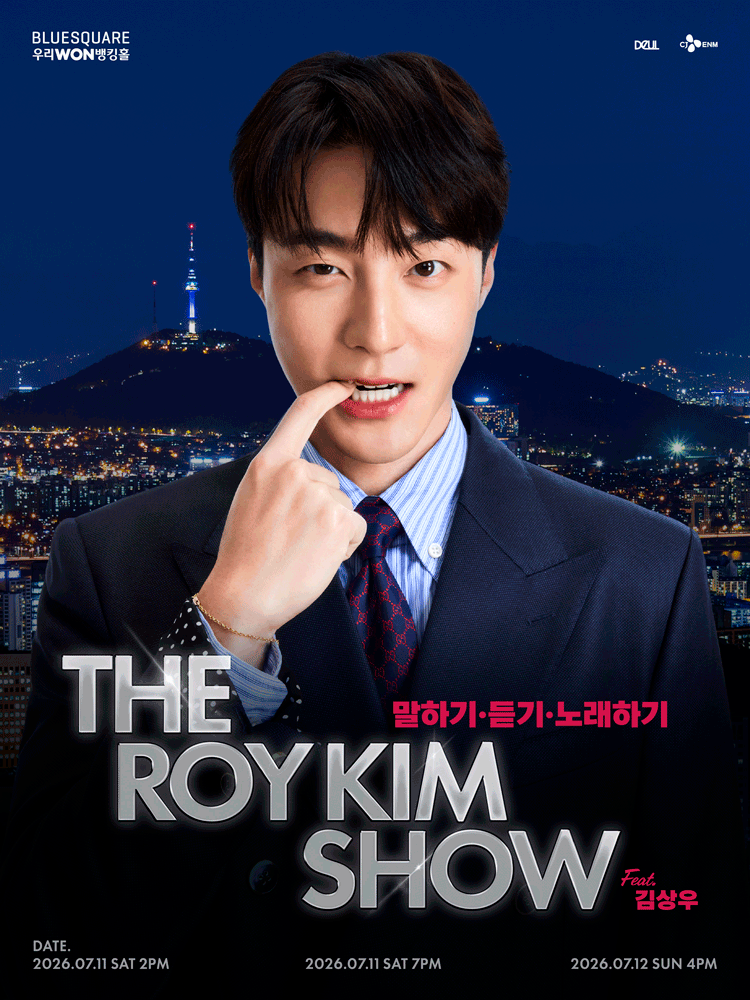
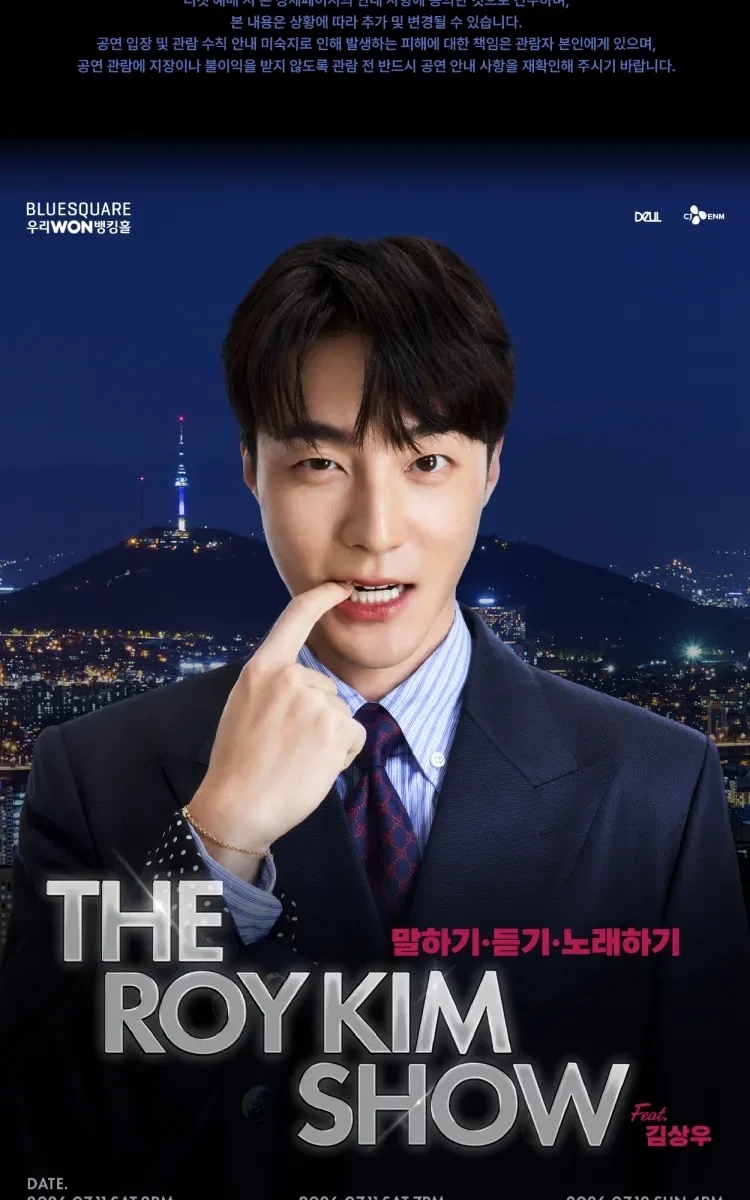
THE ROY KIM SHOW: Speaking, Listening, Singing

Poster

Event Information

Schedule

Saturday, July 11, 2026, 2PM, 7PM
Sunday, July 12, 2026, 4PM / 3 shows over 2 days

Lineup

  • Roy Kim

Ticket Price

  • Reserved Seat (General): 110,000 KRW

Festival

β€» When booking a ticket, it is considered that you have agreed to the performance guidelines, and this content may be added to or changed depending on the performance situation. Please be sure to re-check the performance guidelines before watching to avoid any interference or disadvantages in viewing the performance.

β€» Before authentication and booking, please make sure to check in advance if there are any incorrectly entered parts of your NOL ticket member information (date of birth, contact information, etc.). The information of the NOL ticket booker and the actual viewer (bringing ID) must match, and if they do not match, admission may be restricted.

β€» Re-issuance and admission are impossible in any case, such as loss or damage of the ticket, so please be careful with ticket storage.

[Ticket Delivery Guide]

  • To prevent congestion on the day of the performance, a bulk delivery method will be operated in the early stages of booking.
    (Bulk delivery date: Thursday, June 18th ~ Friday, June 19th, for 2 days)

  • Before purchasing a ticket, please check once more if the delivery address and receiving information (recipient, contact information) are correct.

[Ticket On-site Pickup Guide]

  • When picking up reserved tickets on-site, you must bring both a physical ID that can verify the identity of the booker and the NOL ticket booking statement.

  • Ticket pickup is only possible if the information on the ID and the NOL ticket booking statement match, so please check in advance.

  • Ticket pickup is not possible if you are not the booker or if the booker’s ID cannot be verified.

  • For more details, please check the ‘Ticket On-site Pickup Guide’ in the detailed image below.

[Wheelchair Seat Booking Guide]

  • Wheelchair seat fan club pre-booking: Thursday, May 21, 2026, 10:00 AM (KST) ~ 5:59:59 PM (KST)

  • Wheelchair seat general booking: Friday, May 22, 2026, 10:00 AM (KST) ~

β€» Wheelchair seat purchase is only possible through phone booking via the Blue Square Customer Center (1544-1591) (*Customer Center operating hours: 9 AM ~ 6 PM)

β€» For more details, please check the ‘Wheelchair Seat Booking Guide’ in the detailed image below.

β€» For this performance, the booking standby service and the same seat re-booking service are restricted.

β€» This performance applies the Safe Booking service. Please refer to this for your booking.

A bit about Roy Kim,

Roy Kim emerged as a gentle force in the K-pop industry, winning the fourth season of the superstar survival show Superstar K in 2012 while still a student at Georgetown University. His victory launched a career defined not by flashy choreography, but by his warm, emotive baritone and deeply personal acoustic-driven songcraft. He is best known for the tender, seasonal mega-hit “Bom Bom Bom” (Spring, Spring, Spring), a song that has become a perennial anthem in South Korea, marking him as the definitive “spring singer.” His subsequent discography, featuring introspective albums like Love Love Love and the comforting title track “Home,” solidified his reputation for creating music that feels like a heartfelt conversation. Although his career was significantly impacted by a controversy in 2019β€”he was investigated for being part of a celebrity chat room sharing illicit content, for which the statute of limitations expired on a charge of distributing a photoβ€”his early musical legacy remains a benchmark for the ballad and folk-pop genre within the Korean mainstream.

이 ν¬μŠ€νŒ…μ€ 쿠팑 νŒŒνŠΈλ„ˆμŠ€ ν™œλ™μ˜ μΌν™˜μœΌλ‘œ, 이에 λ”°λ₯Έ μΌμ •μ•‘μ˜ 수수료λ₯Ό μ œκ³΅λ°›μŠ΅λ‹ˆλ‹€.

Soran PERFECT DAY 12 2026: Tickets, Dates, Seating Guide & Everything You Need to Know for the Seoul Concert

Soran PERFECT DAY 12 2026: Tickets, Dates, Seating Guide & Everything You Need to Know for the Seoul Concert

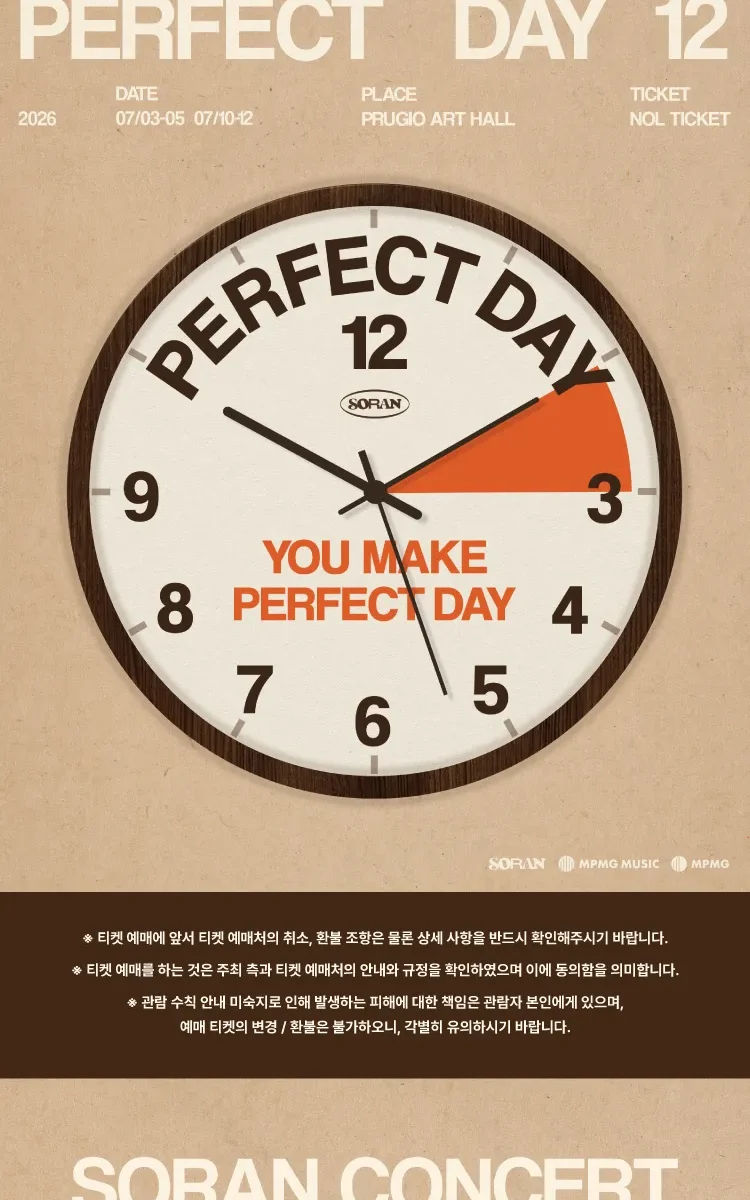
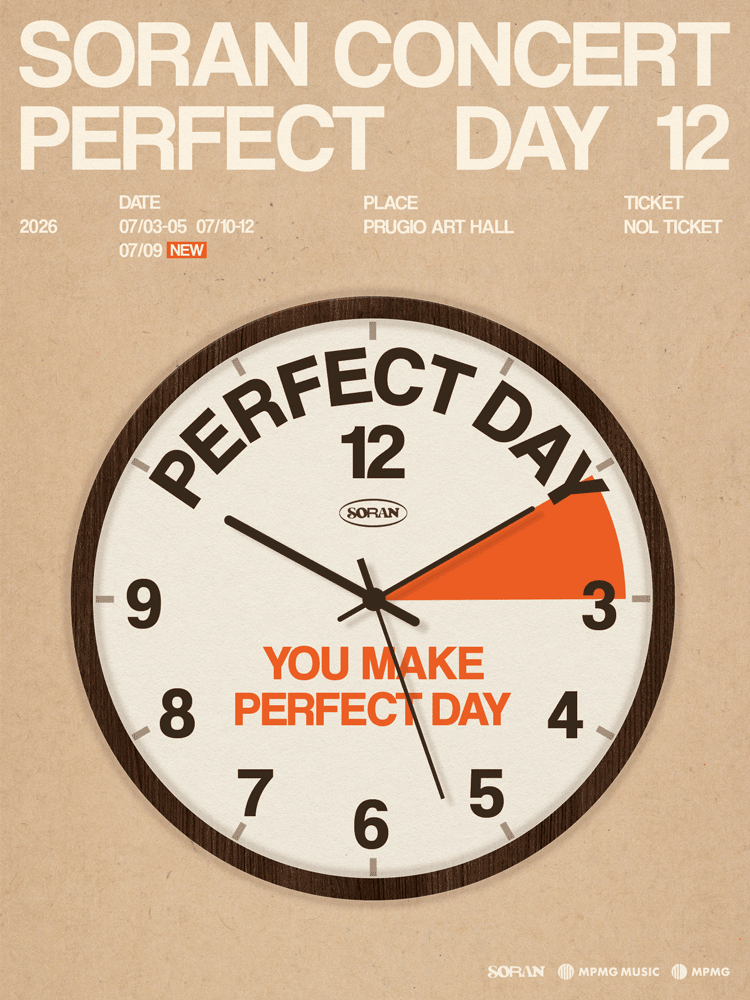
Soran PERFECT DAY 12

Poster

Event Information

Schedule

July 3 (Fri) ~ 5 (Sun), July 10 (Fri) ~ 12 (Sun), 2026 | Fri 8PM / Sat 6PM / Sun 4PM

Lineup

  • Soran (μ†Œλž€)

Ticket Price

  • All Seats (General): 110,000 KRW

What to Expect

This is the twelfth installment of Soran’s “PERFECT DAY” concert series, a sustained run that has established itself as a signature event for the indie rock band. The 2026 edition extends across two extended weekends in July, offering ten total performances at Prugio Art Hall in central Seoul. Previous iterations have developed a reputation for intimate, meticulously arranged setlists that balance the group’s established catalog with live-specific arrangements and occasional unreleased material.

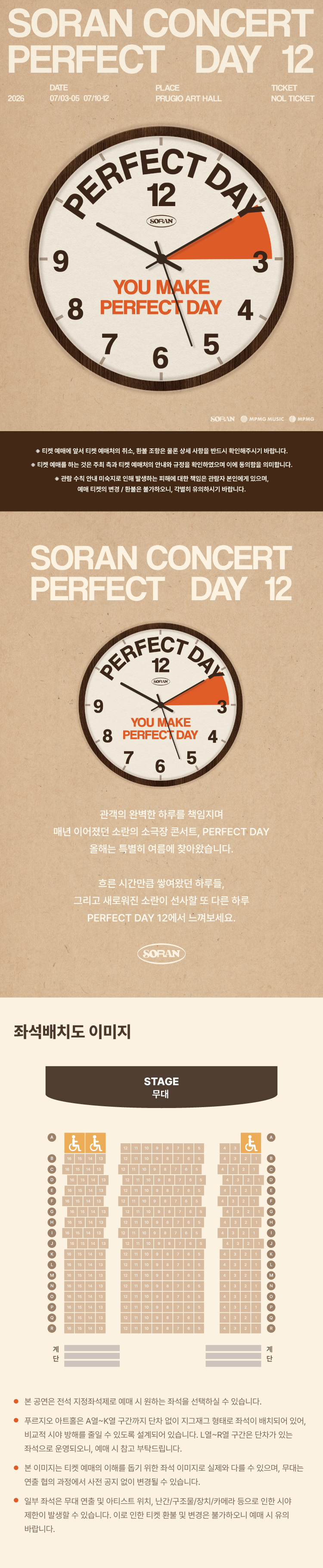
The venue’s configuration merits attention for prospective attendees. Prugio Art Hall operates with a split seating design: rows A through K maintain a flat, zigzag arrangement intended to minimize sightline obstruction between patrons, while rows L through R incorporate elevation changes. Ticket holders select specific seats during booking rather than receiving general admission assignments.

Booking and Attendance Notes

β€» This performance applies the Safe Booking service. Please refer to this when booking.

β€» Prior to booking tickets, please be sure to check the cancellation and refund clauses as well as the detailed information of the ticket booking agency.

β€» Booking a ticket means that you have checked and agreed to the guidance and regulations of the organizer and the ticket booking agency.

β€» Responsibility for damages resulting from a lack of familiarity with the viewing guidelines lies with the viewer, and changes/refunds of booked tickets are not possible, so please be especially mindful.

  • This performance is a fully assigned seating event, and you can select your desired seat when booking.
  • At Prugio Art Hall, seats in sections Row A to Row K are arranged in a zigzag pattern without elevation changes, designed to relatively reduce visual obstruction. Sections Row L to Row R are operated as seats with elevation changes, so please refer to this when booking.
  • Viewing is only possible from the booked seat, and moving to a seat other than the assigned seat is not permitted.
  • Up to 4 tickets per person can be booked for this performance.
  • For one week after the ticket opening, bank transfer cannot be selected as a payment method. Bank transfer selection is only available from midnight on May 29 (Fri) to midnight on June 29 (Mon), so please take note.
  • Proxy receipt or transfer of tickets to anyone other than immediate family members is not permitted. Please make sure to book using an ID in the name of the person who will actually watch the performance.
  • In the case of booking under the name of an immediate family member, identity verification and ticket receipt are possible if you bring all of the following: family relationship verification documents (health insurance card, resident registration abstract, family relationship certificate, etc.) / the booker’s physical ID / the viewer’s physical ID.
  • To avoid congestion on the day of the performance, tickets booked during the early stages of ticket opening will be delivered in bulk.
  • Bulk delivery date: June 15 (Mon) ~ 16 (Tue), for 2 days
  • Regardless of the reason, entry to the venue and re-issuance of tickets are not possible in case of damage, loss, theft, or failure to possess the ticket on-site, so please be careful with ticket storage.
  • Friday and Saturday performances can be booked until 5 PM the day before the performance; Sunday performances can be booked until 11 AM the day before the performance. Cancellations and refunds are not possible after the booking deadline.
  • Any arbitrary transaction of tickets other than the official purchase procedure through the booking site is an illegal act. If an illegal transaction is discovered, it will be handled through a legal explanation process. Please be informed that any damages arising from this are entirely the responsibility of the parties involved in the transaction, and the performance organizer, host, and partner companies bear no responsibility.

Seating ChartVenue Layout

A bit about Soran (μ†Œλž€)

Soran is a South Korean indie pop band that has charmed listeners with their warm, witty, and heartfelt music since their debut in 2010. The four-member groupβ€”consisting of vocalist Go Young-bae, guitarist Lee Tae-wook, bassist Seo Myeon-ho, and drummer Pyeon Yu-ilβ€”originally formed through their university music club and quickly rose to prominence in the indie scene. Their name, which means “a disturbance” or “a small commotion” in Korean, perfectly captures their playful and energetic spirit. Soran is beloved for their relatable, story-driven lyrics that capture the small, tender moments of everyday life, delivered through Go Young-bae’s distinctively sweet and clear vocals. Their breakout hit, “Timing,” from their second album became a viral sensation, resonating deeply for its comforting message about the right moment for love arriving without warning. With a discography that spans energetic, band-driven pop anthems and soft, acoustic ballads, Soran continues to be a source of solace and joy, masterfully blending clever wordplay with melodies that feel like a conversation with a close friend.

이 ν¬μŠ€νŒ…μ€ 쿠팑 νŒŒνŠΈλ„ˆμŠ€ ν™œλ™μ˜ μΌν™˜μœΌλ‘œ, 이에 λ”°λ₯Έ μΌμ •μ•‘μ˜ 수수료λ₯Ό μ œκ³΅λ°›μŠ΅λ‹ˆλ‹€.

2026 Incheon Pentaport Rock Festival Guide: How to Get Blind Tickets and Plan Your Visit to Songdo Moonlight Festival Park

2026 Incheon Pentaport Rock Festival Guide: How to Get Blind Tickets and Plan Your Visit to Songdo Moonlight Festival Park

2026 Incheon Pentaport Rock Festival

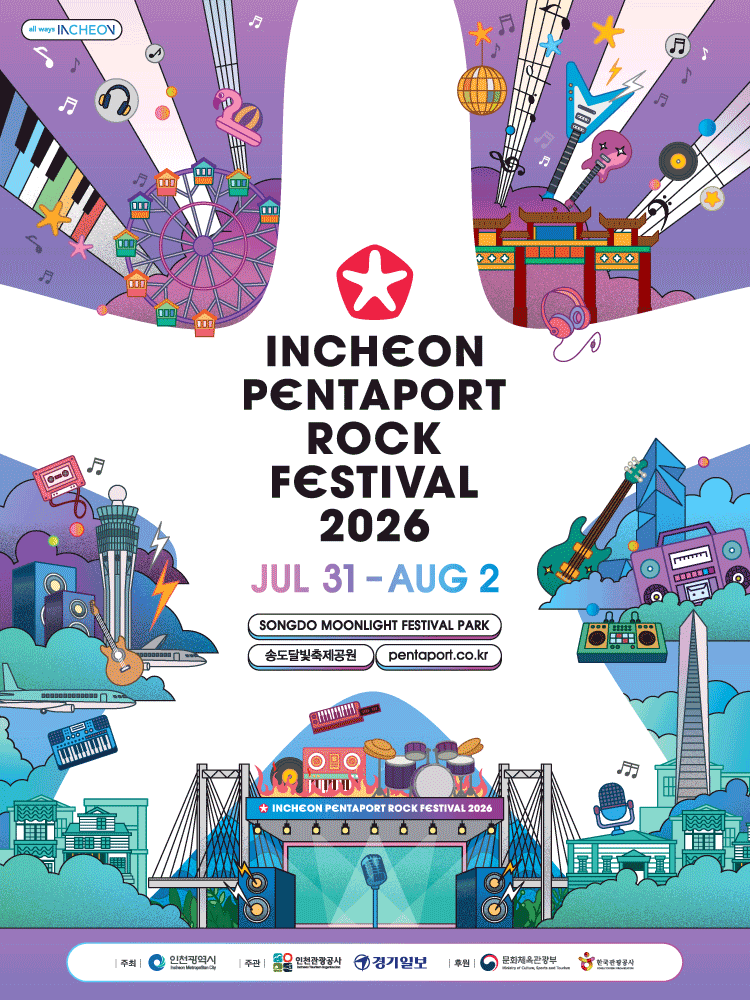
Poster

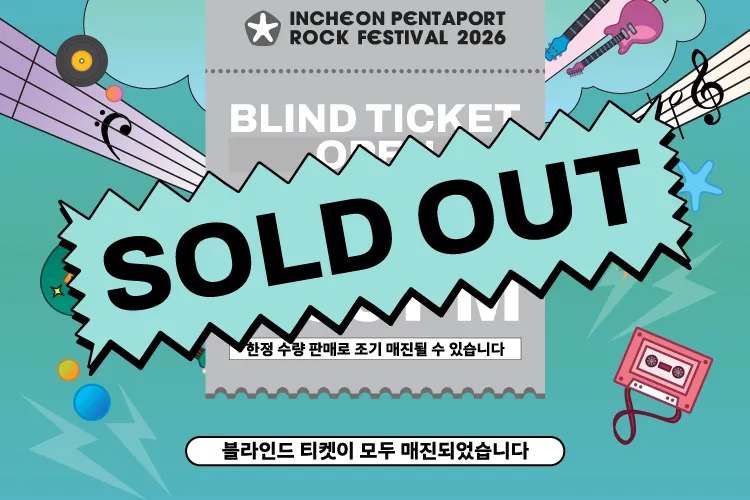
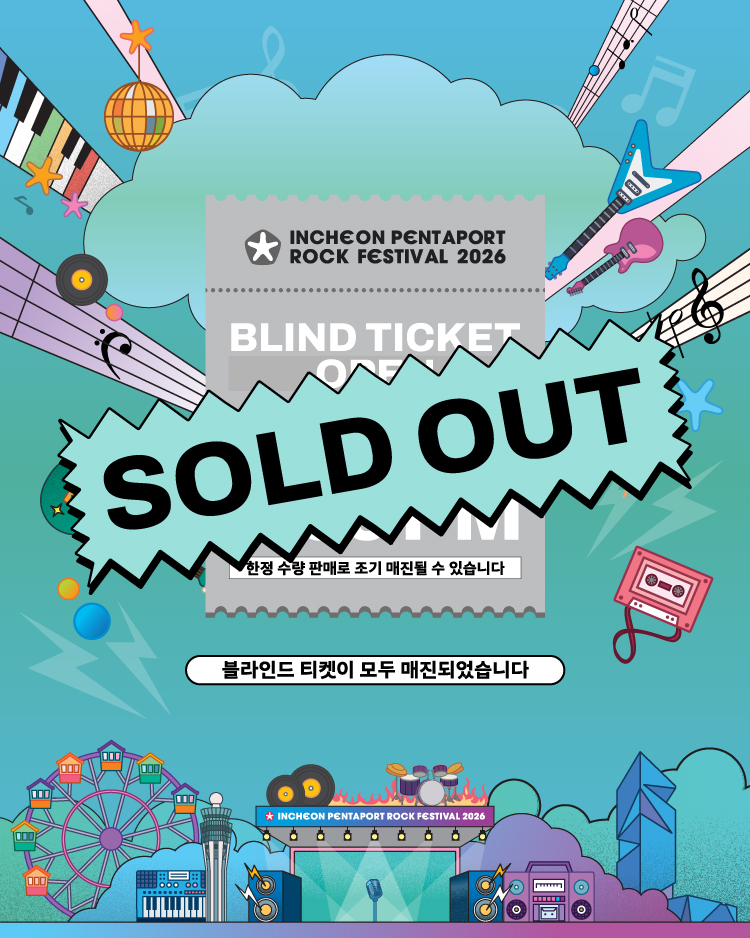
The 2026 Incheon Pentaport Rock Festival will occupy Songdo Moonlight Festival Park from July 31 through August 2, offering three days of rock music programming from 11:00 AM to 10:00 PM daily. The event distinguishes its ticketing approach through a blind sale mechanismβ€”a limited window opening April 24, 2026, at 2:00 PMβ€”that reduces the three-day pass cost by 30 percent (from 240,000 KRW to 168,000 KRW) for purchasers buying before the artist lineup announcement.

Event Information

  • πŸ—“οΈ Date: 2026-07-31 ~ 2026-08-02
  • πŸ“ Venue: Songdo Moonlight Festival Park
  • Address: 350 Central-ro, Yeonsu-gu, Incheon (Songdo-dong)
  • Age Limit: All ages permitted

Located in Incheon’s Songdo International Business District, the Moonlight Festival Park provides an open-air setting for the festival. The all-ages admission policy permits entry for attendees of any age group, though parents and guardians should note the implications of large crowd environments and sustained high-volume music exposure for young children.

Schedule

The festival operates on identical hours across all three days:

  • Friday, July 31, 2026: 11:00 AM ~ 10:00 PM (KST)
  • Saturday, August 1, 2026: 11:00 AM ~ 10:00 PM (KST)
  • Sunday, August 2, 2026: 11:00 AM ~ 10:00 PM (KST)

Ticket Information

Blind Ticket Sale

The blind ticket window opens on Friday, April 24, 2026, at 2:00 PM and closes upon sell-out. This limited-release tranche offers the three-day pass at 168,000 KRWβ€”a reduction from the standard price of 240,000 KRWβ€”available strictly on a first-come, first-served basis. Purchasers are limited to four tickets per ID, and sales terminate automatically once the allocated inventory depletes.

Ticketing Protocol and Restrictions

By completing a ticket purchase, attendees agree to the festival’s performance guidelines, which organizers may modify depending on operational requirements. All tickets are distributed exclusively through a mobile ticket service; physical tickets are not issued, eliminating options for delivery or on-site pickup. The mobile ticket gifting function is disabled for this event.

Mobile tickets require exchange for physical wristbands at the venue entrance. Once obtained, these wristbands permit free re-entry to the festival grounds. Attendees must wear their 3-day pass wristbands continuously throughout the entire viewing schedule, from initial entry through the conclusion of the final day’s programming.

Important constraints regarding wristbands: Entry wristbands cannot be reissued under any circumstances if lost, stolen, or damaged, so attendees should exercise particular care in securing them. Transfer, resale, and name changes are strictly prohibited. The organizers, hosts, and partners assume no responsibility for damages resulting from illegal ticket transactions, which remain entirely the responsibility of the transacting parties.

Performance and Refund Policies

Performing artists and scheduled performance times are subject to change due to unavoidable circumstances. As a matter of policy, refunds are not issued in response to lineup or schedule modifications. Same-day refunds are also unavailable for entry delays caused by venue congestion. Attendees should arrive in advance to accommodate potential queuing at entry points and booths.

Depending on real-time conditions on the event dates, entry may require waiting in organized queues; attendees should follow staff instructions to facilitate smooth ingress.

Accommodations and Equipment

For attendees traveling from outside Incheon, the above link provides access to nearby lodging options within the Songdo area and surrounding districts. Those requiring seating equipment can access festival chair options through the provided affiliate link.

Festival Guidelines

The guidelines referenced in this article and exposed within the official work description are designed to ensure safe, enjoyable festival attendance while minimizing operational inconveniences. Attendees should review the complete festival guidelines provided in the detailed images below before completing their purchase:

이 ν¬μŠ€νŒ…μ€ 쿠팑 νŒŒνŠΈλ„ˆμŠ€ ν™œλ™μ˜ μΌν™˜μœΌλ‘œ, 이에 λ”°λ₯Έ μΌμ •μ•‘μ˜ 수수료λ₯Ό μ œκ³΅λ°›μŠ΅λ‹ˆλ‹€.

Waterbomb Seoul 2026 Guide: Tickets, Dates, and Everything You Need to Know for the Ultimate Summer Experience

Waterbomb Seoul 2026 Guide: Tickets, Dates, and Everything You Need to Know for the Ultimate Summer Experience

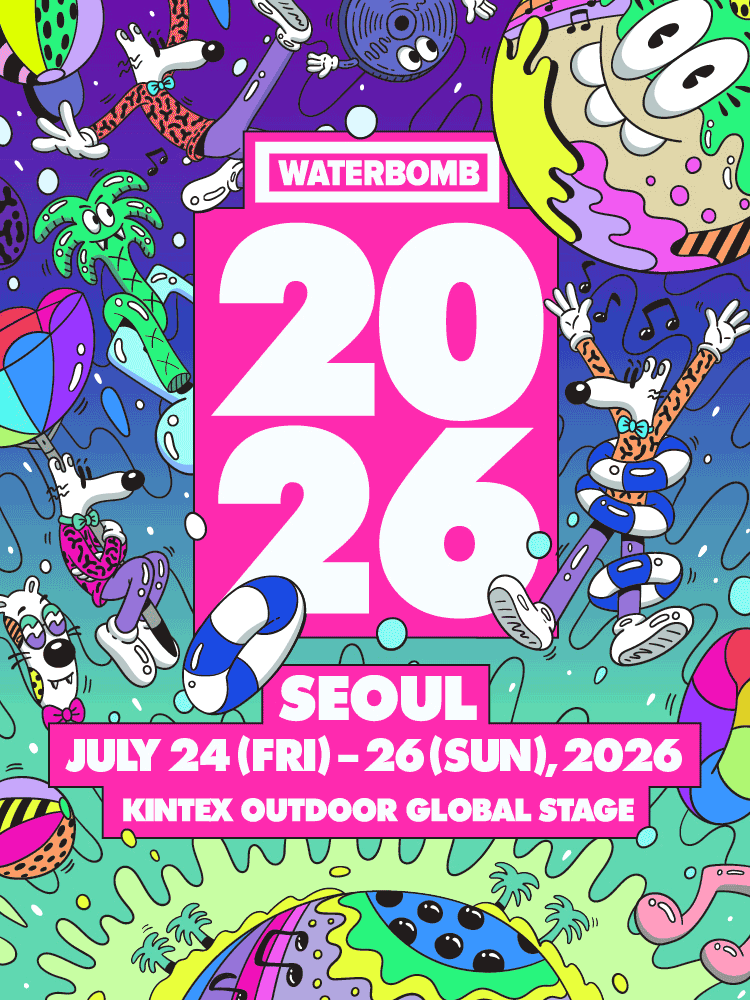
Waterbomb Seoul 2026

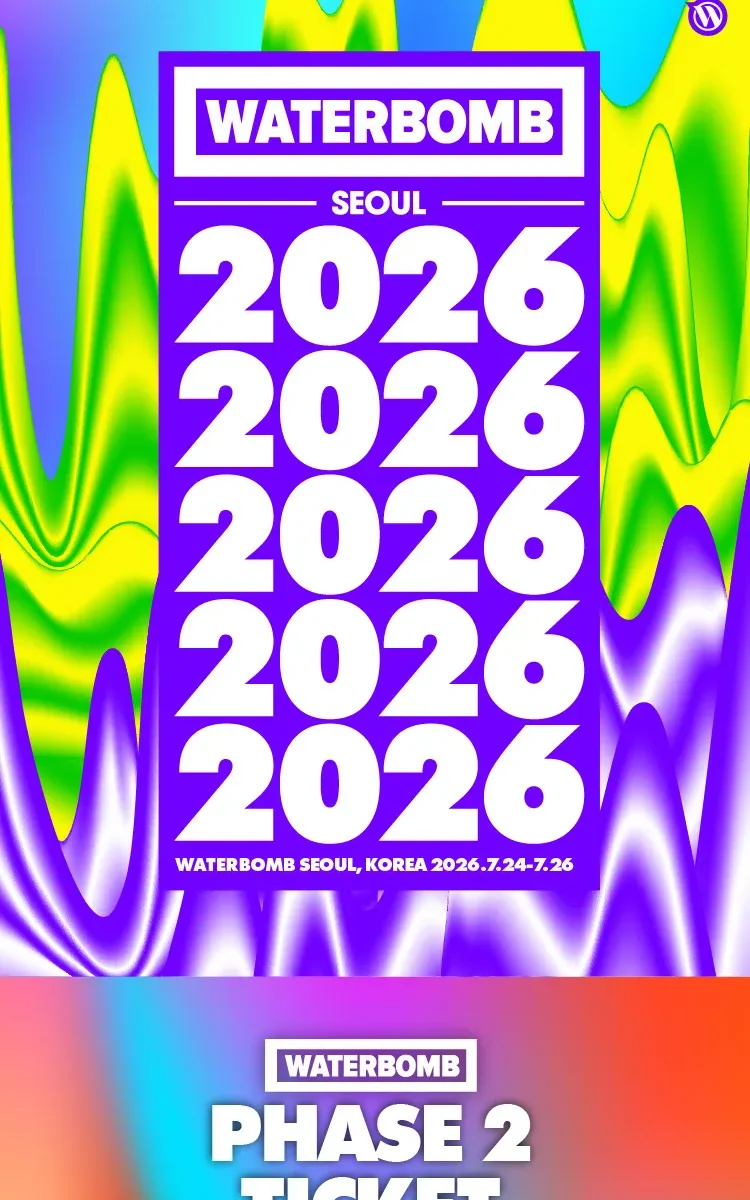
Poster

South Korea’s annual Waterbomb festival returns to Seoul in 2026, offering a distinct alternative to traditional summer concerts through its integration of high-energy EDM and hip-hop performances with large-scale water combat. Unlike conventional music events where audiences remain spectators, Waterbomb operates on a team-based battle systemβ€”Green versus Yellowβ€”where attendees, equipped with water guns, engage in playful warfare while artists perform on stage. This format converts the venue into an immersive summer arena where remaining dry is neither expected nor particularly desirable, making waterproof phone cases and quick-dry clothing advisable preparations rather than afterthoughts.

Event Information

The festival takes place at the KINTEX Outdoor Global Stage, located within the Korea International Exhibition Center in Ilsan, Goyangβ€”a northern suburb of Seoul accessible via the Seoul Metropolitan Subway system. This dedicated outdoor space accommodates the event’s unique combination of concert staging and water-based activities, providing sufficient area for the team zones and water artillery deployment that characterize the Waterbomb experience.

Schedule

Detailed operating hours and timetable will be announced later.

Ticket Prices

Admission is structured by day and team affiliation, with Saturday commanding a premium pricing tier:

  • Friday, July 24:

    • (Fri) 2nd Ticket_Green Team (Admission): 110,000 KRW
    • (Fri) 2nd Ticket_Yellow Team (Admission): 110,000 KRW
  • Saturday, July 25:

    • (Sat) 3rd Ticket_Green Team (Admission): 121,000 KRW
    • (Sat) 3rd Ticket_Yellow Team (Admission): 121,000 KRW
  • Sunday, July 26:

    • (Sun) 3rd Ticket_Green Team (Admission): 110,000 KRW
    • (Sun) 3rd Ticket_Yellow Team (Admission): 110,000 KRW

Team selectionβ€”Green or Yellowβ€”determines which faction you will join during the water battles, though pricing remains consistent across both teams for any given day.

Festival Information and Reservation Guidelines

Waterbomb Seoul 2026 Reservation Notice

Tickets for this event utilize a QR code system; physical tickets are not shipped separately. Instead, QR codes are transmitted collectively to the mobile phone number provided during reservation exactly ten days prior to the event date. The accuracy of the entered mobile number is therefore criticalβ€”errors in contact information may result in non-delivery of admission credentials without possibility of same-day resolution.

Ticketing operates on a tiered release system: quantities are limited for each session, and when tickets for a specific session sell out, the subsequent session opens for purchase. Buyers should verify their eligibility against the age restriction; the event is strictly limited to attendees aged 19 and above, defined as those born on or before December 31, 2007 (based on 2026 calendar year).

Entry requires presentation of physical identification for adult verification; entry will be refused without proper ID, and same-day refunds are not granted for admission denials based on identification failures. The detailed performance timetable will be announced through official channels at a later date. All performance-related informationβ€”including potential schedule changes and safety protocolsβ€”is disseminated exclusively through the official Instagram account and website. Reservation of tickets constitutes agreement to all terms regarding reservation procedures, entry protocols, refund policies, and viewing guidelines.

이 ν¬μŠ€νŒ…μ€ 쿠팑 νŒŒνŠΈλ„ˆμŠ€ ν™œλ™μ˜ μΌν™˜μœΌλ‘œ, 이에 λ”°λ₯Έ μΌμ •μ•‘μ˜ 수수료λ₯Ό μ œκ³΅λ°›μŠ΅λ‹ˆλ‹€.

Busan Fireworks Festival Guide: Best Viewing Locations, Transportation Tips, and Visitor Advice

<-2> Busan Fireworks Festival

| Location | Gwangalli Beach area |
| Host | Busan Metropolitan City |
| Organizer | Busan Culture & Tourism Festival Organizing Committee |
| Homepage | |

Overview

The Busan Fireworks Festival represents not merely a pyrotechnic display but a comprehensive multimedia maritime show that has become the largest of its kind in Asia, drawing over one million spectators annually to the southern port city. Hosted by Busan Metropolitan City and organized by the Busan Culture & Tourism Festival Organizing Committee, this event stands alongside the Busan International Film Festival as one of the metropolis’s signature cultural products.

What distinguishes this festival from its counterpart in Seoulβ€”specifically the Seoul International Fireworks Festival, with which it shares recognition as one of Korea’s two major fireworks celebrationsβ€”is its maritime setting. Whereas Seoul’s event unfolds along the narrow Han River, necessitating strict safety limitations that constrain production scale, Busan’s festival launches from the open sea, allowing for unrestricted pyrotechnic creativity and larger explosive displays. The festival integrates laser shows with precisely choreographed musical accompaniment, featuring unique firework shapes and giant shells that transform the night sky above Gwangalli Beach into a synchronized canvas of light and sound.

Venue and Timing

The festival occurs annually on the last Saturday of October, a scheduling choice designed to maximize attendance while preserving Sunday for recovery from the inevitable logistical challenges. This Saturday tradition mirrors the Seoul International Fireworks Festival’s approach, though since 2019 the event has shifted to the first Saturday of November.

The primary stage encompasses the waters fronting Gwangalli Beach and the iconic Gwangandaegyo Bridge, where barges position themselves to launch fireworks from both sea and bridge structures. The maritime location effectively eliminates fire concerns; indeed, during the 14th festival in 2018, when a fire broke out on a barge, many attendees remained oblivious to the incident.

Since the 11th festival in 2015, the production has expanded to a “3-Point” system, launching fireworks simultaneously from Marine City and Igidae in addition to Gwangalli Beach. However, this creates a tiered viewing experience: the “Overseas Invited Fireworks Show” remains visible exclusively from Gwangalli Beach, while the “Busan Multi Fireworks Show” can be viewed from all three locations. Certain central areas of Gwangalli sandy beach have been designated as premium tourist seating since 2015.

Historical Evolution

The festival’s origins trace to November 16, 2005, when an Advanced Multimedia Maritime Show celebrated the APEC Summit with an investment of 1.3 billion won, attracting one million spectators and creating what locals described as a “hell gate” scene on Busan Metro Line 2. Inspired by this success, the city rebranded the event as the Busan World Fireworks Festival on November 10, 2006, expanding the scale to accommodate 1.1 million attendees; from 2007 onward, pre-festival events accompanied the main celebration.

By the 6th festival in 2010, attendance had surged to 2.6 millionβ€”establishing the event as Busan’s representative tourism product and prompting the city to specifically target Japanese tourists residing in Tsushima. The 2011 festival proceeded despite rain, while the 2012 edition, originally scheduled for October 26–27, was postponed to 8:00 PM on October 28 due to inclement weather. The 2013 festival ran from Friday, October 25 to Saturday, October 26 under the theme “50 Years of Love, Busan!” and included a public proposal event during the 2012 festival for a couple selected through open recruitment.

The 10th festival in 2014 featured narration by Bae Chul-soo, while 2015 marked a significant operational change: the introduction of paid seating on the beach (S seats at 70,000 won and R seats with tables at 100,000 won), the implementation of the 3-Point production, and narration by Yang Hee-eun alongside KNN announcer Jeong Hee-jeong and stadium announcer Ragio of the Busan kt Sonicboom. The 2016 edition abolished the pre-festival, scheduling colorful smoke bombs from 18:00–20:00 by China’s Sunny Co. (2011 competition winner), an Overseas Invited Fireworks Show from 20:00–20:15, an LED Water Board Maritime Show from 20:15–20:25, and the main Busan Multi Fireworks Show from 20:25–21:00, with Bae Chul-soo returning as narrator.

The 2017 festival featured Italy’s Paraent Co. for the overseas segment with narration by Yoon Do-hyun, while 2018 hosted Japan’s Marutama Co. with Bae Chul-soo narratingβ€”the latter event notable for a fire on a barge that fortunately did not spread to remaining gunpowder. The 2019 festival, held on Saturday, November 2 with narration by actor Jo Jin-woong, featured OSTs from Japanese animations including Mazinger Z, Cowboy Bebop, and Howl’s Moving Castle during the Japanese team’s performance. The 16th festival, scheduled for November 7, 2020, was canceled due to COVID-19β€”a fate shared by the Seoul International Fireworks Festival that year.

Viewing Locations

The festival offers a spectrum of viewing experiences ranging from immersive beachfront participation to distant, contemplative observation from mountain peaks. Truly, every kind of place is listed among the options, each presenting distinct advantages and compromises regarding sound synchronization, crowd density, and visual perspective.

Primary Beachfront

Gwangalli Beach serves as the epicenter, where over one million people crowd the sandy beach to experience the full multimedia presentation. From this vantage point, fireworks explode in precise synchronization with music including “Busan Seagull,” pop songs, K-pop, and orchestral arrangementsβ€”a cohesion of sound and light unavailable elsewhere. High-rise hotels, condominiums, and restaurants behind the beach offer festival products with extreme overcharging, yet the beach remains optimal for the complete experience. Based on experience, the exodus is said to be a parade of zombies, with Gwang-an Station, Suyeong Station, and Millak Station becoming gathering places for these exhausted crowds.

Millak-dong Waterfront Park ranks as the third most popular viewing spot, located right next to Gwangalli near the Raw Fish Center harbor. While access to the breakwater is completely restricted due to dangerous drop-offs into deep water, and music cannot be heard clearly, spectators flock here when the beach interior becomes impossibly crowded.

Namcheon-dong Samick Beach Apartments on the opposite side ranks as the second-best prime spot alongside Gwangalli Beach proper, offering clear views of the Gwangandaegyo Bridgeβ€”though this popularity means the “hell gate” of congestion opens here as well.

Alternative Coastal Perspectives

Marine City offers a diagonal rear view of the Gwangandaegyo Bridge from a distance actually closer than Gwangalli Beach. Since 2015, fireworks launch from waters in front of Marine City as part of the 3-Point production. Residents of coastal mixed-use apartments here enjoy premium viewsβ€”units facing the bridge command higher pricesβ€”though they suffer greatly from noise pollution.

Yongho Bay (Yongho 1-dong) encompasses the reclaimed land area featuring apartment complexes such as LG Metro City, GS Heights Xi, and W, facing Marine City across the water. This location has attracted huge crowds since becoming known as a viable alternative.

Igidae Park in Yongho-dong offers viewing near Dongsaengmal and Seopjariβ€”the filming location for the movie Haeundβ€”with well-equipped Gwangandaegyo Bridge viewing facilities. Unlike mountain alternatives, this location requires no hiking, and since recent years, audio systems, organizing staff, and police presence have enhanced both atmosphere and safety, albeit with smaller sound volume.

The Bay 101, opened mid-2014 as a complex marina facility with yachts, restaurants, and accommodation, provides an alternative to Marine City or Dongbaekseom, particularly for those wishing to view fireworks launched before Dongbaekseom alongside Marine City’s night viewβ€”though comfort here requires payment.

Cheongsapo, located along the abandoned Donghae Nambu Line site in Haeundae, presents a surprisingly less-known option with clear Gwangandaegyo Bridge visibility. The Cheongsapo Daritdol Observatory offers daytime sightseeing with nighttime fireworks viewing potential.

Mountain Vantage Points

For those willing to sacrifice musical synchronization to avoid crowds, nearby mountains offer panoramic perspectives.

Mt. Hwangnyeong and Mt. Geumnyeong provide elevated views, with the beacon tower at Mt. Hwangnyeong’s summit offering the best overlook of Gwangalli. However, this location has itself become a “hell gate,” particularly around the Geumnyeong Mountain Youth Training Center, with vehicle entry completely restricted and blocked roads necessitating walking up.

Mt. Jangsan (638m altitude) features the Ganbiosan beacon tower, built during the Joseon Dynasty to observe enemy ships, offering panoramic views of the entire Gwangandaegyo Bridge and surroundings. The significant hike requiredβ€”coupled with dangerous descent paths in darknessβ€”deters all but avid hikers, and the fireworks, arranged for beach viewing, lose emotional impact from this distance.

Mt. Baesan in Yeonje-gu (260m) offers comfortable viewing precisely because its distance discourages crowds, though the hiking pressure remains a bonus consideration for those seeking exercise with their pyrotechnics.

Bonglaesan in Yeongdo-gu and Mt. Cheonma in Seo-gu provide views from the old city center and western Busan respectively, with the latter’s observatory offering clear bridge visibilityβ€”though the distance between these locations and Haeundae-gu remains considerable.

Geumjeongsan offers multiple viewing points including Sanggyebong (reached via bus 33 to Guman-deok terminal then hiking), and the 3rd/4th Watchtowers, Godangbong, Gyemyeongam, and Gyemyeongbong Observatory Rock (reached via bus 203 to Geumjeongsanseong East Gate, followed by 40 minutes to 2 hours of hiking). These areas exceed 640m altitude and present dangers after dark, attracting almost exclusively hikers. Gyemyeongam, a subsidiary hermitage of Beomeosa Temple, offers a concrete pathβ€”steep but safer than general trailsβ€”for descent.

Distant and Unique Locations

Dongbaekseom Nurimaru in Haeundae, reached via a 10-minute walk from Dongbaek Station, serves East Busan residents primarily from Haeundae-gu. Professional photographers and amateurs deploy tripods and chairs early to claim prime photo positions.

Dalmaji Hill (Mipo Moontan Road) beyond Dongbaekseom provides clear bridge visibility, drawing crowds seeking alternatives to the main beach.

LCT (Landmark Tower) allows viewing from the 98th to 100th-floor observatories of this super high-rise before Haeundae Beachβ€”access restricted to authorized persons only.

Lotte Mall Gwangbok Branch offers rooftop observatory views of the bridge from the Busan Tower side, though distance limits visibility from this old city center location.

Busan Tower permits viewing but prohibits photography due to glass reflections.

Busan International Finance Center (BIFC) allows viewing from its high-rise observatory, though distance and access restrictions apply.

Pusan National University Main Stadium provides distant views from the top of the stands, while various campuses of Pukyong National University (Yongdang and Daeyeon dormitories/College of Humanities and Social Sciences) offer emergency options when all else fails.

Tsushima Island, Japan (49.5km distant) presents perhaps the most unique viewing experience, where the festival serves as an international tourism product despite the significant sound delay and light scattering that biases colors toward red, orange, and yellow. Japan actively promotes this cross-border viewing opportunity.

Technical Production and Broadcast

The festival’s musical curation has evolved from simple background tracks to sophisticated thematic selections encompassing not only traditional fireworks accompaniment (classical and new age) but trending songs, past hits, and broadly relatable tracksβ€”with the finale invariably remaining classical. As scale increased, famous DJs and celebrity narrators were incorporated, while Gwangandaegyo Bridge LED upgrades enabled subtitle displays for romantic atmosphere. Speakers are installed at major viewing points including Gwangalli Beach, Yongho-dong pier, Igidae City Nature Park, and Dongbaekseom.

For those unable to attend, KNN provides terrestrial DMB and radio broadcastsβ€”though these typically cut off around 8:50 PM for regular programming, just before the finale. Busan MBC DMB broadcast the complete event in 2016. T-broad utilizes multiple cameras for dynamic coverage, while CJ HelloVision broadcasts in Full HD. Nevertheless, the limitations of broadcast media are significant: the super-giant fireworks and bridge explosions vary in size, launch angle, altitude, and distance, requiring constant camera switching that interrupts the experience, and large fireworks cannot be fully captured on screenβ€”reducing the experience to less than a quarter of its in-person impact.

Practical Considerations

Transportation Logistics

The festival creates maximum demand across all transport modes, accompanied by what can only be described as severely overcrowded conditions. Busan Metro extends operating hours, with Line 2’s Geumnyeonsan Station and Gwang-an Station, plus Line 3’s Suyeong Station, serving the area. Bus 38 records its highest annual transport revenue on this day, while buses 1006 and 1011β€”despite not passing nearbyβ€”detour through Suyeong Intersection due to their Gwangandaegyo Bridge routes.

From Busan Station, bus 41 provides direct service, with buses 40, 1001, and 1003 as alternativesβ€”though traffic delays are inevitable. The metro route requires taking Line 1 to Seomyeon, transferring to Line 2, and alighting at Geumnyeonsan Station. From Bujeon Station, bus 83 offers the most convenient access. From Busan Central Bus Terminal, bus 51 travels directly to Gwangalli Beach in approximately 90 minutes (longer with traffic), though the metro alternative via Seomyeon also exceeds one hour. From Busan Western Intercity Bus Terminal, Line 2 from Sasang Station provides immediate access.

Critical logistical realities include the complete closure of Gwangnam-ro, Gwang-an-ro, and Gwang-an Beach Road to general vehicles, with only city buses permitted on some routes. The lower deck of Gwangandaegyo Bridge closes entirely, forcing detours via Suyeong Intersection, the 2nd Mandeok Tunnel, or the Busan Outer Ring Expressway. City tour buses suspend operations, while Haeundae–Nam-masan intercity buses occasionally cancel last services when Gwangalli proves impossible to enter.

The scale of attendanceβ€”2.6 million representing over half Busan’s 3.5 million populationβ€”creates a uniquely challenging environment. In Seoul terms, this equates to eight million people converging on Yeouido. Communication failures are severe, with A-GPS often failing to function, and the crush of humanity at Suyeong, Gwang-an, and Millak Stations requires police and railway social service agents to control crowds from the station stairs themselves. Paradoxically, walking to Millak Station or Centum City Station may prove faster than attempting to board at the immediate vicinity.

Indeed, walking often outpaces vehicular transport: the Marine City area via Centum City requires approximately one hour on foot, Haeundae New Town two hours, and Seomyeon similarly two hours. Residents prepared to walk should note that bicyclesβ€”including folding modelsβ€”are strictly prohibited on city buses and metro trains on festival day, with station employees and railway social service agents enforcing this restriction.

For those unable to navigate the post-festival exodus, spending the night at Gwangalli Beach or nearby PC cafes until the first morning train presents a viable alternative.

Safety and Etiquette

The convergence of millions in limited space creates genuine safety concerns, with transport capacity at bus stops and subway stations easily exceeded. Spectators must exercise patience and yield to one another to prevent disasters. Families with infants or young children face particular risks during the exodus, when falls could result in crushing injuries. Two return strategies are recommended: leaving slightly before the finale concludes, or preparing refreshments to extend the beach stay by 1–2 hours post-event, allowing crowds to dissipate naturally.

First-time attendees must prepare for significant temperature drops; despite Busan’s southern location, October nights by the sea are extremely cold with biting winds. Parkas, knee blankets, and scarves are essential regardless of daytime warmth. Snacks and drinks are advisable given the difficulty of procurement amidst crowds, and restroom use should be completed by 6:00 PM at the latestβ€”women face particularly cumbersome queues, despite increased mobile toilet facilities and agreements allowing beachside merchants to open restrooms to the public.

Manners expectations include removing shoes when entering the sandy beach, avoiding foods with excessive moisture that might spill on neighboring spectators, maintaining queue discipline, and remaining seated during the performance to preserve sightlines for those behind.

Economic and Environmental Impact

The festival’s economic reality includes extreme overcharging across accommodation and dining, with beachfront cafe window seats commanding 100,000 to 150,000 won for reservations including minimal refreshmentsβ€”a practice nearly universal among major franchises except for directly managed S Cafe locations.

Environmental management remains challenging despite the distribution of 50,000 trash bags in 2014 (continuing through 2017), with local residents citing light pollution, noise, and illegal dumping as grounds for petitions to abolish the event. Attendees must take personal responsibility for their waste.

Capturing the Experience

For those determined to film, the advice is paradoxical: abandon the attempt to capture the climax. Fireworks are moving fluids that defy fixed capture, and the emotion created by sea breeze, music, and spectacle cannot be preserved even one-tenth by camera. Moderate photography followed by complete immersion in the experienceβ€”which can never be repeatedβ€”is the recommended approach.

Video Archives

2018 Busan Fireworks Festival Video

2019 Busan Fireworks Festival Video

As the organizers note: if watched from a high place, it becomes merely a fireworks festival; if watched from the beach, it becomes a multimedia maritime show. The choice remains with each individual spectator.

What is Busan famous for?

Busan sits on Korea’s southeastern coast, where the Nakdong River delta meets the Sea of Japan. Mountains crowd the city from the west and north, leaving limited flat land that has built upward into dense residential towers. As the country’s second-largest city, it developed around a protected natural harbor that remains one of East Asia’s busiest container ports.

Haeundae Beach occupies the eastern curve of the coastline, a 1.5-kilometer strip of sand backed by high-rise hotels and apartment blocks. Further west, Gwangalli Beach offers a narrower but longer arch with direct views across the bay to Gwangan Bridge. These two beaches host the annual Busan Fireworks Festival each October, when spectators gather on the sand to watch displays launched from the bridge deck and from barges anchored offshore.

The port drives the local economy, handling international shipping routes and passenger ferries to Japan. At Jagalchi Fish Market, vendors sell live seafood from tanks that line the lower level, while the upper floors house restaurants where buyers eat fish cleaned and prepared on the spot. The industry shapes daily routines here more than in inland cities; mornings start before dawn at the auction halls.

Gwangan Bridge spans 7.4 kilometers across the bay, connecting the central districts with Haeundae. The cable-stayed design features LED lighting that changes color after dark. During the fireworks festival, crews mount launch tubes on the bridge itself, using the structure as a firing platform that stretches horizontally across the water.

In October, the Busan International Film Festival brings directors and distributors to the city for ten days of screenings at venues including the Busan Cinema Center, where an outdoor theater seats four thousand. Elsewhere, Gamcheon Culture Village covers a steep slope with houses painted in blues, pinks, and yellows, arranged in tiers that follow the contour lines and connected by staircases that replace streets too narrow for cars.

The festival works because of this geography. Viewers can spread along both beaches with clear sightlines to the bridge, while the bay contains the debris and reflects the light. The subway connects both beach areas, the port’s logistics experience helps manage the temporary infrastructure, and the density of hotels accommodates the overflow crowds. Using the bridge as a launch platform creates a horizontal line of fire that is visible from multiple angles across the city.
2026 G2A at KINTEX: Tickets, Lineup, and Complete Event Guide for October 9

2026 G2A at KINTEX: Tickets, Lineup, and Complete Event Guide for October 9

γ€ˆ2026 G2A〉 at KINTEX

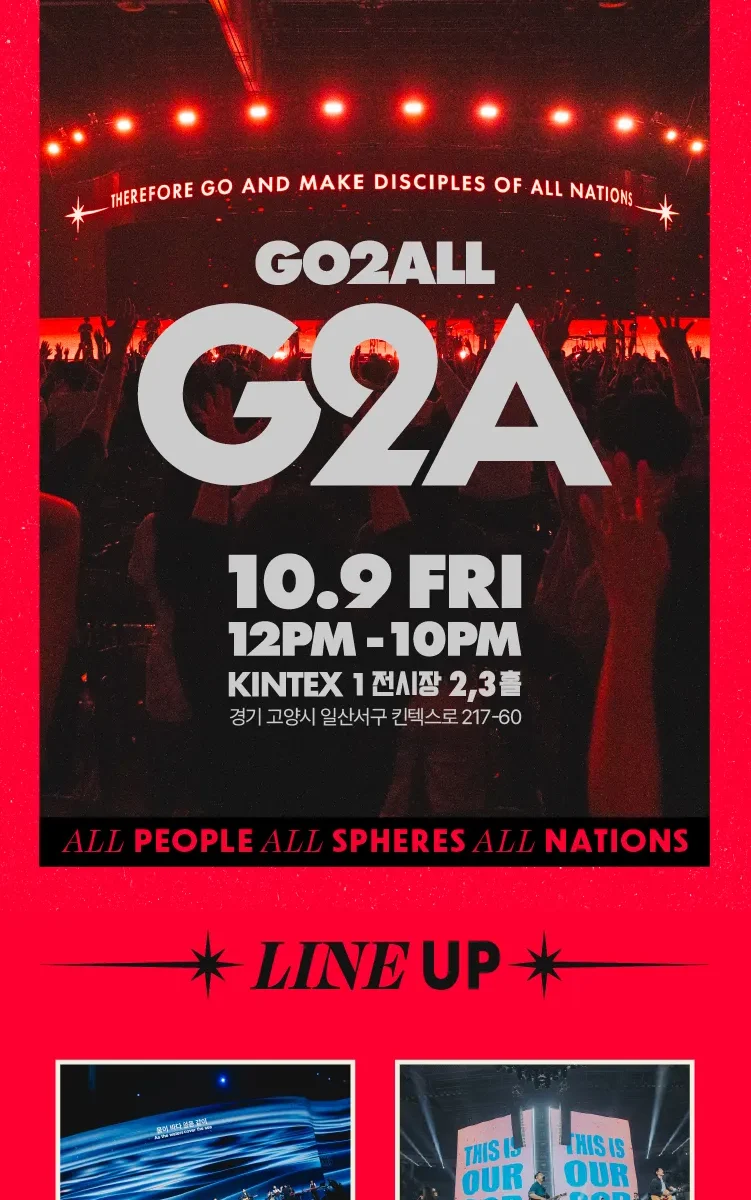
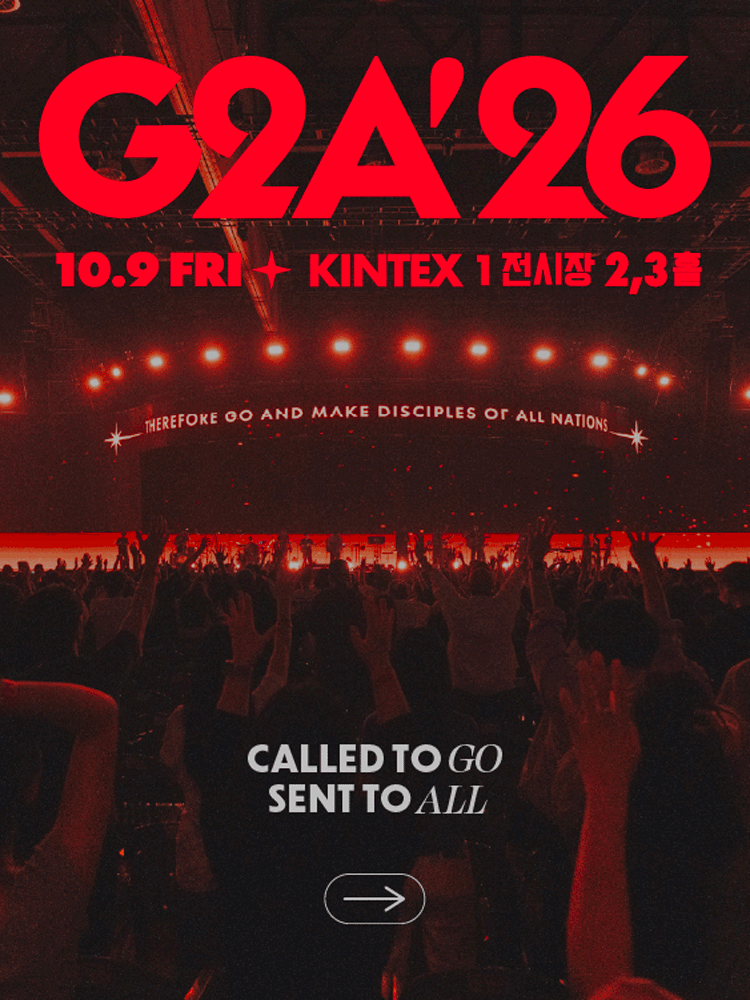
Poster

Event Overview

γ€ˆ2026 G2A〉 is a single-day Christian worship gathering taking place at KINTEX in Goyang, combining live performances from multiple worship collectives with a communal atmosphere open to attendees of all ages. The event centers on contemporary worship music, with seven distinct teams scheduled to perform across the afternoon.

Event Information

Schedule

Date Time
October 9th (Fri) 12:00 PM

Lineup

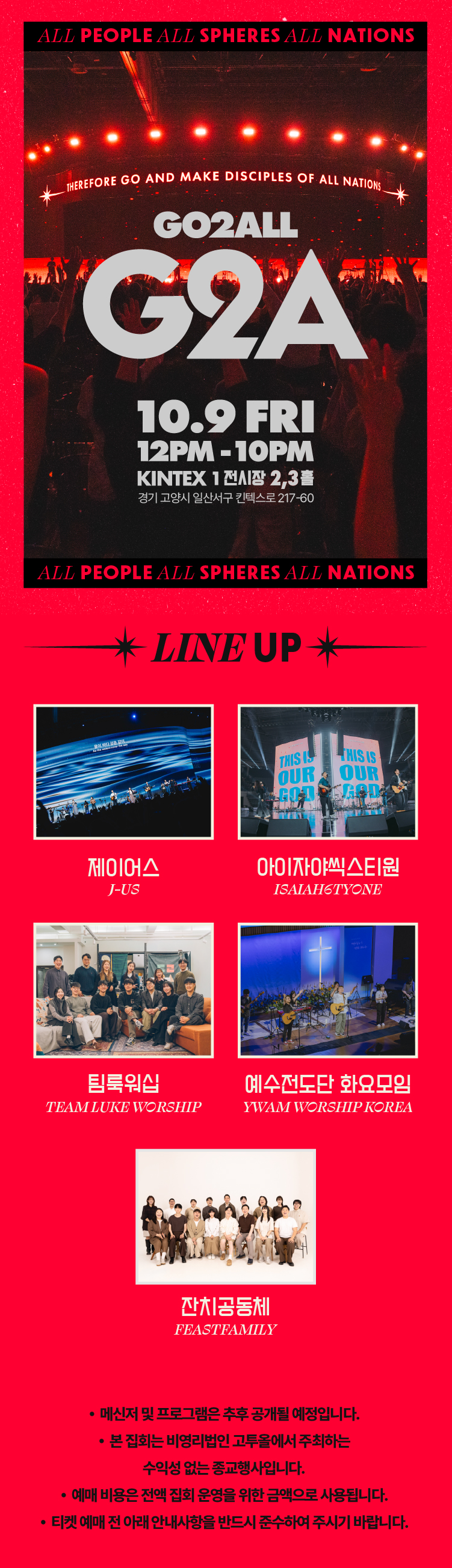
The 2026 edition features seven worship teams, each bringing distinct approaches to contemporary Christian music:

  • J-US
  • THIS 19 OUR GOD
  • THIS IS OUR
  • ISAIAH6TYONE
  • TEAM LUKE WORSHIP
  • YWAM WORSHIP KOREA
  • FEASTFAMILY

Ticket Information

Ticket Type Price
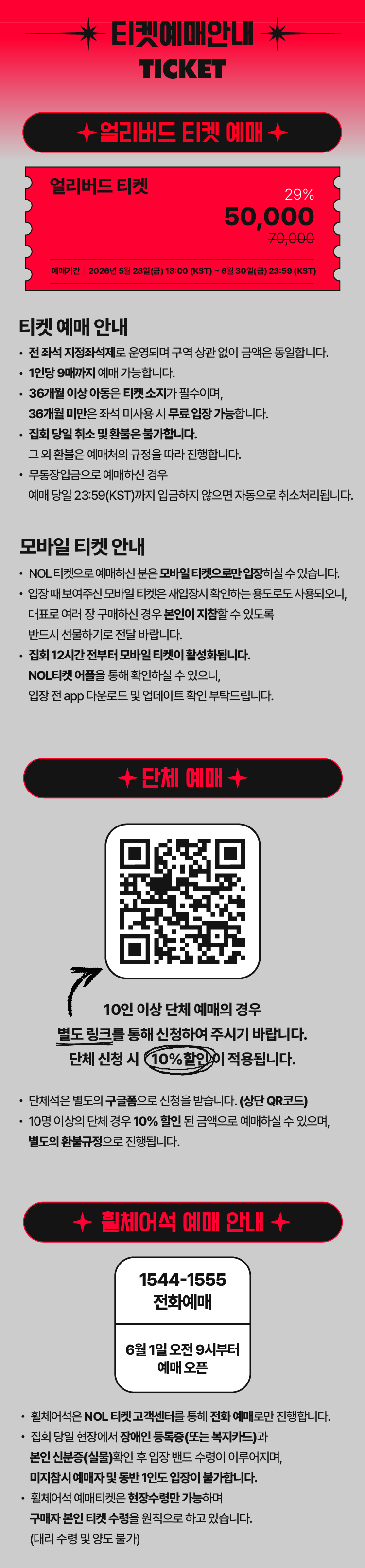
General Seat (Early Bird) 50,000 KRW

Early Bird Sales Period

Thursday, May 28, 2026, 18:00 (KST) ~ Tuesday, June 30, 23:59 (KST)

Reservation Guidelines

  • Ticket limit: 9 tickets per person
  • Group discount: 10% reduction available for group reservations (application required via separate link)

Wheelchair Seat Reservations

Wheelchair seating is available exclusively through telephone reservation via the NOL Ticket Customer Center (1544-1555), beginning June 1st at 9:00 AM (KST). Customer Center hours are 9:00 AM to 6:00 PM.

On the event day, reservees must present both a disabled registration card (or welfare card) and matching physical ID to receive entry bands for themselves and one accompanying person. Failure to produce these documents will result in denial of entry. Wheelchair seat tickets must be collected on-site by the purchaser personally; proxy pickup and ticket transfers are prohibited.

Mobile Entry

This gathering operates on a mobile-only ticket system. Physical tickets are not issued, and neither delivery nor on-site pickup services are provided.

Official Channels

Event image 1
Event image 2
Event image 3

A bit about μ˜ˆμˆ˜μ „λ„λ‹¨ ν™”μš”λͺ¨μž„ YWAM WORSHIP KOREA

Emerging from the heart of a global missions movement, YWAM WORSHIP KOREA (μ˜ˆμˆ˜μ „λ„λ‹¨ ν™”μš”λͺ¨μž„) is not just a musical act, but the creative expression of a community. Formally known as the Tuesday Gathering of Youth With A Mission Korea, this collective has been a foundational pillar in the landscape of modern Korean worship music since the 1990s. Their sound, deeply characterized by passionate intercession and a prophetic spirit, played a crucial role in shaping the “Korean-style” worship that swept through Asia and the global missions field. With an extensive discography that includes influential live-recorded albums like Lord of All Nations, they are revered for their raw, prayer-saturated anthems that often transcend musical performance, functioning instead as an engine for spiritual revival and a soundtrack for a generation devoted to the Great Commission.

이 ν¬μŠ€νŒ…μ€ 쿠팑 νŒŒνŠΈλ„ˆμŠ€ ν™œλ™μ˜ μΌν™˜μœΌλ‘œ, 이에 λ”°λ₯Έ μΌμ •μ•‘μ˜ 수수료λ₯Ό μ œκ³΅λ°›μŠ΅λ‹ˆλ‹€.

Seoul Summer Beach 2026: Enjoy Free Water Parks and Urban Leisure at Gwanghwamun Square

Seoul Summer Beach 2026: Enjoy Free Water Parks and Urban Leisure at Gwanghwamun Square

πŸ—“οΈ 2026.07.20 ~ 2026.08.09

Seoul Summer Beach marks its 4th anniversary in 2026, returning to Gwanghwamun Square and Sejong-ro Park from July 20 through August 9 as Seoul’s representative summer festival that both tourists and citizens can enjoy in the city center during the hot summer. Operating under the slogan “Wave Summer, Play Seoul,” the event converts a portion of central Seoul’s primary civic plazaβ€”terrain typically reserved for political gatherings and cultural exhibitionsβ€”into a special summer vacation space where people can enjoy cool water activities and relaxing rest simultaneously in the heart of downtown Seoul. This twenty-one-day installation creates an unusual juxtaposition of aquatic leisure and administrative architecture, allowing visitors to experience water recreation without traveling to the coast while surrounded by government ministries and historic Joseon dynasty landmarks.

The programming divides into three functional zones, each addressing different preferences for how urban dwellers might spend a summer afternoon. The Water Play Zone contains active recreation infrastructure: swimming pools, water slides, overhead water buckets, and bounce pools designed for physical cooling and family use. Those seeking less strenuous activity can move to the Play Wave Zone, which centers on the Sand Agitβ€”a hybrid installation combining a sand playground with a shelter for overhead coverβ€”alongside promotional booths operated by various institutions and companies. Commercial activity concentrates in the Play Market Zone, where small business flea markets and food trucks create a marketplace atmosphere that operates alongside the corporate promotional programming to provide diverse retail and dining options.

What separates this festival from conventional water parks or coastal tourism is its location within the metropolitan core combined with its pricing structure. Installing water facilities on the asphalt of Sejong-daero rather than riverside sand requires different engineering constraints and creates a distinct visitor experience specific to this plaza. The absence of admission fees removes economic barriers that typically restrict access to private aquatic facilities in the capital, while the 4th anniversary indicates operational experience that should manifest in practical logistics like queue management, hygiene protocols, and crowd flow. The integration of small business vending with corporate promotional events also distinguishes the commercial structure from standard municipal festivals that rely exclusively on government funding or single-source sponsorship.

πŸ“ Address: 175 Sejong-daero (Sejong-ro), Jongno-gu, Seoul

πŸ›οΈ Accommodations near the event

πŸ’° Fee: Free

πŸ“ž Inquiry: 02-6941-0645

⭐️ Instagram: https://www.instagram.com/seoulsummerbeach/

Seoul Summer Beach

Gwanghwamun Square occupies the space directly in front of Gyeongbokgung Palace’s main gate in central Seoul. Until 2022, this area functioned as a major traffic intersection with twelve lanes of vehicles passing between the palace and the downtown business district. The renovation completed that year removed the road entirely, expanding the public space from 11,000 to 40,000 square meters and restoring a pedestrian connection between the palace and the city that had been severed since the Japanese colonial period.

The redesigned plaza centers on two bronze monuments that predate the square itself. The statue of Admiral Yi Sun-sin has stood here since 1968, depicting the 16th-century naval commander who repelled the Japanese invasion using ironclad turtle ships and innovative tactics. To the south, added in 2009, sits King Sejong the Great, the 15th-century monarch who oversaw the creation of Hangul, the Korean writing system. Both figures face south toward the city, positioned along a sight line that runs from the palace gate down to Cheonggyecheon Stream, while Bugaksan Mountain rises behind the palace to the north.

The square serves practical daily functions for the city. Office workers from the surrounding Jongno skyscrapers cross it during lunch breaks. Tourists use it as a staging area before entering Gyeongbokgung Palace. Protestors gather here because of its visibility and accessibility via Gwanghwamun Station on subway lines 3 and 5. The flat, open granite surface accommodates large crowds without fixed seating or barriers.

During Seoul Summer Beach 2026, the city will install artificial sand beaches across the northern section of the plaza, along with shallow wading pools and mist-generating machines. This temporary conversion will turn the civic space into a seasonal facility for cooling off during the humid summer months. The installation demonstrates how the square accommodates changing uses without permanent alteration, returning to its standard granite surface each autumn.

2026 Dalseong Water Splash Youth Festival in Daegu: Enjoy Free K-Pop Concerts and Local Youth Markets

2026 Dalseong Water Splash Youth Festival in Daegu: Enjoy Free K-Pop Concerts and Local Youth Markets

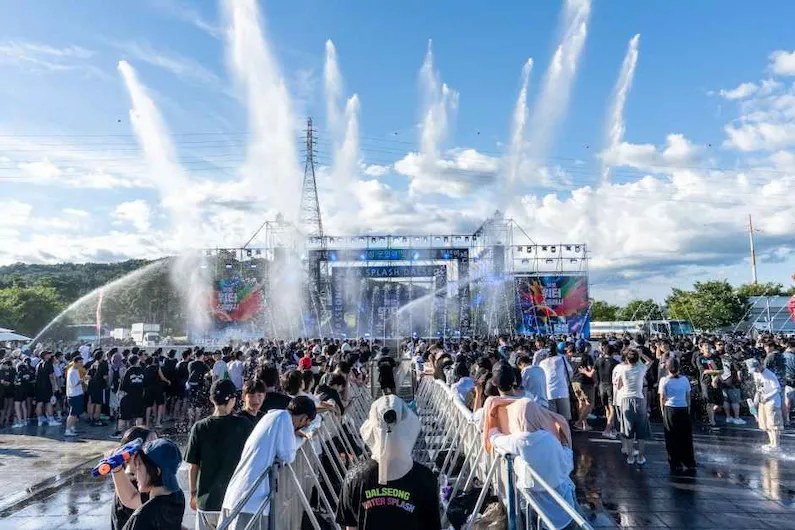
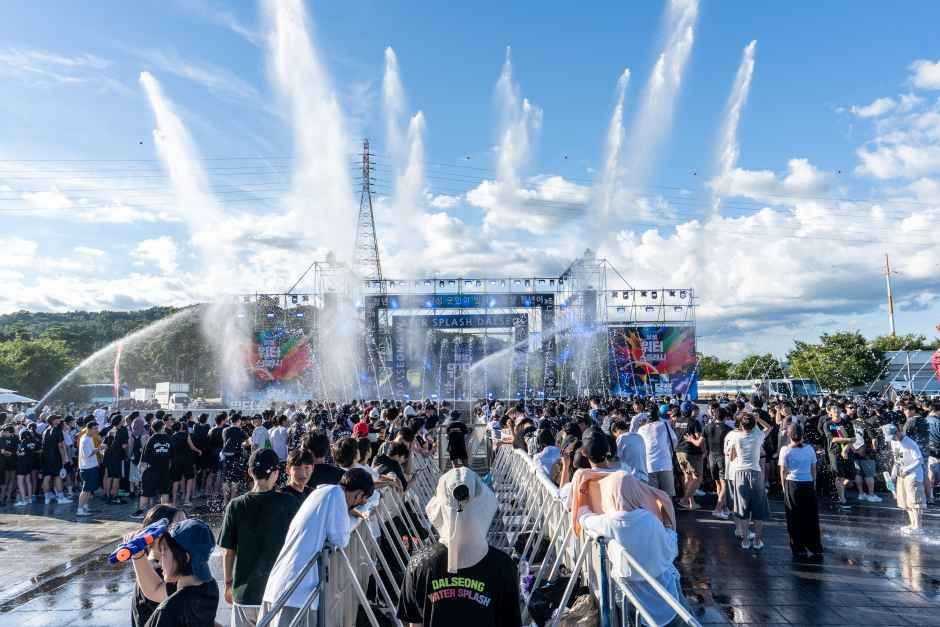
The Dalseong Water Splash Youth Festival returns on July 18, 2026, for its second iteration following a successful 2025 debut that established it as the first government-initiated water festival in the Daegu metropolitan area. While municipal festivals often prioritize broad demographic appeal, this event targets youth participation specificallyβ€”not merely as attendees but as economic stakeholders and cultural producers.

What distinguishes this festival from conventional summer music events is its structural integration of commerce and performance. Rather than outsourcing vendor operations to established chains, the festival reserves its Youth Market and food truck allocations exclusively for local young entrepreneurs and small business owners. These vendors sell handmade props, accessories, clothing, and aromatherapy products alongside coffee and snacksβ€”categories selected to highlight craft-based and culinary startups rather than standardized festival fare.

The performance programming balances commercial appeal with regional representation. Headliners Chungha, Haon, Zion.T, Nucksal, and DJ Subinβ€”spanning genres from K-pop and R&B to hip-hop and electronic musicβ€”perform alongside local youth teams. This dual-tier approach provides professional production values while maintaining visibility for emerging regional talent, a combination rarely available in free municipal events.

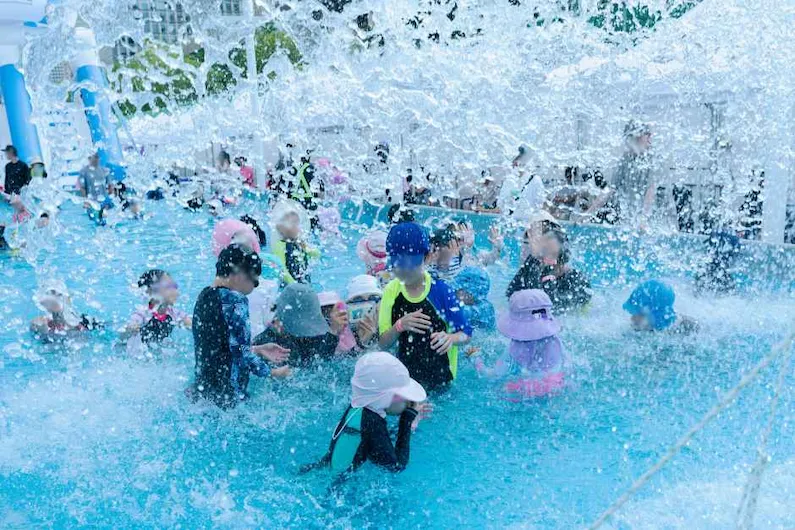
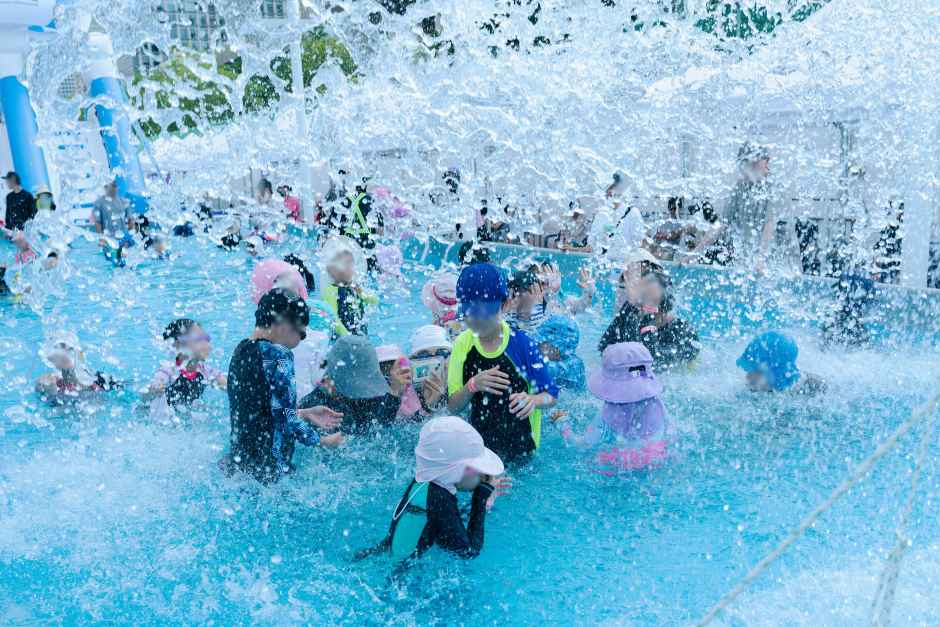
Practical design choices differentiate the experience from typical open-air concerts. The signature Water Splash Time operates simultaneously with DJ sets and live performances, allowing attendees to cool off within the main festival grounds rather than retreating to distant water stations. This integration addresses the physical reality of July heat in Daeguβ€”where temperatures regularly exceed 30Β°Cβ€”without disrupting engagement with the stage.

Side programs extend beyond passive consumption. Youth Experience Programs include face painting and temporary tattoo stations (specific activities subject to final confirmation), alongside informational booths for the Dalseong Youth Innovation Center. These elements provide interactive alternatives during set changes or for attendees seeking respite from the central crowd.

The festival’s operational model reflects a specific municipal strategy: establishing Dalseong-gun as a youth-cultural destination while providing infrastructure for the area’s entrepreneurial ecosystem. For attendees, this translates to free admissionβ€”a rarity for events featuring nationally recognized musical actsβ€”supported by government funding rather than commercial ticket sales.

πŸ—“οΈ 2026.07.18 ~ 2026.07.18

πŸ“ Address: 57 Gangjeongbon-gil, Dasa-eup, Dalseong-gun, Daegu

πŸ›οΈ Accommodation near the event

πŸ’° Fee: Free

πŸ“ž Inquiry: 053-668-4267

⭐️ Instagram: https://www.instagram.com/dalseong_culture/

πŸ–₯️ Website: https://www.dsart.or.kr/

Youth Festival Dalseong Water Splash

What is Dalseong?

Dalseong, formally Dalseong-gun, occupies the southern periphery of Daegu Metropolitan City. It stretches across the flat alluvial plain of the Nakdong River, a landscape defined by rice paddies, vegetable fields, and the wide, slow-moving waterway that forms its western boundary. While central Daegu compresses itself into vertical towers and narrow streets, Dalseong spreads horizontally. The district contains the city’s largest continuous tracts of undeveloped land, making it an inevitable choice when the city needs to accommodate crowds, stages, or temporary infrastructure that would overwhelm the urban core.

For centuries, this area supplied produce to Daegu’s markets. The soil here grows watermelons, peppers, and tomatoes in rotation with rice, and the agricultural patterns remain visible even as the city has expanded around them.

This practical geography has determined its modern function. When Daegu hosts summer music festivals, youth markets, or water-based recreation events, they usually happen here. The flat terrain allows for the installation of temporary stages and vendor stalls without extensive preparation, while the riverbank provides natural access for swimming, boating, or beach events that would be impossible downtown. Dalseong does not function as a tourist destination in the traditional sense; it serves as the city’s overflow space, the place where large gatherings can occur without disrupting the normal rhythm of urban life. It offers roomβ€”the simple, physical luxury of distance and sky that the crowded center cannot provide.

Andong International Mask Dance Festival 2026: Complete Guide to Korea’s Ancient Mask Dance Heritage, Event Dates, and What to See

Andong International Mask Dance Festival

Overview

The Andong International Mask Dance Festival is an annual celebration of traditional Korean mask dance held every October in Andong-si, Gyeongsangbuk-do. The festival takes its artistic and spiritual foundation from the Byeolsingut ritual of Hahoe Village, a tradition spanning more than eight centuries. What began in 1997 as a ten-day event has evolved into one of Korea’s most significant showcases of intangible cultural heritage.

The festival’s core distinction lies in its direct connection to living history. Unlike festival experiences that recreate traditions superficially, this event sublimates the authentic Byeolsingut ceremony of Hahoe Villageβ€”a ritual performed by villagers for generations to drive away evil spirits and ensure communal prosperity. The mask dances performed here are not reconstructions but continuations of lineages passed down through families, with performers often representing the third or fourth generation of their craft.

Historical Significance and Recognition

The festival emerged from a deliberate cultural initiative: inspiring pride through the transmission and reproduction of traditional Korean culture. This mission has earned it substantial institutional recognition. It stands as one of Gyeongsangbuk-do’s five major festivals, sharing this designation with events celebrating Korea’s liquor, rice cakes and feasts, the Yeongju Punggi Ginseng Festival, the Bonghwa Pine Mushroom Festival, and the Cheongdo Bullfighting Festival.

The Ministry of Culture and Tourism acknowledged its quality early, ranking it 2nd among national second-half festivals in its 1999 evaluation and including it in the top 10 festivals of 1998. The selection as a special event for Visit Korea Year 2001 further cemented its status as a representative festival of both Andong-si and the broader Gyeongsangbuk-do regionβ€”a landmark that defines the city’s cultural identity.

Scale and Impact

Attendance figures demonstrate the festival’s draw. The 2019 edition attracted 1.02 million visitors source, substantial numbers for a festival rooted in classical performance traditions rather than mainstream entertainment. This figure suggests the event succeeds in making centuries-old ritual dance accessible to contemporary audiences without sacrificing authenticity.

What Distinguishes This Festival

Four characteristics separate this from other cultural festivals:

Continuity with village ritual: Most mask festivals present theatrical entertainment. Andong’s event preserves the ritual function of Byeolsingutβ€”the communal spiritual cleansing that originally motivated these performances.

International scope: The “International” designation reflects genuine exchange. Practitioners of mask traditions from other cultures participate, creating dialogue between Korean talchum and comparable forms worldwide.

Regional specificity: The festival cannot be relocated or replicated. Its meaning depends on Hahoe Village’s UNESCO World Heritage status and the particular mask designs created there during the Goryeo dynasty.

Duration and depth: Ten days allows for programming that moves beyond headline performances to include workshops, academic seminars, and opportunities for visitors to learn basic movements from master practitioners.

Practical Information

  • When: 10 days in October (annual)
  • Where: Andong-si, Gyeongsangbuk-do, with events centered on Hahoe Village and surrounding venues
  • Founded: 1997
  • Attendance: 1.02 million (2019 edition)

For visitors, the festival offers something increasingly rare: direct engagement with a performance tradition that has persisted since before standardized written records of Korean history. The masks themselvesβ€”carved from alder wood and painted with mineral pigments according to methods unchanged for centuriesβ€”remain in the possession of village families, brought out for ritual and festival alike.

[[Category:Andong-si]][[Category:Festivals of Gyeongsangbuk-do]][[Category:Traditional Korean Culture]][[Category:Namuwiki Daegyeong Region Project]]

What is Andong’s mask dance heritage?

Andong’s mask dance tradition centers on talchum, a theatrical form in which performers wear wooden masks to act out satirical dramas. Under the rigid social hierarchy of the Joseon era, these performances gave commoners a rare public voiceβ€”masked anonymity allowed criticism of the ruling class that would otherwise have been dangerous.

The Hahoe Byeolsingut Talnori anchors this heritage. The village of Hahoe has performed this ritual since the Goryeo dynasty in the 12th century, honoring local spirits and praying for communal prosperity. Where other Korean mask dance traditions eventually developed professional troupes, Andong’s remained bound to village lifeβ€”performed by Hahoe residents themselves as a dongje, a collective rite of obligation rather than entertainment. The masks reflect this purpose: carved from alder wood with exaggerated, asymmetrical features that catch light differently as performers move, so a single mask can suggest sorrow from one angle and mockery from another.

Andong’s significance also stems from its position within a larger regional network. The surrounding area nurtured distinct yeonhui traditionsβ€”Bongsan, Gangnyeong, Suyeongβ€”while the Nakdong River brought traders and traveling performers through the city. These encounters created a more varied mask dance culture than existed in isolated regions. When Japanese colonial authorities suppressed Korean folk performance in the early 20th century, and when rapid modernization threatened to erase it afterward, Andong’s geographic isolation and the Hahoe clan’s record-keeping preserved an unusually complete transmission.

Today the tradition persists in annual byeolsingut performances that follow documented ancestral protocols. Scholars attend to study movement sequences; tourists come to witness what is often described as Korea’s oldest surviving theater. The performances have also shifted in practical waysβ€”electrical lighting now replaces torchlight, and some younger performers learned the dances in university arts programs rather than from village elders. These changes raise questions that the community continues to negotiate: at what point does adaptation become departure, and who decides? What remains clear is that Andong offers one of the few places where mask dance operates simultaneously as historical documentation, religious practice, and living art.

Experience the Magic: Gongju Princess Festival 2025 (May 3rd – December 6th)

Experience the Magic: Gongju Princess Festival 2025 (May 3rd - December 6th)

Gongju Festival

πŸ—“οΈ Festival Period: 2025.05.03 ~ 2025.12.06

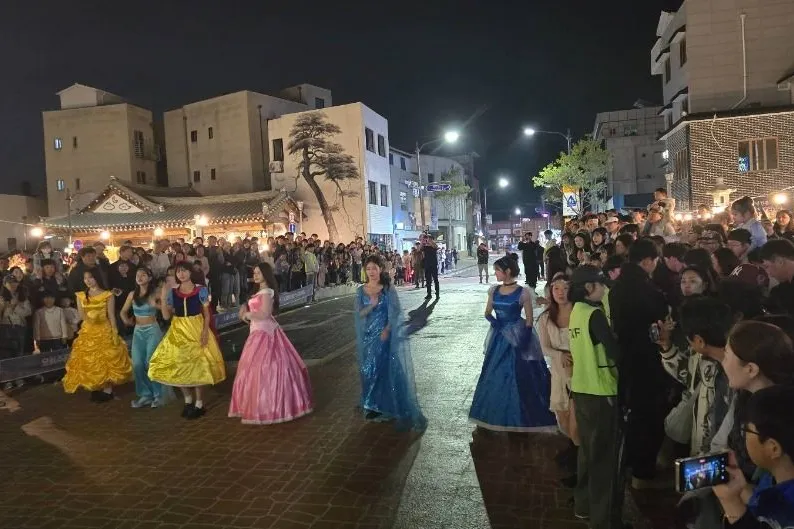
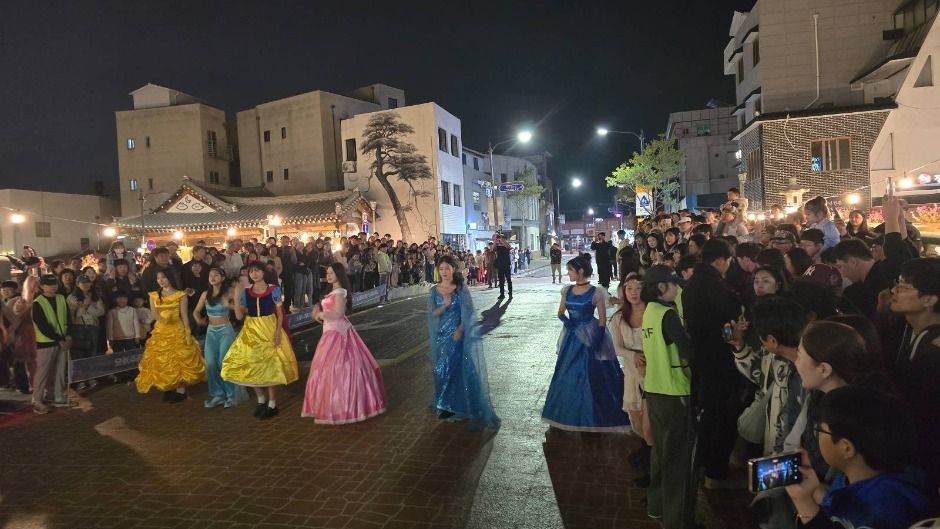
The Gongju Festival presents a unique nighttime tourism experience centered around an enchanting "Princess" concept, hosted in the historic city of Gongju. This recurring event transforms the Jeminchon Gamyeonggil area into a vibrant nocturnal spectacle on specific dates throughout the year. Attendees can anticipate a series of engaging activities, including a distinctive nighttime parade embodying the Princess theme, a bustling nighttime flea market offering various goods, and specially curated events designed for participants embracing the "Princess" identity. A key feature of the festival is its seasonal evolution; the themes of spring, summer, autumn, and winter will each bring a different atmosphere and aesthetic to the Jeminchon Gamyeonggil area, ensuring a fresh experience with each iteration.

Schedule

The festival takes place on the following specific dates within the overall period:

  • May 3, 2025
  • July 5, 2025
  • October 4, 2025
  • December 6, 2025

Program Highlights

The festival offers a structured program designed to immerse visitors in its unique concept:

  1. Main Program: The centerpiece of the event is the Nighttime Parade, meticulously organized around the central Princess concept.
  2. Side Programs: Complementing the parade are additional attractions, including a lively Flea Market operating during the event hours and various Events further developing the Princess theme.
  3. Consumer Participation Program: Visitors are encouraged to actively engage through offerings like the Princess Maker Package and participation in Various Events designed for direct involvement.

πŸ“ Location

Address: 75 Bonghwang-ro, Gongju-si, Chungcheongnam-do (Banjuk-dong)

πŸ›οΈ Accommodation near the event

πŸ’° Fee

Admission to the festival grounds and viewing the main events is free of charge.

πŸ“ž Inquiries

For further information, please contact the organizers directly at 041-852-8066.

πŸ–₯️ Official Information

Visit the official event website for the latest updates and details: Homepage

Gongju Festival

What is Gongju’s Royal History?

Gongju, once the capital of the Baekje Kingdom from 475 to 538 AD, played a significant role in Korea’s early history. During this time, Baekje was one of the Three Kingdoms of Korea, noted for its cultural and artistic contributions. Gongju was a center of political influence and cultural development, contributing to advancements in architecture, religion, and the arts.

A key site reflecting Gongju’s royal history is the Tomb of King Muryeong, a UNESCO World Heritage Site. Discovered in 1971, the tomb contained numerous artifacts, including gold crowns and jewelry, showcasing the craftsmanship of the Baekje period and its interactions with neighboring cultures.

Gongju’s historical significance is further highlighted by sites like the Gongsanseong Fortress and the Baekje Cultural Land, which continue to draw visitors interested in Korea’s ancient heritage. The Gongju Princess Festival also celebrates this history, offering a chance to explore the traditions and stories of Baekje royalty.

Analytics