Re: Battle City
This exhibition is part of Taipower’s Kaohsiung Third Phase Public Art Installation Project, a long-running initiative that brings contemporary art into the public sphere across the city’s industrial and urban landscapes. It marks a significant moment for artist Chang Li-jen, whose “Battle City” series returns to the spotlight in a new and expanded form.
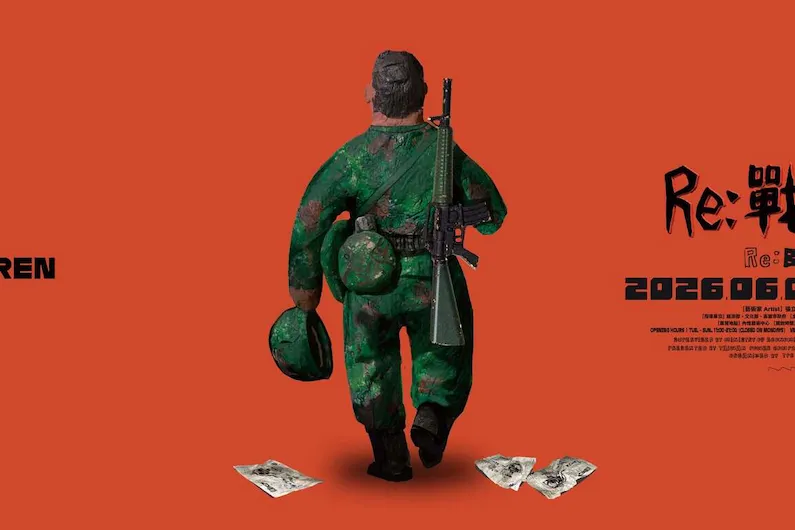
“Re” carries the meaning of restarting and returning once again. In this exhibition, it symbolizes the trajectory of artist Chang Li-jen’s complete exhibition of the “Battle City” series at the Taipei Education University Art Museum in 2024, and how, after the works were collected by Taiwan Power Company, he looked back at his own creations based on existing accumulations to further adjust, supplement, and advance them. Through animated videos, comics, storyboard manuscripts, scene models, characters, and filming props, this exhibition focuses on the “worldview” constructed by the artist in “Battle City,” forming a multiple contrast with the real world between retrospection and renewal.
For Chang Li-jen, “Battle City,” which took fourteen years to complete, was a process of exploring the “essence of art.” Initially, he wondered: what exactly is art? Could it avoid being defined too quickly? Were there other imaginative possibilities? Simultaneously, he explored how an artist creates paths for thinking and perceiving the world, and how to confirm the meaning of one’s environment and era to oneself. These are not abstract concerns; they shape the very structure and content of the series, which builds an intricate fictional universe while remaining in constant dialogue with the artist’s own cultural surroundings.
The model animations of Parts 1 and 2 and the comic of Part 3 of “Battle City” are “by-products” generated during the artist’s process of exploring these paths and possibilities, resembling a kind of creative residue. Other components of the series, such as scene models, characters, and storyboards, are like nested Russian dolls, produced solely for the purpose of making the animations. This means that what the public previously perceived as final works—including animations and comics—as well as the scenes and props from the production process, are, for the artist, “results that were not the primary objective.” The exhibition invite visitors to reconsider their assumptions about what constitutes a completed artwork, and to appreciate the layered process behind the finished images.
Even the artist himself could be described as a by-product of a specific culture. Chang Li-jen does not seek a creative home within mainstream art history or discourse. Instead, viewers can discover many shadows of subcultures in “Battle City”: whether it is the tokusatsu filming techniques inspired by the “Doraemon” comics, or the strange tales regarding the end of the world and aliens in “World Mysteries.” The peculiar imaginations of the world presented in childhood readings deeply fascinated the artist. These childhood reading experiences remained in his memory and consciousness, and years later during creation, they were reorganized and transformed into part of the works.
The meaning of the exhibition title “Re” is embodied in the first-time presentation of “Battle City” Part 1 〈Light of Taiwan (Second Playthrough)〉. In the world of gaming, a “second playthrough” represents the process where a player, after completing the game for the first time, starts the game again carrying accumulated experience points, equipment, and other gains. For the artist, this re-creation is like stepping into a time machine, deliberately overlapping the present with the past to respond to and compensate for his past self who was limited by the conditions of that time.
From filming and editing animated images from years ago—where the process of exploring production techniques was not yet perfected—to supplementing story fragments deleted due to real-world factors, the artist seems to have restarted the life-gears of creation, rolling “Battle City” toward the next narrative cycle, and continuing to carve out brand new paths within the déjà vu of reincarnation. The result is an exhibition that rewards both newcomers encountering the series for the first time and those who followed its earlier iterations, offering a rare look at how an artist revisits, reworks, and ultimately reimagines his own deep-rooted creative world.

Who is Chang Li-jen?
Chang Li-jen is a Taiwanese contemporary artist working with digital media, architecture, and memory. Born in Tainan in 1982 and now based in Taipei, Chang studied sculpture before turning to new media. His work uses 3D animation, video-game aesthetics, and virtual environments to reconstruct real places from remembered or imagined experience.
Much of his art is about how people inhabit and remember space. He treats digital environments not as simulations but as places where memory can be examined and changed. His video installations are often narrative-driven, leading viewers through altered urban landscapes in which familiar buildings and streets follow the logic of memory rather than geography.
Chang has shown his work throughout Taiwan and internationally. His pieces combine autobiographical details with broader social history, and their tone is more reflective than sensational. In Re: Battle City, an immersive exhibition in Kaohsiung, he applied this approach to the city itself. The exhibition used his characteristic 3D and game-like imagery to present Kaohsiung as both a real place and a constructed one, shaped by personal association and collective experience. The result was less a depiction of the city than a version of it built from multiple perspectives.
The value of Chang’s work lies in its insistence that digital media can carry emotional and historical weight. His environments ask to be explored rather than simply viewed, and they reward attention with a clearer sense of how memory and invention overlap.
