Abeno Harukas Art Museum “Andrew Wyeth Exhibition”

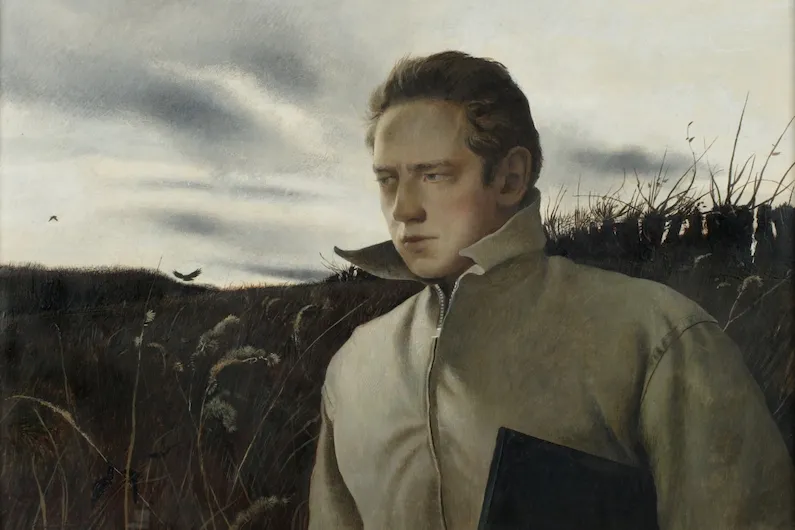
Andrew Wyeth (1917–2009) is one of the most widely admired American painters of the twentieth century, an artist who “depicts America,” and his work has long found a devoted following in Japan. This autumn, a long-awaited retrospective — the first in Japan in 17 years and the first since the artist’s passing — will be held at the Abeno Harukas Art Museum.

Wyeth built his career in deliberate contrast to the prevailing currents of post-war American art. Rather than follow the avant-garde trends of the era, he devoted himself to the people and landscapes he knew intimately: the two regions he had traveled between since childhood — his home state of Pennsylvania and Maine, where his summer home was located. Working in a quiet, realist style, Wyeth combined what he discovered and felt in those places with a deep spirituality cultivated through his own life experiences, creating paintings that move people across regions and nations.

The exhibition brings together approximately 100 of Wyeth’s paintings, including 15 works being exhibited in Japan for the first time. The extensive lineup includes numerous masterpieces loaned from various parts of the United States, as well as works from some of Japan’s leading private collections. The exhibition also focuses on motifs that Wyeth frequently depicted, such as windows and doors. By drawing attention to these recurring subjects, the show highlights the “boundaries” that run through Wyeth’s art — light and shadow, life and death, self and others — and conveys a quiet message of hope in an era of increasing division.
Exhibition Details
Period: 2026/10/3 (Sat) – 12/6 (Sun)
*Some exhibits will be rotated during the exhibition period. Please check the official museum website for details.
Closed: 10/5 (Mon)
Hours: Tue–Fri 10:00–20:00, Mon/Sat/Sun and Holidays 10:00–18:00
*Admission until 30 minutes before closing.
Location: Abeno Harukas Art Museum (Abeno Harukas 16F, 1-1-43 Abenosuji, Abeno-ku, Osaka City)
Fees:
| Category | General | Advance tickets / Groups (15+) |
|---|---|---|
| Adults | 2,200 yen | 2,000 yen |
| College / High School students | 1,800 yen | 1,600 yen |
| Elementary / Junior High students | 500 yen | 300 yen |
*Advance tickets are on sale until 10/2 (Fri).
Inquiries: 06-4399-9050 (Abeno Harukas Art Museum)
Website: https://www.ktv.jp/event/wyeth/
Andrew Wyeth
Andrew Wyeth (1917–2009) was an American painter from Chadds Ford, Pennsylvania. He was the youngest child of N.C. Wyeth, the illustrator, and received his early art training at home from his father. He did not enroll in an academy or spend time in the European centers of modernism. His subject matter came almost entirely from two regions: the countryside near his Pennsylvania home and the coastal area around Cushing, Maine, where his family spent summers.
Wyeth worked mainly in egg tempera and drybrush watercolor. Egg tempera dries quickly and requires layered brushwork, which allowed him to control fine detail. Drybrush watercolor produces a textured, chalky surface by applying pigment with a relatively dry brush. These techniques suited his interest in weathered buildings, empty fields, and figures shown in ordinary indoor or outdoor settings. He did not follow the major modernist movements of his lifetime. He preferred to work from direct observation, usually of people he knew and places he returned to over many years.
Christina’s World (1948) is his best-known painting. It shows a woman reclining in a field, with her head raised and her body angled toward a frame house and barn in the middle distance. The model was Christina Olson, a neighbor in Cushing who had a progressive neurological condition and limited use of her legs. Wyeth later described her as refusing a wheelchair and moving by dragging herself across the ground. The painting combines a close view of the figure with a broad view of the landscape. It was acquired by the Museum of Modern Art in 1948 and has since become one of the most widely reproduced American images, though its exact meaning remains a subject of interpretation.
In 1986, Wyeth revealed a collection of more than 240 drawings, watercolors, and tempera paintings made over roughly fifteen years depicting Helga Testorf, a German-born neighbor in Chadds Ford. The works had been produced and stored without public notice. They show Testorf indoors, often sitting, reading, or sleeping, and sometimes posed against walls or in rooms in the nearby Kuerner farmhouse. The announcement attracted intense press coverage, partly because the existence of the series had been kept private. The collection was exhibited in 1987 at the National Gallery of Art in Washington, D.C. The public attention focused as much on the circumstances of the series’ discovery as on the work itself.
Wyeth received the Presidential Medal of Freedom in 1963 and the National Medal of Arts in 2007. His paintings are held in the collections of major American museums, including the Metropolitan Museum of Art, the National Gallery of Art, and the Museum of Modern Art. Critical opinion during his lifetime was divided. Some reviewers saw his style as sentimental or too closely tied to illustration; others identified his strength as the patient rendering of specific places and the restraint with which he treated human figures. Wyeth consistently described his own project in narrow terms: he painted his life, which was rooted in the Brandywine Valley and midcoast Maine and in the people he saw year after year. That emphasis on the local is the clearest way to understand both the range and the limits of his work.
