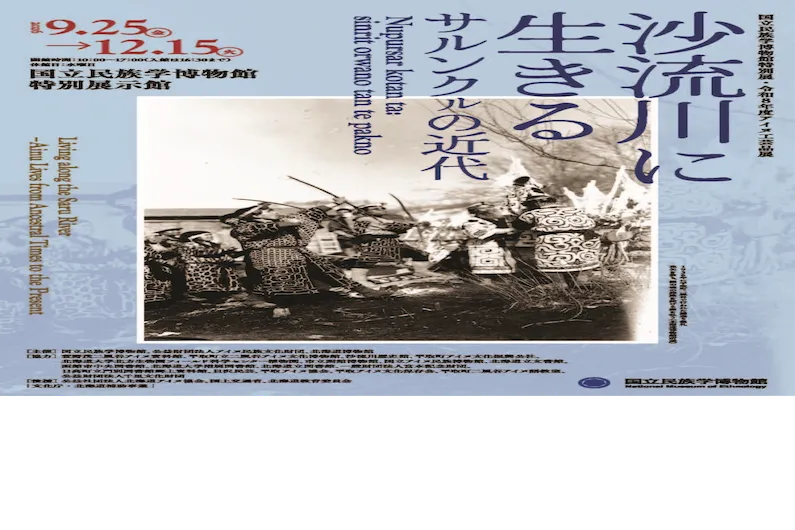
National Museum of Ethnology Special Exhibition: Reiwa 8 Ainu Crafts Exhibition — Living along the Saru River: The Modern Era of the Sarunkur — In the Village of Nupursar, from Life to This Day

The Saru River rises in the Hidaka Mountains and flows into the Pacific Ocean. Along its basin, Ainu people have lived for generations, forming a history that reaches back to ancient times. The Reiwa 8 (FY2026) special exhibition at the National Museum of Ethnology (Minpaku) is built around craft objects collected from that basin, focusing on pieces whose makers and users are known. These objects are presented alongside photographs, documents, and the words of descendants. Together, they illuminate the lives of people who lived through the rapid changes of the modern era and trace the connection to Ainu communities living today.
What makes this exhibition distinctive is its attention to named individuals rather than anonymous artifacts. Visitors can follow the work of two important figures from the Saru River basin, Kunimatsu Nitani and Shigeru Kayano, and see how their knowledge was recorded, rebuilt, and passed on.
■ Kunimatsu Nitani (1888-1960), who spoke, wrote, and left behind records of his own culture
Kunimatsu Nitani was known as a transmitter of Ainu culture and is said to have possessed the most extensive knowledge regarding faith in the Saru River basin. The exhibition displays items he made and used, along with photographs and manuscripts of Nitani. In 1950, he constructed an Ainu house as an outdoor exhibit at the Museum of Ethnology affiliated with the Japanese Society of Ethnology in Tokyo; the rituals performed at that time are reproduced in the exhibition, giving visitors a view of a documented ceremonial moment in the modern era.

■ Shigeru Kayano (1926-2006) and Minpaku
Shigeru Kayano is widely known as the first Ainu member of the National Diet, as a writer, and as a leading voice in the movement to revive the Ainu language. This exhibition also introduces his significant contributions to the restoration and transmission of folk tools, which are sometimes less familiar to the public.
In 1979, when the “Ainu Culture” exhibition area opened at Minpaku, the traditional house (cise) was built by people from Nibutani, Biratori Town, with Kayano at the center. In 1993, during the International Year of the World’s Indigenous People, Minpaku held the special exhibition “Ainu Mosir — The World of the Ainu as Seen through Ethnic Patterns,” and Kayano contributed a message in the Ainu language. These moments are placed alongside his broader efforts to keep Ainu material culture alive.

■ Regarding the Ainu language in the title
The people living in the Saru River basin are called “Sarunkur” in the Ainu language. The reading and meaning of the Ainu title are as follows:
Reading: Nupursar kotan ta: sinrit orwano tan te pakno
Meaning: In the settlements of the spiritual/sacred Saru River basin: from the era of the ancestors to the present
The title reflects the exhibition’s focus on continuity, from the lives of ancestors to the people living in the Saru River basin today.

Exhibition details
| Period | Friday, September 25, 2026 – Tuesday, December 15, 2026 |
| Closed | Every Wednesday (if Wednesday is a public holiday, the immediately following weekday) |
| Hours | 10:00–17:00 (Admission until 16:30) |
| Venue | National Museum of Ethnology, Special Exhibition Hall, 10-1 Senri Banpaku Koen, Suita City |
| Admission | General: 1,200 yen (810 yen)<br>University students: 600 yen (340 yen)<br>High school students and below: free |
| Included | Main building exhibitions can also be viewed |
| Contact | 06-6876-2151 (Main) |
| Website | https://www.minpaku.ac.jp/ |
The rates in parentheses are discounted rates for groups of 20 or more, those using the museum for university classes, repeat visitors within 3 months, and persons aged 65 and over (for general admission). Certification is required. Persons holding a disability certificate may view the exhibition for free, along with one accompanying person.
Who are the Ainu?
The Ainu are an indigenous people of northern Japan, primarily Hokkaidō, and they also have historical connections to Sakhalin and the Kuril Islands. The word Ainu means “person” in the Ainu language, which is not related to Japanese and has its own oral literature. For centuries, Ainu communities supported themselves by hunting, fishing, gathering, and trading with neighbouring peoples. Central to their worldview was the idea that kamuy, or spirits or deities, could appear in animals, plants, rivers, and mountains. Rituals, tool patterns, and clothing designs all grew out of these beliefs.
One regional group is the Sarunkur, meaning “people of the Saru River basin” in southern Hokkaidō. The Saru River was rich in salmon, and the nearby forests contained deer, bear, and plant materials, so the region could support a settled seasonal pattern of life. People moved between coastal and inland sites as food sources became available. Because Ainu history was not written down, it was passed on differently: through sung narratives, embroidered motifs, carving, ceremony, and repeated practice. Elders taught children how to hunt, fish, prepare food, and make clothing by working alongside them. In this way, practical skills and cultural knowledge remained inseparable.
From the Meiji period onward, the Japanese government began to absorb Hokkaidō into the national administrative structure. Ainu land was taken, traditional hunting and fishing were restricted, and Ainu children were required to attend Japanese-language schools. The use of the Ainu language was discouraged, and many customs were treated as outdated. By the mid-twentieth century, most Ainu families had lost direct access to the subsistence grounds their ancestors had used. Academic research often described Ainu culture as a remnant, useful for museum collections but irrelevant to modern life.
Since the late twentieth century, this situation has shifted. Ainu organisations have worked to revive the language, restore craft traditions, and seek formal recognition as an indigenous people. The Japanese government acknowledged the Ainu as an indigenous people in 2008, and a 2019 law replaced older assimilation-era acts with measures aimed at supporting Ainu culture and regional economies. Ainu language classes, craft workshops, and oral-history projects now exist in several parts of Hokkaidō. Museums have also changed their approach. The National Museum of Ethnology in Osaka has collaborated with Ainu communities rather than treating them only as sources of artefacts. The Reiwa 8 Ainu Crafts Exhibition is part of this longer effort: it presents objects as the work of contemporary makers and inheritors of specific traditions. The carved itokpa motifs on tools and the woven attus robes are shown as techniques that continue to be taught and practised.
The question “Who are the Ainu?” is therefore not an inquiry into a vanished people. It is a question about how a nation addresses indigenous rights, language survival, and cultural policy. The Sarunkur and other Ainu groups remain engaged with these issues, and their answers are visible in both their current activities and the historical evidence preserved in museums and archives.
