Rie Ito “Drift & Nest” Solo Exhibition in Osaka 2026: Experience the Intersection of Architecture and Woodcraft at e/n gallery

Rie Ito "Drift & Nest" Solo Exhibition in Osaka 2026: Experience the Intersection of Architecture and Woodcraft at e/n gallery

Woodworker Rie Ito’s First Solo Exhibition “Drift & Nest”

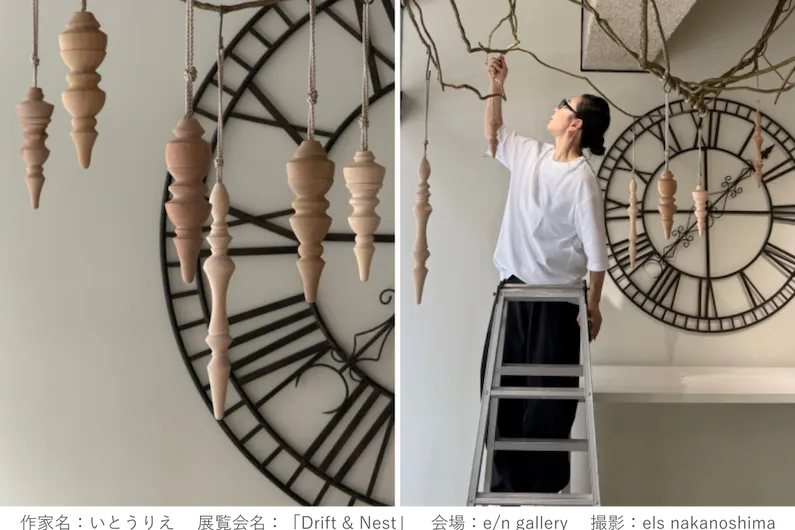
Rie Ito, a first-class registered architect and woodworker based in Nara Prefecture, will present her first solo exhibition, “Drift & Nest,” at e/n gallery in Osaka. The exhibition will feature a wide variety of aesthetically beautiful functional vessels made from various tree species, retaining the texture of the wood and unique shapes—including ornaments, long plates, high-stemmed cups, decorative plates, and flower vases.

The title of the exhibition points to two distinct groups of work. The hanging sculptures 《Drift》 are created by shaping fragrant woods such as Japanese cypress and camphor into spindle shapes using a lathe. The functional vessels 《nest》, on the other hand, are palm-sized and remain beautiful even when stacked. Moving between the boundaries of craft and sculpture, and between using and viewing, this is a profound exhibition that contemplates the time it takes for wood to reach our daily lives.

The venue is e/n gallery, located on the first floor of the Riverside Building, a registered tangible cultural property in Nakanoshima, Osaka—a setting that adds a quiet layer of history to the show’s meditation on materials and time.

Exhibition details

  • Exhibition period: 2026/10/7 (Wed) – 10/17 (Sat)
  • Closed: 10/12 (Mon/Holiday)
  • Hours: 11:00 – 19:00 (until 17:00 on Saturdays and Sundays)
  • Location: e/n gallery (Riverside Building 1F, 3-1-8 Nakanoshima, Kita-ku, Osaka City)
  • Admission: Free
  • Inquiries: [email protected]
  • Website: en-gallery.com/exhibition

🛏️ See hotels near the event

Rie Ito is a Japanese woodcraft artist whose work combines concerns of sculpture, architecture, and traditional woodworking. Based in Japan, she carves, bends, and assembles local hardwoods into forms that are both structural and organic: vessels with the asymmetry of drifting boats, and lattice-like enclosures that resemble birds’ nests. Her process is guided by the material itself. Grain direction, weight, and natural irregularities all influence the final shape, and the pieces tend to look as if they were discovered rather than imposed.

Ito’s central interest is spatial. Her objects are small, but they define interiors and exteriors with architectural clarity. A hollow vessel suggests shelter; an open lattice suggests a boundary; the spaces between slats become as important as the wood itself. This makes her work useful to think about alongside architecture, though it remains firmly within craft.

In Drift & Nest, Ito sets two conditions against each other. The drift pieces are elongated and off-balance, as if caught in motion. The nest pieces are compact, dense, and protective. The pairing does not treat “home” as a fixed idea; instead, it treats shelter as something that can be carried, rebuilt, or abandoned. Wood functions here as a material with its own behavior. It bends, expands, contracts, and retains traces of the tree it came from. Ito’s versions of that behavior are precise but not rigid—objects that hold their shape while still appearing sensitive to the forces around them.

Visit “THE GATE” at Nagoya Station 2026: Plan Your Perfect Trip and Discover the Culture of Aichi and Central Japan

Visit "THE GATE" at Nagoya Station 2026: Plan Your Perfect Trip and Discover the Culture of Aichi and Central Japan

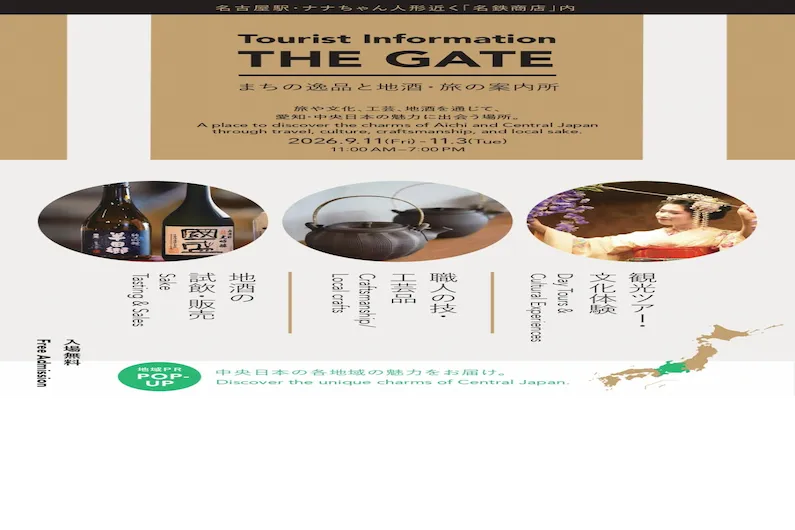
Tourist Information “THE GATE”

A place to encounter the charms of Aichi and Central Japan through travel, culture, crafts, and local sake.

For a limited time, Nagoya Station will host “THE GATE,” a tourist information center focused on the traditional culture, crafts, and regional sake of Aichi and Central Japan. From September 11 to November 3, 2026, the venue at the Meitetsu Department Store Special Space will offer expert guidance, consultations, and tour reservations for anyone planning to explore the area.

🛏️ View hotels near the event

A starting point for Aichi and Central Japan

THE GATE is more than a place to pick up brochures. It combines travel information with the region’s cultural traditions, putting local crafts and sake alongside the practical advice travelers need. That combination makes the venue useful for two kinds of visitors: travelers who want a tailored introduction to the region, and locals who want to rediscover what their own area has to offer.

Expert guides are on hand to answer questions and help shape itineraries. Consultations can be handled in person, and tour reservations can be made directly at the venue, which saves time compared to contacting multiple operators separately. Whether you have a specific route in mind or are still deciding what to see, the guidance available here is designed to make the next step clear.

Practical information

Item Details
Dates September 11, 2026 (Fri) – November 3, 2026 (Tue/Holiday)
Closed None
Hours 11:00–19:00
Location Meitetsu Department Store Special Space, 1F Meitetsu Bus Terminal Building, 1-2-4 Meieki, Nakamura-ku, Nagoya-shi, Aichi 450-0002
Contact Aichi Tourism Association – TEL: 052-581-5788
Website URL Tourist Information “THE GATE”
Access Approx. 2 minutes walk from Meitetsu Nagoya Station and Kintetsu Nagoya Station<br>Approx. 5 minutes walk from JR Nagoya Station

The venue is located on the first floor of the Meitetsu Bus Terminal Building, so it is an easy stop for anyone coming through Nagoya’s main train stations. With no closed days during the event period, it is open every day from 11:00 to 19:00. The event runs until November 3, 2026—a Tuesday and national holiday—making that day a fitting final chance to encounter the charms of Aichi and Central Japan.

THE GATE is a travel information and cultural exhibition space located at Nagoya Station. It opened in time for the 2026 travel season and provides practical services for visitors to Nagoya, Aichi, and the wider Central Japan region, alongside exhibits and activities related to local culture.

The name is intended to emphasize the station’s role as an entry point to the area. Nagoya Station is one of Central Japan’s main transport hubs, with JR lines, Meitetsu, the municipal subway, and long-distance buses converging there. THE GATE is part of the recent redevelopment around the station and combines digital information displays, rotating exhibitions, and hands-on cultural programming in a single space.

Visitors can:

  • Pick up maps and multilingual sightseeing recommendations for Nagoya Castle, Atsuta Shrine, Osu Shopping Street, and other destinations in Chubu.
  • Book regional rail passes, day tours, and cultural workshops, including Seto-yaki pottery-making with local craftspeople and arimatsu shibori tie-dyeing classes.
  • View an interactive exhibition corner that covers Aichi’s traditional crafts, samurai history, festival culture, automotive innovation, aerospace engineering, and next-generation rail systems.
  • Purchase curated local specialties from Aichi and neighboring Gifu, Mie, and Shizuoka, such as miso katsu, tebasaki, red bean desserts, and other regional food and gift items.
  • Attend scheduled events, including tea ceremony demonstrations, taiko drum performances, and seasonal festival showcases that rotate through the year.

The space is designed to be useful for different types of travelers. For those passing through Nagoya for a single day before connecting to another city by Shinkansen, it offers a quick overview of what can be done in a limited time. For visitors planning a longer trip across Central Japan, it provides route guidance, ticket assistance, and access to workshops and tours that would otherwise require more research.

The exhibition contents and event schedule change periodically, so the center also works as a place to return to during a longer stay. It does not replace the experience of visiting the places it covers, but it gives visitors enough context to plan where to go and what to pay attention to.

THE GATE is a practical first stop for travelers looking for clear information about Aichi’s history, industry, and contemporary culture before deciding how to spend their time in the region.

SAKAMOTO DAYS Exhibition 2026 in Nagoya: See Rare Manuscripts and Original Artwork at Telepia Hall

SAKAMOTO DAYS Exhibition 2026 in Nagoya: See Rare Manuscripts and Original Artwork at Telepia Hall

SAKAMOTO DAYS Exhibition

The premise is simple enough: a plump, easygoing man runs an ordinary shop in town. He is also a former legendary hitman. Since its serialization began in 2020, SAKAMOTO DAYS has gained a devoted readership through Yuto Suzuki’s overwhelming artwork, charming characters, and story structures that slide effortlessly between comedy and high-stakes action. The TV anime adaptation drew an even wider audience. Now, a large-scale original work exhibition is touring to Nagoya.

At the heart of the exhibition are Suzuki’s intense, beautifully rendered illustrations. The exhibition fixtures and spatial composition have been designed to be dynamic, encouraging visitors to experience with their whole bodies the nerve-wracking battles of assassins, the vividness hidden within a single blow amid fierce fighting, and the profound story shaped by layers of past karmic ties. That experience is organized around two “lines”: the line of determination that assassins wield with their respective weapons, and the line delivered by Suzuki from the tip of his pen. Destruction and creation stand at the center of the whole event.

For manga devotees, the original materials are the main attraction. The exhibition displays more than 170 completed manuscripts, including color illustrations, alongside over 90 pieces of treasured creative material, all unveiled with the full cooperation of the author. These include unpublished sketches, storyboard drafts known as names, and “rejected drawings” of pages—material that gives a rare look at the working process behind the finished manga.

Exhibition details

  • Dates: October 3 (Sat) – November 23 (Mon/Holiday), 2026
  • Time: 10:00–17:00 (Last admission 16:30)
  • Venue: Telepia Hall
  • Fees:
    • General: 2,000 yen
    • Middle/High School students: 1,500 yen
    • Elementary school students: 900 yen
    • With goods (limited quantity): 4,200 yen
  • Contact: SAKAMOTO DAYS Exhibition Nagoya Secretariat
    • TEL: 090-9712-7096
  • Website: https://telepiahall.com/event/sakamoto-days/
  • Official X (Nagoya Venue): https://x.com/telepiahall

Access:

  • 10-minute walk from “Sakae” Station on the Nagoya City Subway Higashiyama Line
  • 10-minute walk from “Takaoka” Station on the Nagoya City Subway Sakura-dori Line

Ticket notes:

  • For this exhibition, only October 3 (Sat) and October 4 (Sun) from 10:00 to 13:00 require a date-and-time-specified admission ticket. Those tickets are already sold out. For all other dates and times, visitors may enter without specifying a date and time.
  • Ticket purchases at the venue window are cash payment only.
  • The venue window will not sell date-and-time-specified admission tickets or admission tickets with goods.

Planning to go from outside Nagoya? 🛏️ See hotels near the event

What is SAKAMOTO DAYS?

SAKAMOTO DAYS is a Japanese manga series written and illustrated by Yuto Suzuki. It has been serialized in Weekly Shonen Jump since November 2020.

The story centers on Taro Sakamoto, a former hitman whose reputation once made him a target for every ambitious killer in the business. At the height of his career, he falls in love with a woman named Aoi and decides to retire. He trades the job for a convenience store, a wife, and a child, and for a while the new life holds. But the past keeps arriving at his doorstep: old rivals, hired assassins, and a standing bounty eventually force him back into action.

Sakamoto has gained weight since his prime, and he no longer looks like the sharp, dangerous figure he once was. That contrast is part of the series’ humor, but it is not played only for jokes. When his family is threatened, he moves with the same speed and precision he had as a hitman, and the fight scenes treat his abilities as practical skills rather than magical gifts. He is supported by Shin Asakura, a store clerk who can read minds, and a former hitman named Son Hee. The three handle conflicts that come to them, usually because someone from Sakamoto’s past wants a score settled.

The action is inventive without trying to impress the reader through sheer scale. Suzuki’s paneling keeps the choreography legible, and fights are often resolved using the environment or the opponent’s own abilities. The tone alternates between slapstick and violence, but the shifts are controlled. The supporting cast each have distinct motives and fighting styles, which matter more than simple rankings of strength. The series never insists on telling the reader that family is important; it simply shows Sakamoto protecting his, and lets the actions speak for themselves.

An exhibition in Nagoya in 2026 will display Suzuki’s original manuscripts and artwork, offering a closer look at the draftsmanship behind the series.

Andrew Wyeth Exhibition 2026 at Abeno Harukas Art Museum: Experience the Masterpieces of American Realism in Osaka

Andrew Wyeth Exhibition 2026 at Abeno Harukas Art Museum: Experience the Masterpieces of American Realism in Osaka

Abeno Harukas Art Museum “Andrew Wyeth Exhibition”

Self-portrait by Andrew Wyeth

Andrew Wyeth (1917–2009) is one of the most widely admired American painters of the twentieth century, an artist who “depicts America,” and his work has long found a devoted following in Japan. This autumn, a long-awaited retrospective — the first in Japan in 17 years and the first since the artist’s passing — will be held at the Abeno Harukas Art Museum.

Christina Olson

Wyeth built his career in deliberate contrast to the prevailing currents of post-war American art. Rather than follow the avant-garde trends of the era, he devoted himself to the people and landscapes he knew intimately: the two regions he had traveled between since childhood — his home state of Pennsylvania and Maine, where his summer home was located. Working in a quiet, realist style, Wyeth combined what he discovered and felt in those places with a deep spirituality cultivated through his own life experiences, creating paintings that move people across regions and nations.

Lighthouse

The exhibition brings together approximately 100 of Wyeth’s paintings, including 15 works being exhibited in Japan for the first time. The extensive lineup includes numerous masterpieces loaned from various parts of the United States, as well as works from some of Japan’s leading private collections. The exhibition also focuses on motifs that Wyeth frequently depicted, such as windows and doors. By drawing attention to these recurring subjects, the show highlights the “boundaries” that run through Wyeth’s art — light and shadow, life and death, self and others — and conveys a quiet message of hope in an era of increasing division.


Exhibition Details

Period: 2026/10/3 (Sat) – 12/6 (Sun)
*Some exhibits will be rotated during the exhibition period. Please check the official museum website for details.

Closed: 10/5 (Mon)

Hours: Tue–Fri 10:00–20:00, Mon/Sat/Sun and Holidays 10:00–18:00
*Admission until 30 minutes before closing.

Location: Abeno Harukas Art Museum (Abeno Harukas 16F, 1-1-43 Abenosuji, Abeno-ku, Osaka City)

Fees:

Category General Advance tickets / Groups (15+)
Adults 2,200 yen 2,000 yen
College / High School students 1,800 yen 1,600 yen
Elementary / Junior High students 500 yen 300 yen

*Advance tickets are on sale until 10/2 (Fri).

Inquiries: 06-4399-9050 (Abeno Harukas Art Museum)

Website: https://www.ktv.jp/event/wyeth/

🛏️ See hotels near the event

Andrew Wyeth

Andrew Wyeth (1917–2009) was an American painter from Chadds Ford, Pennsylvania. He was the youngest child of N.C. Wyeth, the illustrator, and received his early art training at home from his father. He did not enroll in an academy or spend time in the European centers of modernism. His subject matter came almost entirely from two regions: the countryside near his Pennsylvania home and the coastal area around Cushing, Maine, where his family spent summers.

Wyeth worked mainly in egg tempera and drybrush watercolor. Egg tempera dries quickly and requires layered brushwork, which allowed him to control fine detail. Drybrush watercolor produces a textured, chalky surface by applying pigment with a relatively dry brush. These techniques suited his interest in weathered buildings, empty fields, and figures shown in ordinary indoor or outdoor settings. He did not follow the major modernist movements of his lifetime. He preferred to work from direct observation, usually of people he knew and places he returned to over many years.

Christina’s World (1948) is his best-known painting. It shows a woman reclining in a field, with her head raised and her body angled toward a frame house and barn in the middle distance. The model was Christina Olson, a neighbor in Cushing who had a progressive neurological condition and limited use of her legs. Wyeth later described her as refusing a wheelchair and moving by dragging herself across the ground. The painting combines a close view of the figure with a broad view of the landscape. It was acquired by the Museum of Modern Art in 1948 and has since become one of the most widely reproduced American images, though its exact meaning remains a subject of interpretation.

In 1986, Wyeth revealed a collection of more than 240 drawings, watercolors, and tempera paintings made over roughly fifteen years depicting Helga Testorf, a German-born neighbor in Chadds Ford. The works had been produced and stored without public notice. They show Testorf indoors, often sitting, reading, or sleeping, and sometimes posed against walls or in rooms in the nearby Kuerner farmhouse. The announcement attracted intense press coverage, partly because the existence of the series had been kept private. The collection was exhibited in 1987 at the National Gallery of Art in Washington, D.C. The public attention focused as much on the circumstances of the series’ discovery as on the work itself.

Wyeth received the Presidential Medal of Freedom in 1963 and the National Medal of Arts in 2007. His paintings are held in the collections of major American museums, including the Metropolitan Museum of Art, the National Gallery of Art, and the Museum of Modern Art. Critical opinion during his lifetime was divided. Some reviewers saw his style as sentimental or too closely tied to illustration; others identified his strength as the patient rendering of specific places and the restraint with which he treated human figures. Wyeth consistently described his own project in narrow terms: he painted his life, which was rooted in the Brandywine Valley and midcoast Maine and in the people he saw year after year. That emphasis on the local is the clearest way to understand both the range and the limits of his work.

Visit the Reiwa 8 Ainu Crafts Exhibition at the National Museum of Ethnology: Discover the Living History of the Sarunkur (2026)

Visit the Reiwa 8 Ainu Crafts Exhibition at the National Museum of Ethnology: Discover the Living History of the Sarunkur (2026)

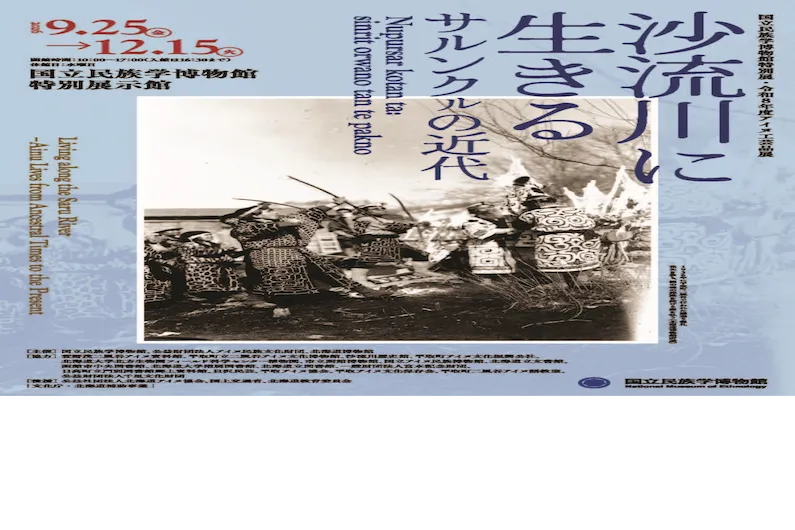
National Museum of Ethnology Special Exhibition: Reiwa 8 Ainu Crafts Exhibition — Living along the Saru River: The Modern Era of the Sarunkur — In the Village of Nupursar, from Life to This Day

Special exhibition poster

The Saru River rises in the Hidaka Mountains and flows into the Pacific Ocean. Along its basin, Ainu people have lived for generations, forming a history that reaches back to ancient times. The Reiwa 8 (FY2026) special exhibition at the National Museum of Ethnology (Minpaku) is built around craft objects collected from that basin, focusing on pieces whose makers and users are known. These objects are presented alongside photographs, documents, and the words of descendants. Together, they illuminate the lives of people who lived through the rapid changes of the modern era and trace the connection to Ainu communities living today.

What makes this exhibition distinctive is its attention to named individuals rather than anonymous artifacts. Visitors can follow the work of two important figures from the Saru River basin, Kunimatsu Nitani and Shigeru Kayano, and see how their knowledge was recorded, rebuilt, and passed on.

■ Kunimatsu Nitani (1888-1960), who spoke, wrote, and left behind records of his own culture

Kunimatsu Nitani was known as a transmitter of Ainu culture and is said to have possessed the most extensive knowledge regarding faith in the Saru River basin. The exhibition displays items he made and used, along with photographs and manuscripts of Nitani. In 1950, he constructed an Ainu house as an outdoor exhibit at the Museum of Ethnology affiliated with the Japanese Society of Ethnology in Tokyo; the rituals performed at that time are reproduced in the exhibition, giving visitors a view of a documented ceremonial moment in the modern era.

Kunimatsu Nitani performing a ritual before the construction of the house, 1950, Tokyo (Collection of Miyamoto Memorial Foundation)

■ Shigeru Kayano (1926-2006) and Minpaku

Shigeru Kayano is widely known as the first Ainu member of the National Diet, as a writer, and as a leading voice in the movement to revive the Ainu language. This exhibition also introduces his significant contributions to the restoration and transmission of folk tools, which are sometimes less familiar to the public.

In 1979, when the “Ainu Culture” exhibition area opened at Minpaku, the traditional house (cise) was built by people from Nibutani, Biratori Town, with Kayano at the center. In 1993, during the International Year of the World’s Indigenous People, Minpaku held the special exhibition “Ainu Mosir — The World of the Ainu as Seen through Ethnic Patterns,” and Kayano contributed a message in the Ainu language. These moments are placed alongside his broader efforts to keep Ainu material culture alive.

Shigeru Kayano and others performing a ritual before construction in the "Ainu Culture" exhibition area, 1979

■ Regarding the Ainu language in the title

The people living in the Saru River basin are called “Sarunkur” in the Ainu language. The reading and meaning of the Ainu title are as follows:

Reading: Nupursar kotan ta: sinrit orwano tan te pakno
Meaning: In the settlements of the spiritual/sacred Saru River basin: from the era of the ancestors to the present

The title reflects the exhibition’s focus on continuity, from the lives of ancestors to the people living in the Saru River basin today.

Clothing (Collection of Biratori Town Nibutani Ainu Culture Museum)

Exhibition details

Period Friday, September 25, 2026 – Tuesday, December 15, 2026
Closed Every Wednesday (if Wednesday is a public holiday, the immediately following weekday)
Hours 10:00–17:00 (Admission until 16:30)
Venue National Museum of Ethnology, Special Exhibition Hall, 10-1 Senri Banpaku Koen, Suita City
Admission General: 1,200 yen (810 yen)<br>University students: 600 yen (340 yen)<br>High school students and below: free
Included Main building exhibitions can also be viewed
Contact 06-6876-2151 (Main)
Website https://www.minpaku.ac.jp/

The rates in parentheses are discounted rates for groups of 20 or more, those using the museum for university classes, repeat visitors within 3 months, and persons aged 65 and over (for general admission). Certification is required. Persons holding a disability certificate may view the exhibition for free, along with one accompanying person.

🛏️ View hotels near the event

Who are the Ainu?

The Ainu are an indigenous people of northern Japan, primarily Hokkaidō, and they also have historical connections to Sakhalin and the Kuril Islands. The word Ainu means “person” in the Ainu language, which is not related to Japanese and has its own oral literature. For centuries, Ainu communities supported themselves by hunting, fishing, gathering, and trading with neighbouring peoples. Central to their worldview was the idea that kamuy, or spirits or deities, could appear in animals, plants, rivers, and mountains. Rituals, tool patterns, and clothing designs all grew out of these beliefs.

One regional group is the Sarunkur, meaning “people of the Saru River basin” in southern Hokkaidō. The Saru River was rich in salmon, and the nearby forests contained deer, bear, and plant materials, so the region could support a settled seasonal pattern of life. People moved between coastal and inland sites as food sources became available. Because Ainu history was not written down, it was passed on differently: through sung narratives, embroidered motifs, carving, ceremony, and repeated practice. Elders taught children how to hunt, fish, prepare food, and make clothing by working alongside them. In this way, practical skills and cultural knowledge remained inseparable.

From the Meiji period onward, the Japanese government began to absorb Hokkaidō into the national administrative structure. Ainu land was taken, traditional hunting and fishing were restricted, and Ainu children were required to attend Japanese-language schools. The use of the Ainu language was discouraged, and many customs were treated as outdated. By the mid-twentieth century, most Ainu families had lost direct access to the subsistence grounds their ancestors had used. Academic research often described Ainu culture as a remnant, useful for museum collections but irrelevant to modern life.

Since the late twentieth century, this situation has shifted. Ainu organisations have worked to revive the language, restore craft traditions, and seek formal recognition as an indigenous people. The Japanese government acknowledged the Ainu as an indigenous people in 2008, and a 2019 law replaced older assimilation-era acts with measures aimed at supporting Ainu culture and regional economies. Ainu language classes, craft workshops, and oral-history projects now exist in several parts of Hokkaidō. Museums have also changed their approach. The National Museum of Ethnology in Osaka has collaborated with Ainu communities rather than treating them only as sources of artefacts. The Reiwa 8 Ainu Crafts Exhibition is part of this longer effort: it presents objects as the work of contemporary makers and inheritors of specific traditions. The carved itokpa motifs on tools and the woven attus robes are shown as techniques that continue to be taught and practised.

The question “Who are the Ainu?” is therefore not an inquiry into a vanished people. It is a question about how a nation addresses indigenous rights, language survival, and cultural policy. The Sarunkur and other Ainu groups remain engaged with these issues, and their answers are visible in both their current activities and the historical evidence preserved in museums and archives.
Visit the 2026 Morteza Zahedi Exhibition at Calo Bookshop & Cafe: Celebrate the New Edition of ‘Cockroach Sister, Where Are You Going?’ in Osaka

Visit the 2026 Morteza Zahedi Exhibition at Calo Bookshop & Cafe: Celebrate the New Edition of 'Cockroach Sister, Where Are You Going?' in Osaka

New Edition of ‘Cockroach Sister, Where Are You Going?’ and Morteza’s Picture Book Exhibition

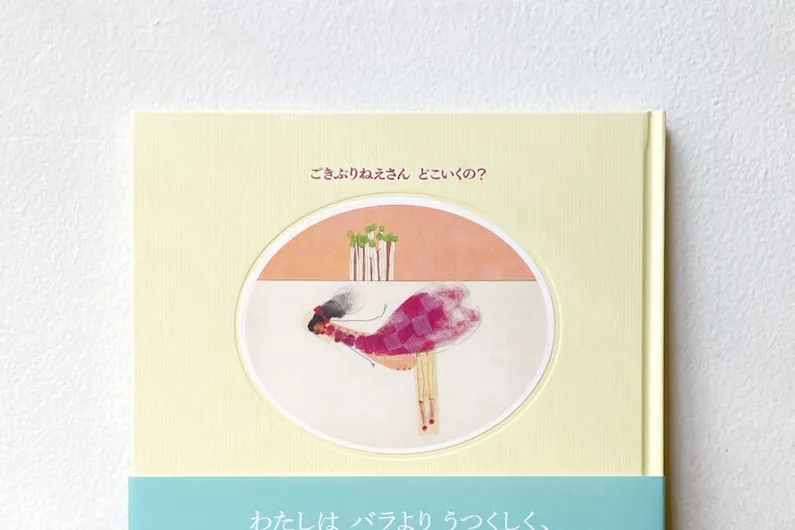
The folk tale “Cockroach Sister, Where Are You Going?”, which has been loved in Iran, has been republished after 20 years by Yamayamasha, a new picture book publisher in Nagano, with a beautiful and elegant binding. An exhibition commemorating the publication of the new edition will be held at Calo Bookshop & Cafe, the same venue that hosted Morteza Zahedi’s original art exhibition when the Japanese version was first published in 2006.

“I am more beautiful than a rose, and loved by everyone.”

The cute illustrations that enhance the story of the positive Cockroach Sister are filled with the challenges of illustrator Morteza, who was still in his 20s at the time. The original drawings from the new edition of “Cockroach Sister, Where Are You Going?” will be introduced through panel displays. Picture books and works previously created by Morteza will also be exhibited. Along with original merchandise, the exhibition offers a chance to enjoy the charm of the works and the world of Iranian picture books from multiple perspectives.

Event Details

🛏️ See hotels near the event

Morteza Zahedi is an Iranian visual artist and photographer based in Tehran. He works mainly in photography and the artist’s book. His pictures tend to be oblique: an object on a table, a figure caught at the edge of the frame, a street seen through a half-covered window. In sequence, they form a longer account of public space and the unspoken rules that govern it.

He is best known internationally for Cockroach Sister, Where Are You Going?, a photobook whose title borrows a phrase commonly directed at women on the streets of Iran. The book examines how women move through spaces that are not fully theirs. Instead of documenting harassment directly, it alternates photographs, notes, and brief observations, letting the viewer notice the small gestures and cautious positions that such spaces require. The work is less a record of abuse than an inquiry into visibility: who is seen, who looks away, and who is expected to leave.

Zahedi’s approach treats the artist’s book as a longer form in its own right rather than a container for individual images. The new edition of Cockroach Sister, Where Are You Going?, on display at the 2026 Osaka exhibition, is a chance to study the book as a physical object and to follow its structure from page to page. It returns throughout to a central question—where a woman is allowed to go—but does not resolve it.

98th Japan Coffee Festival 2026 in Osaka: Taste Rare Ethiopia Helef Coffee Across Yodogawa Ward

98th Japan Coffee Festival 2026 in Osaka: Taste Rare Ethiopia Helef Coffee Across Yodogawa Ward

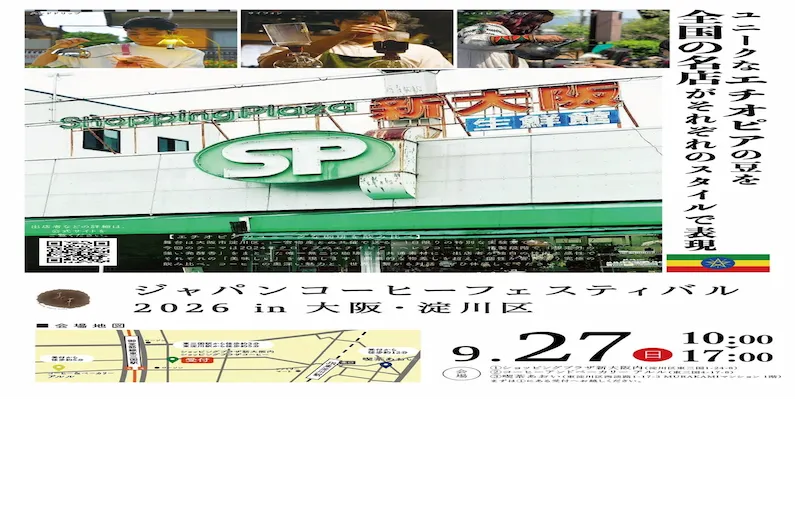
98th Japan Coffee Festival 2026 in Osaka, Yodogawa Ward

The Japan Coffee Festival, a tasting festival aiming for the development and dissemination of coffee culture within Japan, will return to Yodogawa Ward, Osaka City, on September 27, 2026. For the 98th edition, the common theme is the rare 2024 Crop Ethiopia Helef Coffee (Washed), a bean that acquired an unexpectedly strong fermented aroma during the processing stage. Renowned coffee shops gathered from across the country will brew it according to their own techniques and sensibilities, using hand drip, syphon, Ethiopia style, and more.

Of the three coffee tickets provided at reception, one is a “Ticket of Fate,” which can only be used at the shop drawn via a gashapon (capsule toy) machine. The festival also works as a walking route: the three venues span Yodogawa Ward and Higashiyodogawa Ward, with cups to be enjoyed while strolling through the town between stops.

Event details

  • Date: 2026/9/27 (Sun)
  • Time: 10:00–17:00
  • Location:
    1. General Reception / Inside Shopping Plaza Shin-Osaka (1-24-8 Higashimikuni, Yodogawa-ku, Osaka City)
    2. Coffee and Bakery Arle (4-17-8 Higashimikuni, Yodogawa-ku, Osaka City)
    3. Kissa Aoi (1st Floor MURAKAMI Mansion, 1-17-3 Nishiawaji, Higashiyodogawa-ku, Osaka City)
  • Note: When visiting, please first come to the general reception inside ① Shopping Plaza Shin-Osaka.
  • Fee: Advance 1,800 yen / Same-day 2,000 yen
    • Includes 3 coffee tickets, special pamphlet, and a 100-yen discount coupon for coffee bean sales
    • Refill tickets available for 1,200 yen
  • Contact: [email protected]
  • Website: https://www.japancoffeefestival.com/

🛏️ View hotels near the event

Ethiopia Helef Coffee

Ethiopia Helef is a single-origin Arabica coffee from the Helef area in the highlands of southern Ethiopia. It is not a widely distributed commercial grade but a microlot: a small, separate harvest that can be traced to a specific community and set of farm plots. In the specialty trade, it is bought and sold on those terms, not as a blended commodity.

The trees grow at 1,800 to 2,200 meters above sea level, in volcanic soil and under shade from native forest. The slow maturation that results gives the beans a dense structure and a flavor profile that is more floral and tea-like than most other coffees. The cup commonly shows jasmine, bergamot, ripe stone fruit, and honeyed citrus, with a bright mouthfeel and a clean, lingering finish.

Production is limited. Much of Helef is processed at small washing stations, where cherry sorting and drying are done manually and in small batches. Only a modest number of bags reaches the international market each year, and most of that volume is sold to specialty buyers. It is not the kind of coffee that turns up in a standard retail display.

At the 98th Japan Coffee Festival in Osaka, Ethiopia Helef is being offered in Yodogawa Ward. For festival attendees, it is a chance to taste an uncommon Ethiopian origin and to see what high-grown, carefully processed Arabica can do without the usual commercial blending.

Well Being ESAKA 2026 at Esaka Park: Free September 26 Autumn Marche with Gourmet Food, Handmade Goods, and Live Performances

Well Being ESAKA 2026 at Esaka Park: Free September 26 Autumn Marche with Gourmet Food, Handmade Goods, and Live Performances

Well Being ESAKA

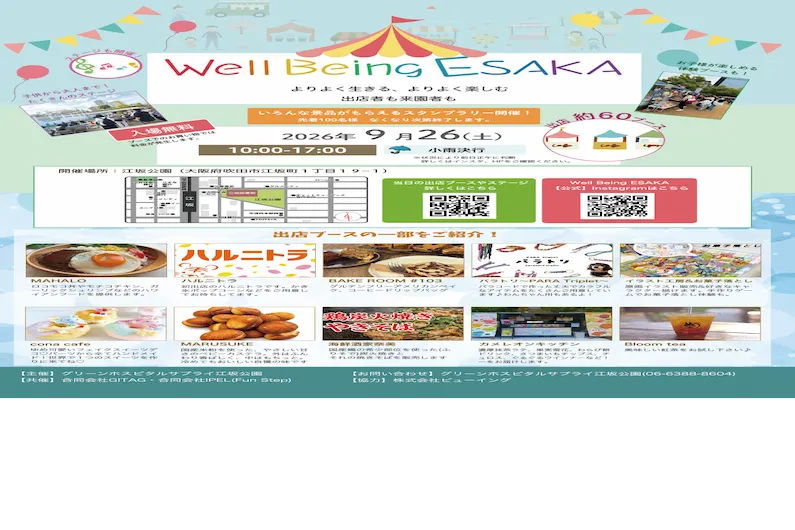
Esaka Park will host a free-admission marche event on Saturday, September 26, 2026, under the theme “A day in autumn to live better and enjoy better.” With the autumn breeze expected to make the open-air setting comfortable, the event combines food stalls, shopping booths, and live stage performances in one place. The theme points to a simple idea: taking a day in autumn to eat well, browse, and enjoy the outdoors.

Since the event is outdoors, visitors should note that it will be held in light rain but cancelled in stormy weather.

Gourmet and shopping booths

A long line of booths will extend through the venue, offering an array of gourmet options. Visitors can find curry, Hawaiian food, fried chicken, and crepes, as well as sales booths featuring one-of-a-kind handmade accessories and miscellaneous goods. Because admission is free, the only cost is whatever visitors choose to spend on food or items. The mix of gourmet stalls and handcrafted goods gives attendees a reason to linger, whether for a full meal or just to browse.

Stage performances

Live music, dance, and hula performances are scheduled during the event. These stage acts are meant to bring the crowd together and will fill the venue with enthusiasm and smiles. With performances running throughout the day, visitors can plan their time around both the stages and the booths.

Event details

  • Event Period: Saturday, September 26, 2026 (Held in light rain, cancelled in stormy weather)
  • Event Time: 10:00–17:00
  • Event Location: Esaka Park (1-19-1 Esakamachi, Suita City, Osaka Prefecture)
  • Fee: Free admission
  • Website: https://wellbeingesaka.com/

🛏️ View hotels near the event

What is Esaka Park?

Esaka Park is a public green space in Suita City, Osaka Prefecture, Japan. It sits in the Esaka neighborhood, a dense area of offices, shops, and apartment buildings. The park’s main features are its open lawns, shaded pathways, seasonal flower beds, and a children’s playground. People use it for walking, jogging, picnicking, or simply sitting on a bench away from traffic.

The park also serves as a venue for community events. Local festivals, morning markets, and outdoor gatherings are held here throughout the year. Its open layout allows for market stalls, a small stage, and room for visitors without feeling cramped. One upcoming event is the Well Being ESAKA 2026 Autumn Marche, a market planned to include food vendors, handmade goods, and live performances. For people who live or work nearby, the park is a practical and pleasant place to meet others and spend time outside.

Nagoya Horikawa Water Magic Festival 2026: Enjoy Onboard Beer Bars, Floating Markets, and Riverside Events

Nagoya Horikawa Water Magic Festival 2026: Enjoy Onboard Beer Bars, Floating Markets, and Riverside Events

Horikawa Water Magic Festival 2026

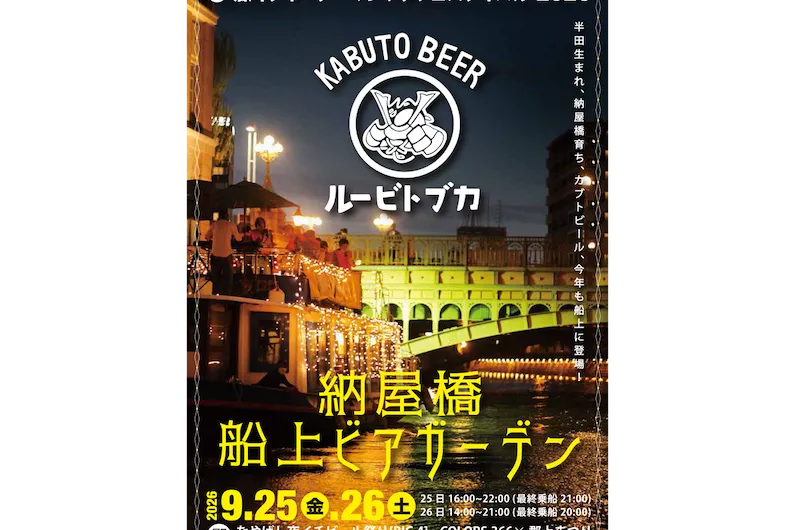
On September 25 and 26, 2026, the Horikawa River and Nayabashi area in Nagoya will host the Horikawa Water Magic Festival. The two-day event revives Showa Nama Kabuto Beer for this occasion only, and pairs it with an onboard beer bar, a floating market on stand-up paddleboards, and the illuminated night view from the water. The riverside is also the site of two concurrent events, so the festival works as a single night out with several different stops.

Onboard Beer Bar

A ferry runs from Pier Nayabashi to the onboard beer bar on the river. On board, you can drink Kabuto Beer or a soft drink while taking in the night view from the water.

  • Date & Time: September 25 (Fri) 16:00–22:00, September 26 (Sat) 14:00–21:00
    The final trip is scheduled for one hour before closing on both days. Depending on congestion, boarding restrictions may be implemented or the final boarding time may be moved earlier, so allow plenty of time. Please also understand if the beer sells out.
  • Price: Enjoyment Ticket: 1,000 yen (includes round trip between Pier Nayabashi and the onboard beer garden, plus one drink). Under-20s: 500 yen. One child of elementary school age or younger is free per one adult (drink not included).
  • Additional Drinks: Kabuto Beer 800 yen, soft drinks 500 yen
  • Boarding Point: Pier Nayabashi (Nayabashi Southeast, in front of Terrasse Nayabashi)

Floating Market

SUPs (Stand Up Paddleboards) will appear on the waters of the Horikawa River to provide snacks and other items.

  • Date & Time: September 26 (Sat), scheduled for the afternoon
  • Price: Free
  • Location: Horikawa Nayabashi area waters

Distribution of SRT Fans

SRT Fans will be distributed at the boarding ticket office. Stickers will also be given to those who follow the official SRT Instagram.

SRT is a new road public transportation system integrated with urban development to expand the mobility of the Nagoya city center and increase ground-level activity. You can board and alight at the Nayabashi bus stop and the Yanagibashi bus stop near Nayabashi.

Concurrent Events

Nayabashi Yo-ichi Beer Festival [BIG4]

In addition to the night market, a special two-day “Yo-ichi” will be held where you can enjoy draft beers from four major manufacturers (Asahi, Suntory, Orion, and Sapporo) that are not usually available. There are also plenty of gourmet stalls, so people who do not drink can enjoy it too.

  • Date & Time: September 25 (Fri) 17:00–21:30, September 26 (Sat) 13:00–21:00
  • Venue: Plazas and promenades between Nayabashi and Nishikibashi

Gujo Festival (COLORS.366 × Gujo)

This popular event lets you experience the full charm of Gujo. The atmosphere of Gujo comes through the Gujo Odori dance, Gujo’s “delicious foods,” and local specialty products. It is an easy stop on the way home from work.

  • Date & Time: September 25 (Fri) 16:00–22:00
  • Venue: COLORS.366

🛏️ View hotels near the event

Event Information

  • Dates: September 25 (Fri) and 26 (Sat), 2026. Canceled in case of rain.
  • Time: 25th (Fri) 16:00–22:00; 26th (Sat) 14:00–21:00
  • Location: Horikawa/Nayabashi Area
  • Price: Free admission (onboard beer garden is paid)
  • Contact: Horikawa Water Magic Festival Executive Committee, TEL: 052-972-2891
  • Homepage: http://horikawa-wmf.com/
  • Access: Get off at “Fushimi” Station on the Subway Higashiyama Line/Tsurumai Line. Approximately 8 minutes walk from Exit 8.
  • Remarks: Only takeout food purchased at the information center special tent (Nayabashi Southeast corner) may be brought onto the onboard beer bar. There is no food for sale on board, so those who require food should purchase it at the information center special tent before boarding.

What is Nagoya’s Horikawa Canal?

The Horikawa Canal is a waterway in Nagoya that runs roughly 15 kilometers from Nagoya Port into the downtown area. It was dug in the early 17th century to transport building materials for Nagoya Castle. After the castle’s construction, it became a commercial route for rice, lumber, and other goods moving between the city and the port. Warehouses and merchant operations lined its banks during that period.

In recent decades, the waterfront was redeveloped for public use. It now has walking paths, illuminated bridges, and open gathering spaces. The canal is also used for city events, including the floating beer bars and market stalls of the Water Magic Festival. It remains an active part of Nagoya’s urban landscape, linking the port area to the center of town while serving as a venue for everyday recreation and seasonal events.

Pet Expo 2026 Osaka: Enjoy Dog Shows, Cat Grooming Tips, and Exclusive Pet Shopping at Intex Osaka

Pet Expo 2026 Osaka: Enjoy Dog Shows, Cat Grooming Tips, and Exclusive Pet Shopping at Intex Osaka

Pet Expo 2026 Osaka

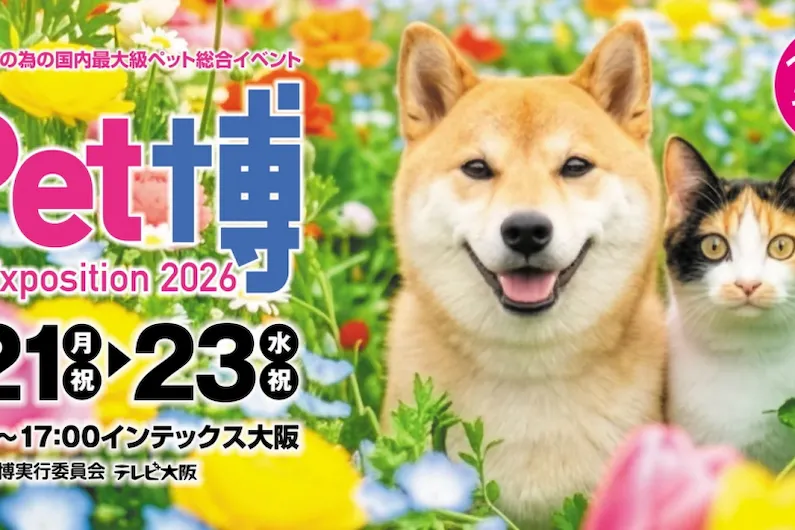
Pet Expo 2026 Osaka key visual
Pet Expo 2026 Osaka

Pet Expo 2026 Osaka is a large-scale participatory event where pets are very welcome, held over three days during the latter half of Silver Week at Intex Osaka Halls 1 and 2. From a sports day and 30m sprints that you can challenge together with your dog, to the “Interaction Farm” where you can experience interacting with and feeding small animals such as goats and rabbits as well as reptiles, along with powerful shows, shopping, and kitchen car gourmet, the expo is an experiential event that anyone—whether bringing a pet or simply an animal lover—can enjoy all day long.

A dog enjoying the expo

Participatory Events to Challenge with Your Dog & Powerful Dog Shows

The event offers plenty of physical activities that are easy to join with your dog, including a sports day and 30m sprints. For those who prefer watching, the “Guenta☆Show” features trained dogs performing “Quadrille,” a team performance showcasing synchronized formations, as well as powerful obstacle jumps.

A cat at the expo

Recommended for Cat Lovers! Cat Shows and Grooming Competitions

Cat lovers will find plenty to see. The TICA-certified Cat Show, held on September 21 and 22 only, brings beautiful cats to the stage one after another. On September 23 only, the Kitten Grooming Competition—greatly acclaimed last year—will demonstrate grooming techniques that keep cats both beautiful and healthy. This is a must-see section for anyone interested in cat care.

Pet Expo 2026 Osaka venue area

Great Deals on Latest Goods and Apparel! Kitchen Cars Also Appear

Many shops will open inside the venue, offering pet apparel at bargain prices, specially selected food and treats, and the latest convenient goods. Because re-entry is permitted, you can take your time shopping with your pet or enjoy gourmet food from kitchen cars located both indoors and outdoors.

Event Overview

  • Dates: September 21 (Mon/Holiday) – 23 (Wed/Holiday), 2026
  • Hours: 10:00–17:00 (last entry at 16:30)
  • Location: Intex Osaka Hall 1 & Hall 2, 1-5-102 Nanko Kita, Suminoe-ku, Osaka City
  • Fees: Adults (junior high school students and above): 1,500 yen (advance: 1,300 yen); Children (4 years old to elementary school students): 800 yen (advance: 700 yen); Children 3 years old and under: free. Some corners require separate participation fees or feed costs.
  • Inquiries: 06-6947-1912 (within TV Osaka Business Bureau)
  • Website: pethaku.com/osaka

🛏️ View hotels near the event

What is Intex Osaka?

Intex Osaka is an international exhibition and convention center on reclaimed land in Osaka Bay, adjacent to the Asia and Pacific Trade Center (ATC). It has been in operation since 1985 and is used for trade fairs, public exhibitions, corporate events, and cultural programs. Exhibitors and visitors come from within Japan and from other countries.

The facility contains multiple exhibition halls, along with the usual support spaces for large events: conference rooms, catering areas, registration spaces, and service docks. The separation of public access from logistical operations is a practical advantage, since it lets organizers move materials and equipment in and out without interfering with visitors. Access from central Osaka is straightforward: the nearest station, Trade Center-mae, is on the Nanko Port Town Line, which connects to the Osaka Metro Chuo Line at Nakafuto. There is also on-site parking for those driving. The site is a short walk from the waterfront, which is a minor but welcome detail between sessions.

For Pet Expo, the venue’s strengths are functional rather than decorative. The halls are large enough to run dog show rings, grooming demonstration stages, and exhibitor booths in parallel, while the aisle widths and entrance points help manage visitor flow around animals and queues. The transport options are relevant for an event where attendees bring pets, carry purchases, or need to move heavy equipment. This combination of space and access is what makes Intex Osaka suited to Pet Expo.

Analytics