Nagoya Architecture Festival 2026
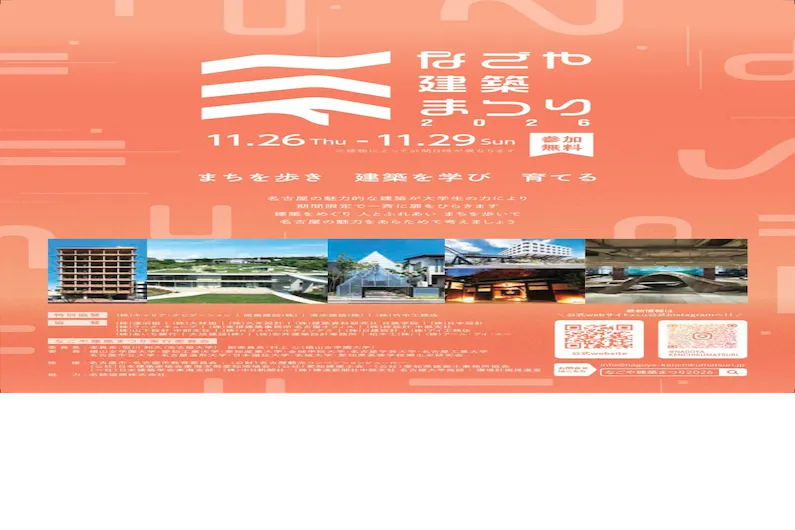
Why not take a walk through the city of Nagoya and rediscover the charm of architecture? The **Nagoya Architecture Festival 2026 is an event where you can enjoy the diverse architecture of Nagoya, from historic buildings to contemporary architecture, while exploring the city on foot.
The festival features special openings of locations that are usually inaccessible, as well as guided tours, exhibitions, and lectures. Students studying architecture will also participate as guides, offering their own perspective on the buildings and spaces around them. Rather than staying in one venue, the festival stretches across the city itself—turning a normal walk around Nagoya into a chance to see familiar streets from a new angle.
What makes it special
- **Special openings of places normally closed to the public
- **Guided tours, exhibitions, and architecture lectures
- **Student architecture guides at participating buildings
- **A free event that lets you design your own route
Because the festival is spread across multiple neighborhoods, you can explore at your own pace and focus on the areas that interest you most.
Event details
- Dates: Thursday, November 26, 2026 – Sunday, November 29, 2026
- Closed days: Opening dates and times vary by building. Please check the “Nagoya Architecture Festival 2026” official website for details.
- Location: Buildings at 40 facilities throughout Nagoya city will be open. Please check the “Nagoya Architecture Festival 2026” official website for details.
- Fees: Free to participate (some facilities may require separate fees such as admission charges)
- Website: https://nagoya-kenchikumatsuri.jp/
Six areas to explore
The festival is held in six areas:
- **Nagoya Castle / Shirakabe
- **Nagoya Station / Endonji
- **Sakae / Marunouchi
- **Tsurumai
- **Kakuozan
- **Motoyama
Each area has its own architectural character, so you can plan a focused route or spend a day moving between neighborhoods. For the full list of open buildings, check the open architecture map.
If you’re coming from outside Nagoya, you’ll want a place to stay. 🛏️ View hotels near the event
The Nagoya Architecture Festival 2026 is a special opportunity to enjoy architecture and city walking, making your usual city look a little different. Whether you’re a longtime architecture enthusiast or just curious about the buildings you pass every day, the festival gives you a reason to slow down and take a closer look.
What is Nagoya famous for?
Nagoya is known primarily as a center of Japanese manufacturing. Toyota was founded there, and the city’s industrial heritage remains visible: robotics exhibits, factory tours, and an urban landscape shaped by postwar production. It is a working industrial city, not just a place that displays its industrial past.
The city’s historical landmarks are less famous than those in Kyoto or Nara, but they draw a steady number of visitors. Nagoya Castle was the residence of the Owari branch of the Tokugawa clan, and its roof is known for the golden shachihoko, decorative tiger-fish figures that signaled samurai authority. Atsuta Shrine, a short distance away, is one of Japan’s most important Shinto sites. It reportedly preserves Kusanagi no Tsurugi, the sword that appears in the founding myths of the imperial line.
Nagoya also has its own food tradition, called Nagoya-meshi. The name covers a set of dishes developed in the city, including hitsumabushi (grilled eel over rice, eaten plain, with condiments, and with tea or broth), miso-katsu (pork cutlet with dark red miso sauce), tebasaki (chicken wings with a sweet-spicy glaze), and ankake spaghetti (noodles in a thick, starchy sauce). These are filling, straightforward dishes, associated with the city’s industrial workforce.
The built environment reflects these different layers. The grounds of Nagoya Castle sit alongside museums and office buildings; old merchant houses are scattered through the downtown; factories and port facilities occupy the southern districts. Nagoya’s reputation is rooted in industry, history, and daily life rather than in any single landmark. It does not offer one compact, easy image. What it offers is a specific Japanese city shaped by its own long history and by the industries it still maintains.
