
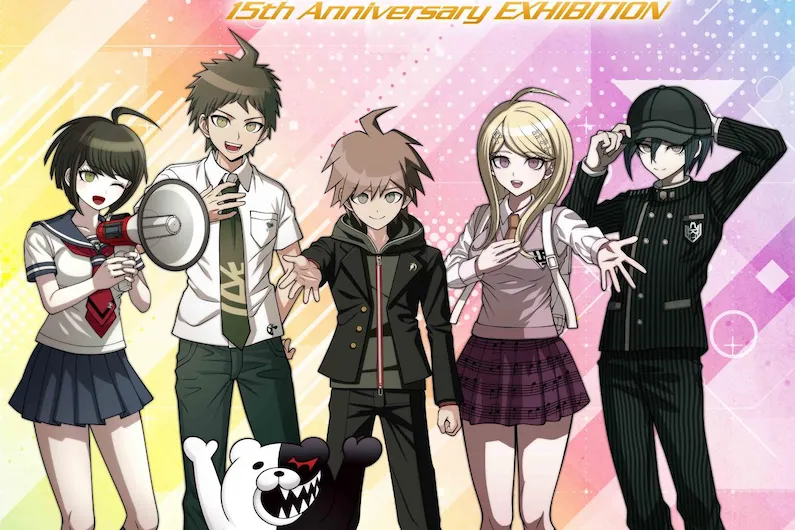
Danganronpa 15th Anniversary Exhibition
To commemorate the 15th anniversary of the Danganronpa games, the first large-scale exhibition for the series has been announced. Visitors can trace the 15-year history of the series through setting materials and illustrations from Danganronpa: Trigger Happy Havoc, Super Danganronpa 2: Goodbye Despair Academy, Ultra Despair Girls, and New Danganronpa V3: Killing Harmony.
The exhibition also includes a riddle-solving game to enjoy inside the venue, and the exhibition shop corner will offer original event goods featuring illustrations newly drawn for this occasion.
Event Details
| Dates | November 28, 2026 (Sat) – December 27, 2026 (Sun) |
| Time | 10:00–17:00 (Last entry 16:00) |
| Location | Telepia Hall, Nagoya |
| Contact | Telepia Hall |
| Official page | Danganronpa 15th Anniversary Exhibition |
Tickets
| Ticket type | Advance | Same-day |
|---|---|---|
| General | 2,200 yen | 2,500 yen |
| Limited goods exchange ticket | 2,500 yen | 2,500 yen |
| In-venue riddle-solving ticket | 2,000 yen | 2,000 yen |
Please note that entry is not possible with only a “Limited goods exchange ticket” or “In-venue riddle-solving ticket.” A general ticket (advance or same-day) must be purchased separately.
Preschool children are free, but they must be accompanied by a guardian.
Access
- 10-minute walk from “Sakae” Station on the Nagoya City Subway Higashiyama Line
- 10-minute walk from “Takaoka” Station on the Nagoya City Subway Sakura-dori Line
Notes
- This exhibition is date-and-time-designated only from 10:00 to 13:00 on November 28 (Sat) and November 29 (Sun). For other dates and times, you may enter without a date/time designation.
- Purchases at the venue counter are cash payment only.
Danganronpa is a Japanese video game franchise created by Spike Chunsoft and writer Kazutaka Kodaka. It began in 2010 with Danganronpa: Trigger Happy Havoc, and later expanded to include several mainline sequels, spin-off games, anime adaptations, stage plays, manga, and a large line of merchandise.
The premise is consistent across the main games. A group of high-school students, each introduced as an “Ultimate” in a particular field, is trapped inside a locked facility by Monokuma, a bear-shaped robot with a black-and-white design. Monokuma tells them they can leave only by taking part in a “Killing Game”: if a student murders someone and is not identified during a class trial, the murderer graduates and the remaining students are executed. If the students name the killer correctly, only the murderer is executed.
The class trials are the main gameplay sections. The player compares testimony with evidence, points out contradictions in the other students’ statements, and votes on the culprit. The trials are built around rapid dialogue exchanges and the series’ visual style, which favors bright pink and black. The tone is closer to a thriller than a courtroom drama, and later games add variations to the trial format to keep the interrogations from becoming repetitive.
The words “hope” and “despair” appear throughout the franchise, usually in arguments about how the survivors should respond after a trial. Those arguments are less philosophical than practical: whether to keep trusting one another, whether to keep investigating, and whether the rules of the Killing Game leave any real choice. The trials themselves are more concerned with concrete details than with themes—how a character died, how another character’s account does not fit the evidence, and what object or conversation disproves a lie.
The series has maintained a sizable audience since the first game. Its visual identity, soundtrack, and character designs are often cited as reasons for that, along with the trial structure, which remains uncommon among murder-mystery games. The Nagoya exhibition for the franchise’s fifteenth anniversary is set to display production materials from the games and give visitors an opportunity to examine how the series was made.
