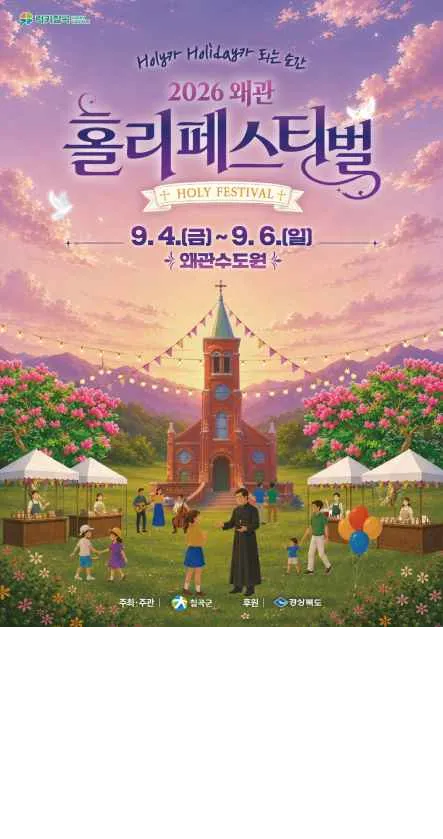
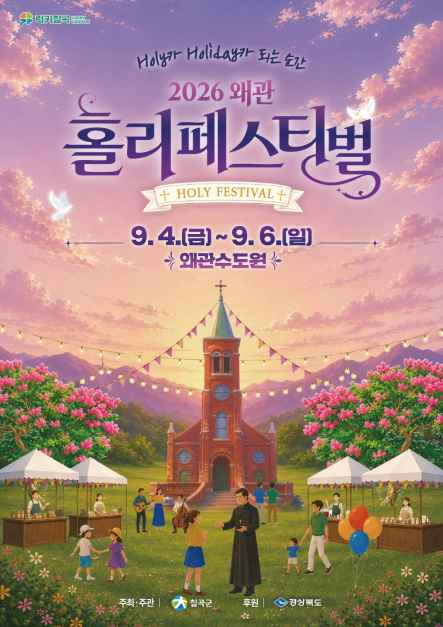
Waegwan Holi Festival
🗓️ 2026.09.04 ~ 2026.09.06
The Waegwan Holi Festival is a curated cultural event that bridges the extensive Catholic heritage of Chilgok-gun, Gyeongbuk, with modern tourism. Built upon a conceptual duality—spending a “Holiday” (representing fun and leisure) within a “Holy” place (representing the sacred and valuable)—the festival centers its activities around the Waegwan Monastery. This venue, which serves as a repository for the history and spirit of Catholicism, provides an architectural atmosphere reminiscent of medieval Europe, offering visitors a setting that is distinct from typical regional festivals.
To enhance the visual and spiritual experience, the organizers have produced the Cathedral of Light and a Forest of Fantasy, integrating artistic installations with the monastery’s existing sanctity.
Music & Performance
The festival balances contemporary entertainment with traditional liturgical music through two primary venues:
- Outdoor Stage: This area hosts the Holy Concert featuring artists Lyn and Ahn Ye-eun, as well as a talk concert with Father Lee Chang-min Marciano—an “MZ priest” known for his appearance on You Quiz. The programming is rounded out by various busking performances and children’s entertainment, including bubble shows, balloon art, and mime.
- Main Cathedral: For those seeking a more contemplative auditory experience, the cathedral hosts pipe organ recitals and performances of Gregorian chants.
Healing & Experience
Visitors can engage with the monastic lifestyle and spiritual practices through a series of immersive programs:
- Monastic Life: Opportunities include participating in the daily life of the monastery, attending evening prayers with a monk, or joining a monastery tour led by a monk (conducted twice daily).
- Spiritual Retreats: The “Holy Stay” offers a comprehensive three-day, two-night retreat and tour program, while the “Candlelight Heavenly Cathedral Abba’s special mass” provides a focused liturgical experience.
- Interactive Activities: A mission-type stamp tour titled “In Search of Pieces of Light” encourages exploration of the grounds. For those seeking mental reprieve, the “Mind shelter” provides a confession letter box where visitors can leave behind their worries and burdens.
- Creative Booths: Hands-on experience booths allow guests to create rosaries, cross keyrings, and stained glass windows, or engage in Bible verse calligraphy and face painting.
- Engagement: A photo booth is available for those wishing to experience wearing a monk’s habit.
Exhibition & Photo Zones
The festival utilizes the monastery’s geography to create several visually striking installations:
- Visual Arts: An archive exhibition is located at the main entrance of the Waegwan Monastery, complemented by an acrylic scasi photo zone and a wisteria mass altar exhibition.
- Atmospheric Lighting: The “landscapes of light” harmonize sound and illumination, while the night views are defined by the Cathedral of Light and the Forest of Fantasy, which utilizes string lights and firefly lighting.
- Special Sites: A dedicated wedding photo zone is situated at the Old Waegwan Cathedral, and designated picnic spaces are available for those seeking relaxation.
Waegwan Monastery ~ Gasil Cathedral Extension Program
To facilitate broader exploration of the region’s religious sites, a shuttle bus service operates between the two primary locations:
- Waegwan Monastery → Gasil Cathedral: Departures at 13:00 and 14:00.
- Gasil Cathedral → Waegwan Monastery: Departures at 15:00 and 16:00.
Food & Market
The festival integrates local commerce through 25 flea markets and 4 food trucks. To incentivize social media engagement, food truck menu vouchers are distributed via lottery, selection, or first-come-first-served methods upon the verification of a festival review posted on SNS.
Event Incentives
Visitors who travel to the venue via the Daegyeong Line can receive 10% discount coupons for restaurants in Waegwan upon verification of their boarding.
📍 Address: 61 Gwanmun-ro, Waegwan-eup, Chilgok-gun, Gyeongsang-do
🛏️ Accommodation near the event
💰 Fee: Free
📞 Inquiry: 054-979-6087
What is Waegwan?
Waegwan sits in North Gyeongsang Province, South Korea, along the Nakdong River between Daegu and Busan. Roughly 20,000 people live in this unremarkable farming town, which would be easy to overlook except for one detail: it contains the most intact example of European monastic life in East Asia.
The name waegwan (왜관) refers to a Japanese trading settlement, but the town’s actual significance lies north of the river, in a valley of the Sobaek Mountains. There, in 1952, German Benedictine monks expelled from communist China founded a new monastery. They built in a style they knew—Gothic-revival, with twin bell towers visible across the rice paddies—and continued practices their order had maintained since medieval Bavaria: Gregorian chant, manuscript work, and brewing.
For seventy years, Waegwan functioned much as any monastery does. Pilgrims came to Yangnak Cathedral. Visitors stayed in the guesthouse. The brewery produced beer according to the Reinheitsgebot. The town itself remained quiet, agricultural, indifferent to its unusual neighbor.
The Holi Festival—named after the European “holy day,” not the Indian color festival—attempts to make this heritage accessible. Organizers describe it as transplanting the “sensorium of medieval Catholic Europe” into rural Korea, offering visitors an approximation of atmosphere without requiring travel to Cluny or Cîteaux.
The claim deserves scrutiny. Medieval monks did not design their lives as aesthetic experiences for outsiders. Their rituals served specific liturgical and agricultural functions. Gregorian chant accompanied the canonical hours; brewing provided safe drinking water and income. Whether these activities retain meaning when staged for spectators—whether the “sensorium” can be extracted from its context—is a question the festival raises without quite answering.
What remains unambiguous is the physical place. The abbey church, the brewery, the manuscripts in the library, the daily office still chanted: these exist whether the interpretation placed upon them holds or not. Waegwan offers something rare in East Asia—continuous European monastic tradition, transplanted once from Bavaria, surviving through war, dictatorship, and now the peculiar pressures of heritage tourism. The town’s value lies less in any spectacle constructed around it than in this persistence, the simple fact of continuity in a valley where nothing else required it.
