
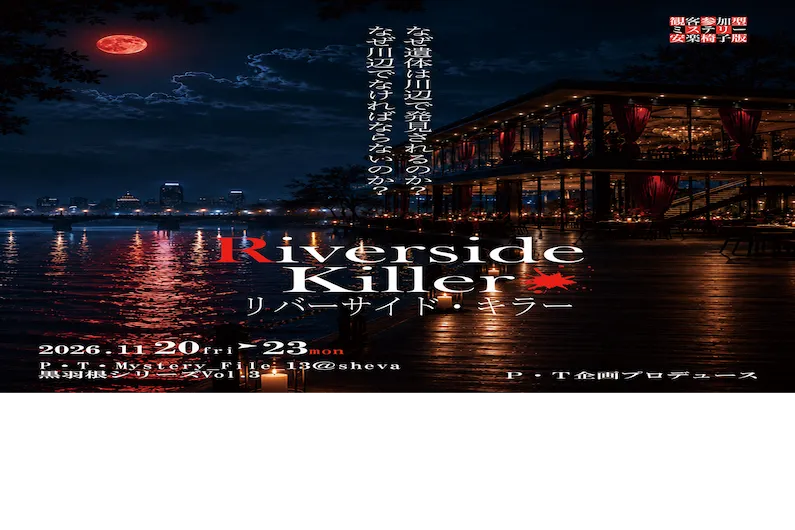
Audience-Participation Mystery: Armchair Edition P.T. Mystery_File.13 Kurobane Series Riverside Killer

An experiential game-style mystery play, this Armchair Edition gives the audience an active role: rather than watching the solution unfold, participants themselves pursue the truth of the case.
The story centers on the “Riverside Killer,” a series of unsolved consecutive murders occurring along the riverbank. In P.T. Mystery_File.13 from the Kurohane Series, attendees work with journalist Takao Kurohane to challenge the mystery of the case. The event is held at the restaurant “sheva” along the Higashiyoko-bori River in Osaka. While enjoying delicious meals and desserts, guests can reason through the mysteries of the incident alongside the characters and fully enjoy a mystery world full of presence.
Event dates and times
| Date | Start times |
|---|---|
| Fri, Nov 20 | 19:00 |
| Sat, Nov 21 | 11:00 / 14:45 / 18:30 |
| Sun, Nov 22 | 11:00 / 14:45 / 18:00 |
| Mon/Holiday, Nov 23 | 11:00 / 14:45 |
Location
- Venue: sheva
- Address: 1F β Honmachi Bridge, 4-8 Honmachibashi, Chuo-ku, Osaka City
Price
- Lunch / Dinner sessions: ¥6,000
- Hors d’oeuvre & Dessert sessions: ¥5,500
Contact and official website
- Inquiries: [email protected]
- Website: https://pt-kikaku.jimdofree.com
What is P.T. Mystery_File?
P.T. Mystery_File is a murder mystery event that combines elements of theater, escape room, and crime fiction. P.T. stands for Participatory Theatre, and the format reflects that: attendees take on the role of investigators rather than observers. The story is not performed for them; it is something they work through themselves.
Each event is built around a “file,” a self-contained case folder containing evidence, testimony, photographs, and leads. The Kurobane Series is the current line of files, named after a figure who links the larger narrative. File.13, the Riverside Killer Mystery, is the newest entry. It is written so that newcomers can start with no prior knowledge, though returning players may notice references and open threads from earlier cases.
The venue, sheva, is set up as the location of the crime. Participants receive a case file and move through the space, examining physical evidence, talking to characters, and deciding what is relevant. The answers are not presented as multiple-choice options. Solving the case depends on discussion, observation, and deduction. The objective is not only to identify the killer but also to determine how the murder was committed, why it happened, and which pieces of evidence matter most.
Groups are kept small and work as their own investigative units. No two teams move through the material in the same order, and their conclusions can differ in detail. At the end of the session, the group is expected to present its findings. The solution is not delivered to them in a reveal; it has to be supported by what they found and how they interpret it.
