Pohang’s Night of Falling Flowers
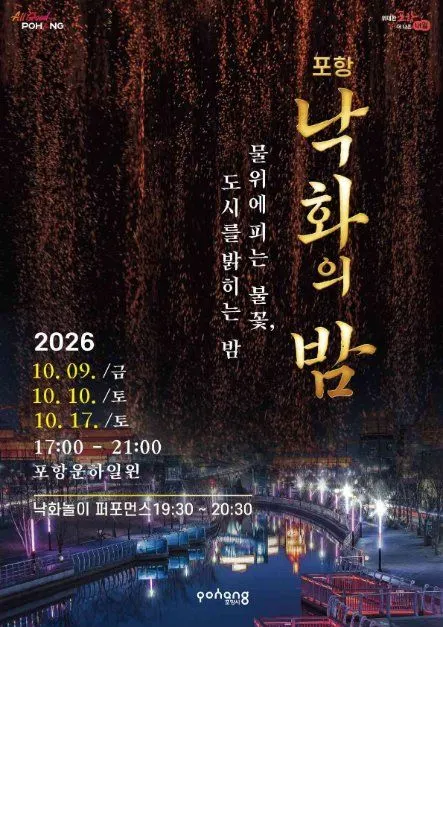
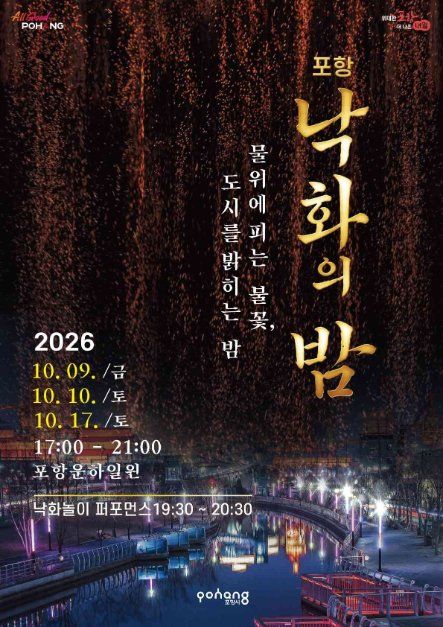
For nine autumn nights, from 9 to 17 October 2026, the Pohang Canal becomes the stage for a different kind of fireworks display. Known officially as Pohang Night of Nakhwa, the event centers on nakhwa-nori, a traditional Korean firework technique that uses charcoal powder wrapped in Hanji, or traditional Korean paper.
The name Nakhwa translates as “falling flowers,” and in this case it describes the embers that drift down as the paper burns. Because no gunpowder is used, the display does not explode. The paper burns slowly, and the light spreads along the Nakhwa lines stretched across the canal. Two 75-meter Nakhwa lines are installed diagonally over the water, creating the festival’s central sight: a band of fire reflected on the canal’s surface.
The setting carries its own meaning. The canal was once cut off but was revived through citizen effort. In Pohang, an industrial city, fire and water appear in the same frame—fire evoking the city’s industrial identity, water standing for restoration. The program is deliberately spare: only Nakhwa and music, with no official ceremonies or singer performances. The evening belongs to the fire, the water, and the people watching.
🗓️ 2026.10.09 ~ 2026.10.17
Main Program
- Nakhwa Performance: 19:30–20:30
Side Programs
- Local artist performances, including Pungmulnori and traditional dance
- Food booths linked with local commercial districts
Concurrent Festivals
- 10.10 (Sat) Handong International Bread Festival
- 10.17 (Sat) Pwang-Pwang Horror Night
📍 Address: 45 Chukhang-ro, Nam-gu, Pohang-si, Gyeongsangbuk-do (Haedo-dong)
🛏️ Accommodations near the event
💰 Fee: Free
📞 Inquiry: 054-270-2248
🖥️ Website: https://www.pohang.go.kr/
What is Nakhwa (Korean falling flower fireworks)?
Nakhwa (낙화) is a traditional Korean firework that releases glowing embers into the air. The name comes from nak (“fall”) and hwa (“flower”), and the embers are meant to resemble flower petals drifting down. It is distinct from conventional fireworks: instead of a loud explosion and a short burst of light, nakhwa produces a slow shower of small flames that fall for several seconds before fading.
The practice dates to the Joseon Dynasty, when artisans made nakhwa from charcoal, paper, and metal. The burning charcoal is placed inside a perforated container, often made of woven material or metal, which is suspended from a pole or swung in a circle. Air moving through the holes keeps the charcoal hot, and glowing fragments are thrown out by the motion. The resulting trails of light appear red-gold against the dark sky and gradually die out as they fall.
Because the effect is simple and close to the ground, nakhwa is often compared to natural sights such as falling leaves, cherry blossoms, or rain in the wind. It is not intended to startle or impress through noise, but to be watched in a relatively quiet setting. At the Pohang Night of Nakhwa, this type of fireworks is staged along the coast, where the falling sparks are reflected in the water. That combination of flame, sky, and sea is the main point, and it is the reason the event continues to draw spectators.
