Gyeongju National Heritage Night Walk
🗓️ 2026.09.18 ~ 2026.09.20
From September 18 to 20, 2026, Gyeongju will hold its annual National Heritage Night, an event built around the city’s history and cultural sites after dark. The official subtitle, “Fragments – Preserved, and To Be Preserved,” describes an occasion that draws on the many national heritages and historical resources still found across Gyeongju. The main venues are the areas around Woljeonggyo Bridge, Gyerim Forest, Gyochon Village, and Gyeongju Eupseong Fortress.
Because these locations date from the Silla Dynasty and remain among Gyeongju’s most representative cultural heritage sites, using them as event spaces gives the festival a distinct identity. Visitors can view nighttime scenery against historic backdrops, take part in history and traditional culture programs, and explore heritage sites in an atmosphere unlike a daytime visit. Altogether, the event runs 45 programs across eight themed categories.
Night View (4 programs)
Programs centered on illuminated scenery and visual spectacles:
- Woljeonggyo Bridge shining on Muncheon Stream
- LED Drone Light Show
- Forest of Myths
- Gyeongju Eupseong where Moonlight Stays
Night Path (10 programs)
Walking, parade, and outdoor activity programs:
- Stepping Stones of Love
- National Heritage Night Walking with Pets
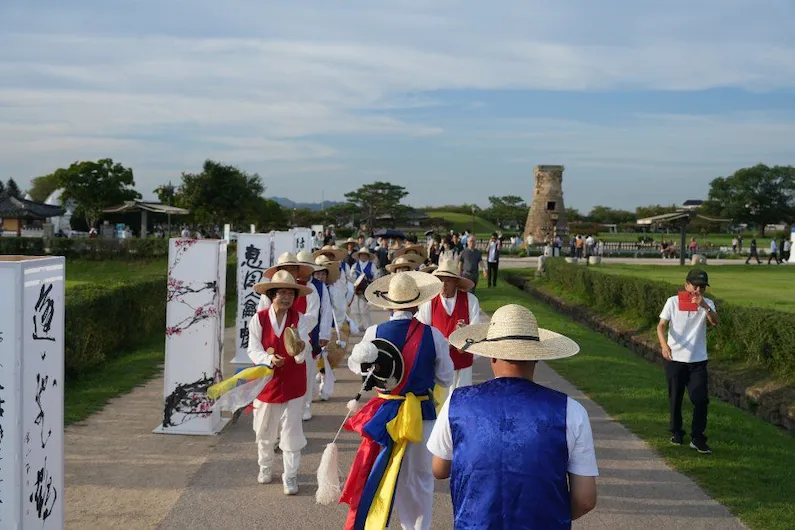
- Nongak (Farmers’ Music) Street Parade
- National Heritage Outing
- National Heritage Commentary for Children
- Gyeongju Exploration for Little People
- Hide-and-Seek with Donggyeong-i and Cheomseong-i
- Clearing the Night Path and Connecting History (National Heritage Plogging)
- Secret Royal Inspector Inspecting the Fortress
- Lantern Making Experience
Night Story (4 programs)
Performance and storytelling programs:
- Busking in Every Corner
- Silla Story Sand Art
- Mysterious Encounter of Time Travel – Goblin Guarding the Egg (Storytelling)
- Sungmundae Media Art
Night Flower (9 programs)
Hands-on activities and art experiences:
- Art Gallery
- Ice Kingdom
- Celestial Observation Constellation Stories
- Gyeongju Night Trip Four-Cut (Paid program)
- Colorful Coloring
- Traditional Culture Experience Playground
- Bojagi Knot Experience (Partially paid)
- Traditional Kite Flying Demonstration and Experience
- DOODLE GYEONGJU (Mr. Doodle Live Drawing)
Night History (12 programs)
Historical learning and traditional craft programs:
- Understanding the Gyeongju Choi Rich Family 100 Times More
- Twelve Zodiacs Grant My Wish
- Silla Jewel Beetle Story
- Gyeongju Humanities Talk Talk
- 4D Real National Heritage Experience (XR Bus)
- Drone Experience
- Silk Weaving (Silk Road History Experience)
- Stamp Tour
- Proving Myself (Hopae/Identification Tag Making)
- Here Comes the Secret Royal Inspector
- Night of Competing Wisdom Byeolsi
- Police and Thief
Night Food (3 programs)
Food and refreshment programs:
- Gyochon Night Snack
- King’s Refreshment Table
- Food Truck (Yongginae/Container Challenge)
Night Market (2 programs)
- Craft Market
- Gyeongju Eupseong Marketplace (Free Market)
Night Stay (1 program)
- Program linked with local accommodation businesses
Most of the event is free to enter, with some programs requiring payment, such as the Gyeongju Night Trip Four-Cut and the Bojagi Knot Experience. Visitors who want to extend their time in the city can use the Night Stay program, which connects them with local accommodation options.
📍 Address: 839-1 Inwang-dong, Gyeongju-si, Gyeongsangbuk-do
🛏️ Accommodation near the event
💰 Fee: Free (Some programs are paid)
📞 Inquiry: 054-743-7182
⭐️ Instagram: https://www.instagram.com/gjnighttrip/
🖥️ Homepage: http://www.경주문화유산야행.kr/
The Silla Kingdom was one of the three major polities of ancient Korea, alongside Goguryeo and Baekje. Its traditional founding date is 57 BCE, and it survived for roughly a millennium, making it one of the longest-lived dynasties in world history. In 676 CE, after a series of conflicts with the other Korean kingdoms and with Tang China, Silla unified most of the Korean Peninsula under its rule. The following centuries saw the consolidation of a centralized government, the development of Buddhist institutions, and a substantial body of artistic and architectural work.
The capital was Seorabeol, the city now known as Gyeongju. At the height of Silla’s power, it was a large urban center with palaces, temples, observatories, and royal tombs spread across the landscape. Many of these structures and burial mounds remain, which is why Gyeongju is sometimes called “the museum without walls.” The site known as the Gyeongju Historic Areas is now listed as a UNESCO World Heritage property.
Silla’s cultural legacy is visible in the objects and monuments that have survived. Cheomseongdae, built in the seventh century, is one of East Asia’s oldest surviving astronomical observatories. The gold crowns and other regalia found in the royal tombs show the craftsmanship and trade connections of the Silla elite. Buddhism, adopted by the court and supported by the state, had a lasting influence on Korean thought, art, and ritual life.
The Gyeongju National Heritage Night program opens access to these places after dark, lighting the palace grounds, temples, and royal burial mounds. The lighting serves a practical purpose: it makes the monuments visible in the evening and allows visitors to see them in a different context. For anyone interested in the history of Korea, the event is a useful way to explore the physical remains of Silla’s capital and the civilization that built it.
