
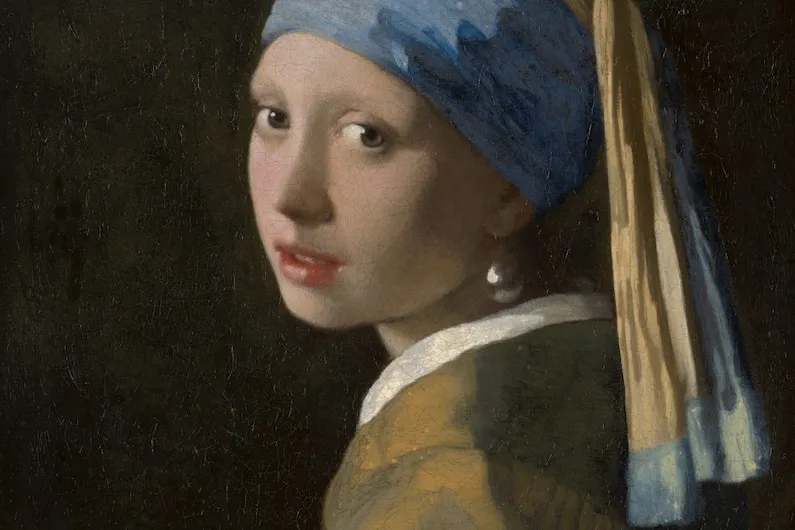
Vermeer’s “Girl with a Pearl Earring” Exhibition at Osaka Nakanoshima Museum of Art: Masterpieces of 17th-Century Dutch Painting, a Miraculous Return to Japan
An exhibition introducing works by Vermeer and Dutch genre paintings from the collection of the Mauritshuis in The Hague, Netherlands, will be held at the Nakanoshima Museum of Art, Osaka. This is a unique opportunity: two of the three Vermeer works owned by the Mauritshuis will come to Japan—the masterpiece “Girl with a Pearl Earring,” returning to Japan for the first time in 14 years, and “Diana and Her Companions.”


This exhibition will be held exclusively at the Nakanoshima Museum of Art, Osaka. There will be no touring to other regions. In addition, 10 masterpieces of 17th-century Dutch painting will be exhibited, including Jan Steen’s “The Old Woman Singing and the Young Man Playing the Flute,” Paulus Potter’s “Bull Reflection in Water,” and Maria van Oosterwijck’s “Flowers in an Ornamental Vase.” There will also be a special visual experience available only here, where you can feel Vermeer’s world of light on a large screen stretching 20 meters in length.


■ The Ambassador is Dutch-born “Miffy”

Miffy, who like Vermeer was born in the Netherlands, will serve as the ambassador for this exhibition. Original plushies of Miffy dressed as the “Girl with a Pearl Earring” will also be available.
■ “Frieren: Beyond Journey’s End” Collaboration Newly Drawn Illustration

The fantasy manga “Frieren: Beyond Journey’s End” by Kanehito Yamada (original story) and Tsukasa Abe (art) is a story about traveling through a world reminiscent of the medieval and early modern Europe in which Vermeer lived. For this occasion, original goods will be sold featuring a special illustration newly drawn by Tsukasa Abe-sensei specifically for this exhibition, where Frieren overlaps with the “Girl with a Pearl Earring.”
Exhibition Details
- Period: Friday, August 21, 2026 – Sunday, September 27, 2026
- Hours: 9:30 – 17:00 (Last admission 16:30)
- Location: Nakanoshima Museum of Art, Osaka, 5th Floor Exhibition Room (4-3-1 Nakanoshima, Kita-ku, Osaka City)
- Fees: Adults 3,000 yen, High school/College students 1,500 yen, Elementary/Junior high students 500 yen *Date and time reservation system
Notes:
- Persons holding a disability certificate (Physical Disability Certificate, Rehabilitation Certificate, Mental Disability Health and Welfare Certificate), including one caregiver, will receive half off the daily fee (proof required). Please purchase at the ticket counter on the 2nd floor on the day of your visit (no advance reservation required).
- For this exhibition, persons aged 65 and over residing in Osaka City will also be required to pay the general admission fee.
Contact:
- Inquiries: 06-4301-7285 (Osaka City General Call Center / Naniwa Call; Reception hours 8:00 – 21:00, open year-round)
- Website: https://vermeer2026.exhibit.jp
What is the significance of Vermeer’s Girl with a Pearl Earring?
Vermeer’s Girl with a Pearl Earring is a tronie, a type of character study that emerged in the Dutch Golden Age. Tronies were not commissioned portraits, nor were they narrative scenes. They were studies of expression, costume, and light, made to display the artist’s skill rather than to tell a story or advertise a sitter’s status. In this painting, Vermeer moves away from the domestic interiors with which he is most often associated. One female figure stands against a dark, flat background. She has turned to look over her shoulder, lips parted, with an earring catching the light. The painting does not claim to be a likeness of a particular woman; the subject remains anonymous. The pearl, a small patch of paint with a bright highlight, is a reminder of how much Vermeer could achieve with a limited number of strokes.
For art historians, the work matters because it embodies what a tronie was supposed to do. It allowed a painter to demonstrate technical skill and sensitive observation of human presence without the constraints of allegory, moral narrative, or portraiture. It also shows Vermeer’s interest in optical effects: the way light can fall on skin, fabric, and metal, and how a viewer’s eye can be led to a single point in the composition.
The painting’s fame is not entirely a modern phenomenon. It has long been admired by specialists, but its wider popularity grew considerably after the publication of Tracy Chevalier’s novel in 1999 and the subsequent film. When it is shown at the Osaka exhibition in 2026, it will be a good opportunity to see the work in person. The painting is small, about 44 by 39 centimetres, and much of its effect depends on the delicate handling of paint and the contrast between the figure and the background. The background has darkened with age, making the figure seem more isolated than it would originally have been. In that sense, the painting is not only a famous image; it is also a demonstration of how a seventeenth-century Dutch painter could turn simple materials into a convincing human presence.
