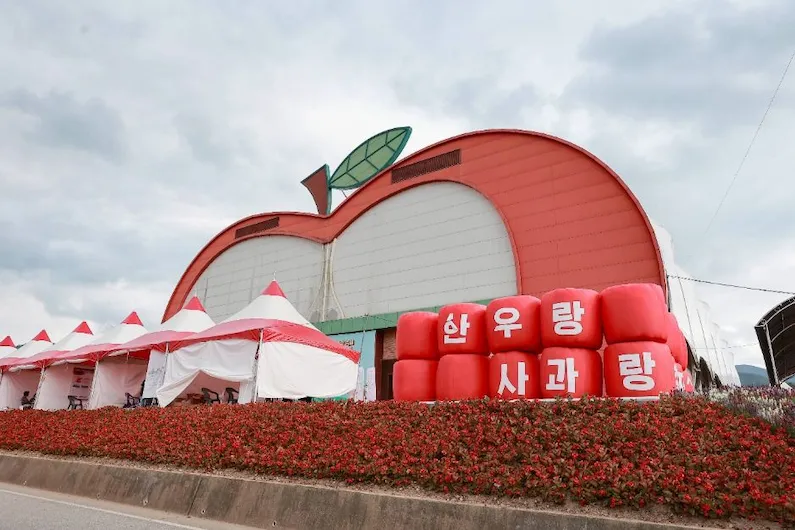
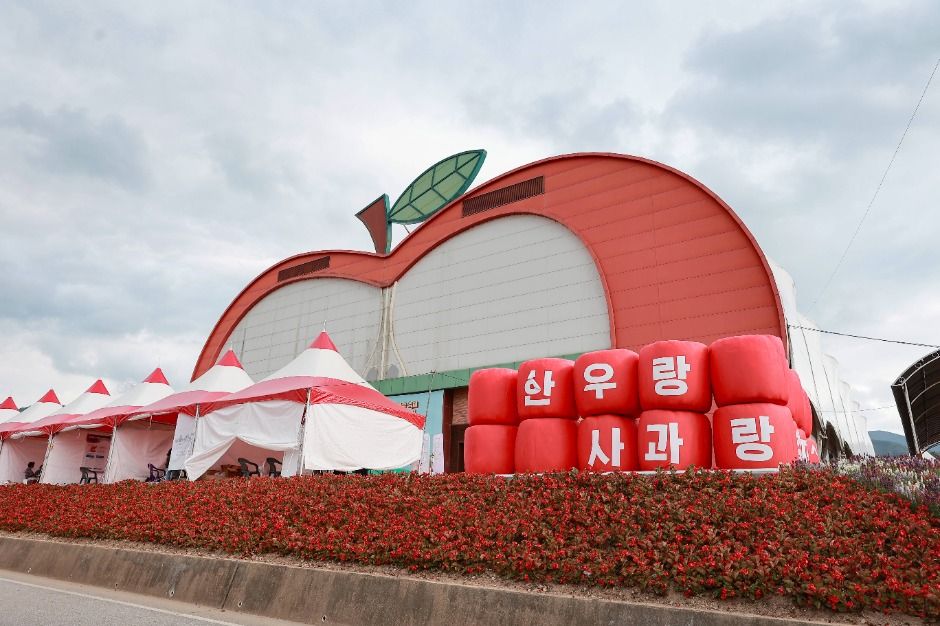
Jangsu Hanwoo and Apple Festival
🗓️ 2026.09.10 ~ 2026.09.13
*The following festival details are from the previous year’s (2025) festival; details for the 2026 festival are currently being updated.*
With Hanwoo (Korean beef) and apples as its central themes, this is Korea’s first “Red Color Festival”—a distinction it has held since its inception in 2007. The festival reached its 19th edition in 2025, making it one of the more established regional celebrations in Jeonbuk Province. What began as a straightforward agricultural showcase has undergone a notable transformation; starting in 2024, the festival moved beyond its two original pillars to encompass what organizers now term “Jangsu Red Food,” incorporating omija (Schisandra berry) and tomato alongside Hanwoo and apples.
This expansion into a broader culinary category has accompanied a push into value-added products. Visitors now encounter not merely raw ingredients but a range of processed goods: apple beer, apple soju, apple bread, and omija liquor among them. The festival’s evolution from Korea’s first Red Color Festival to what it bills as Korea’s first Red Food Festival reflects a deliberate effort to reposition itself within the competitive landscape of Korean cultural tourism events.
Programs and Activities
The festival divides its offerings into four categories, allowing visitors to calibrate their participation according to interest and energy level.
1. Main Programs
The core experience centers on three large-scale installations: the Jangsu Hanwoo Yard, which organizers describe as the nation’s largest; the Apple Yard; and the Red Food Zone. Beyond these exhibition and market spaces, the festival has incorporated interactive culinary programming, including a Jangsu Red Food cooking experience featuring chefs from Culinary Class Wars (the Netflix series known for its Black and White Chefs format). Additional main-stage activities include a Jangsu Red Food temple food making experience and a parent-child cooking program focused on tomato spaghetti preparation.
2. Side Programs
For those drawn to spectacle and physical competition, the festival offers the National Hanwoo carcass carrying experience—a test of strength involving the literal transport of beef carcasses—and the National Jangsu Hanwoo power arm-wrestling competition.
3. Consumer Participation Programs
Hands-on activities with lower barriers to entry include Jangsu apple bracelet making, Jangsu apple keyring crafting, apple golf, apple fishing, and apple rice cake pounding (a twist on the traditional tteok preparation ritual).
4. Other Content
Younger visitors or those seeking gentler interactions can access pony riding and horse feeding experiences.
📍 Address: 378 Hannuri-ro, Jangsu-eup, Jangsu-gun, Jeonbuk Special Self-Governing Province
🛏️ Accommodations near the event
💰 Fee: Free
📞 Inquiry: 063-350-2356
🖥️ Website: https://www.jangsufestival.com/index.php
What is Hanwoo?
Hanwoo is Korea’s native cattle breed, Bos taurus coreanae. For centuries, these animals were bred on the Korean Peninsula primarily as draft animals for rice farming, with written records of their husbandry appearing as early as the second century BCE. Their transition to beef production occurred gradually through the twentieth century as mechanization reduced demand for agricultural labor and rising incomes created new markets for premium domestic meat. By the 1990s, Hanwoo had been repositioned as a luxury product, differentiated from imported beef through branding and quality controls that emphasized its Korean origin.
The breed’s physical characteristics reflect both its history and its current purpose. Hanwoo cattle are generally smaller and slower-maturing than European beef breeds, with a genetic disposition toward intramuscular fat deposition that differs from the more subcutaneous fat typical of Angus or Hereford. Their meat shows fine, web-like marbling rather than the larger fat seams common in heavily grain-finished American beef. The fat itself has a lower melting point and a higher proportion of oleic acid, which produces the clean, slightly sweet flavor that distinguishes Hanwoo from the richer, more complex taste of Japanese Wagyu. The muscle color tends toward bright cherry red, a visual marker that Korean consumers associate with freshness and quality.
Production standards are intensive and tightly controlled. The national grading system, administered by the Korean Ministry of Agriculture, assigns numerical scores for marbling distribution, meat color, fat color, and texture, with 1++ reserved for carcasses meeting the most stringent criteria across all categories. Most cattle enter feedlots at twelve to sixteen months and remain on grain-based finishing rations for an additional six to twelve months—substantially longer than the typical four-to-six-month finishing period for American beef. This extended feeding, combined with the breed’s slower growth rate, means Hanwoo cattle often reach market weight at twenty-four to thirty months of age. The result is higher feed costs and lower throughput, which producers recoup through premium pricing in a domestic market that has historically limited imported beef through tariffs and quotas.
Regional variations within Hanwoo production have developed their own reputations. Hoengseong in Gangwon Province, located in the mountainous interior where the 2018 Winter Olympics were held, established the benchmark for premium Hanwoo during the 1990s and early 2000s through coordinated marketing and consistent grading. More recently, Jangsu County in North Jeolla Province has built comparable recognition by emphasizing longer finishing periods—often pushing cattle past thirty months—and by documenting lineage through bloodline registries that appeal to consumers seeking assurance of genetic purity. The region’s producers cite local water quality and temperature differentials between day and night as factors contributing to cattle health and feed conversion, though the extent to which these variables meaningfully affect meat quality remains subject to the interpretive preferences of graders and consumers rather than controlled analysis.
The economics of Hanwoo production continue to evolve. Domestic consumption peaked in the mid-2000s as beef prices rose and pork, which Korea produces more efficiently, captured market share. Export efforts have been limited by production volume constraints and by the breed’s adaptation to a specific palate—Korean consumers generally prefer leaner, less marbled meat than Japanese or American markets. Recent research programs have attempted to reduce finishing times through selective breeding without sacrificing marbling scores, with mixed results. Meanwhile, the status associations of Hanwoo consumption persist: the meat remains a fixture of gift-giving, celebratory meals, and business entertainment, occasions where its price reinforces rather than constrains its appeal.
