Kimoi Exhibition 2026
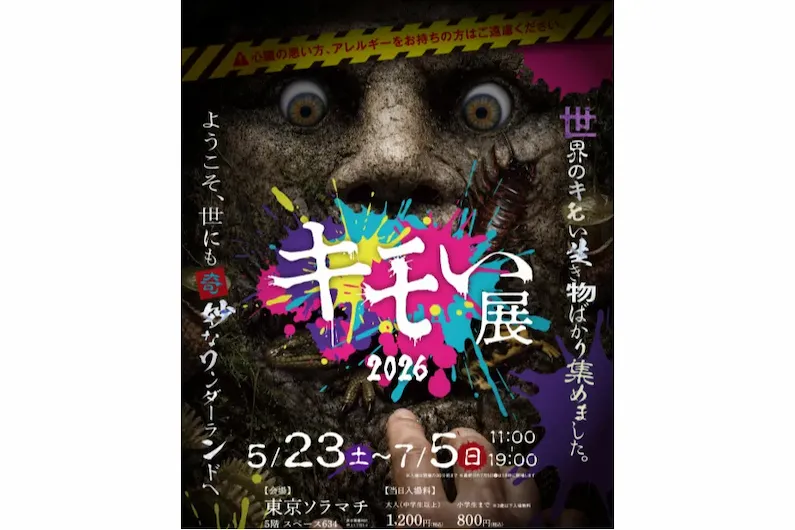
The Kimoi Exhibition has returned to Tokyo Solamachi, presenting its distinctive collection of globally sourced organisms from May 23 through July 5, 2026. Following successful runs in Tokyo, Nagoya, and Osaka that attracted diverse audiences including families and couples, this edition continues to challenge conventional perceptions of biological aesthetics. Rather than showcasing nature’s most charismatic specimens, the exhibition—named after the Japanese kimochi-warui (roughly translating to “disgusting” or “creepy”)—focuses on creatures whose unusual appearances mask sophisticated evolutionary achievements. Visitors have previously reported gaining new perspectives on ecology and rare species behavior, noting that encounters with these highly adapted organisms provoke genuine intellectual engagement beyond initial visceral reactions.
Understanding “Kimoi”
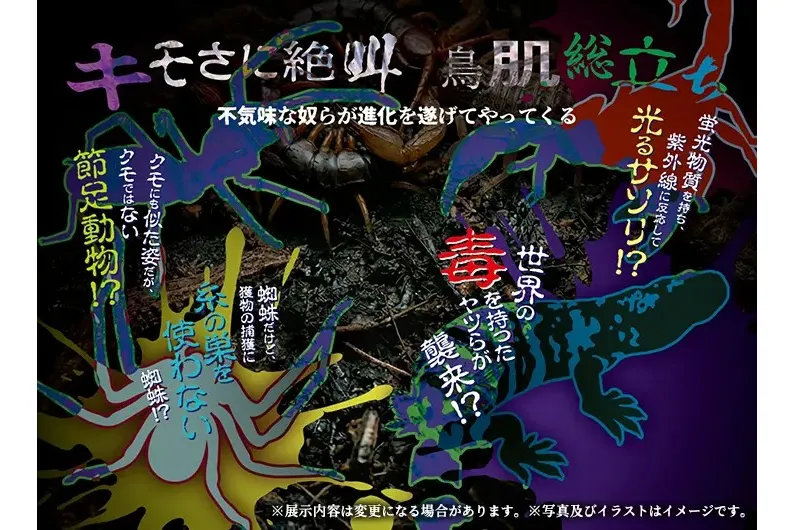
The exhibition operates on the principle that biological value exists independently of human aesthetic preferences. Each creature on display possesses specific morphological traits—unusual body plans, defensive colorations, or specialized feeding apparatuses—that represent optimized solutions to environmental challenges. While these forms may trigger immediate discomfort, they demonstrate the functional ingenuity required for survival in extreme or competitive habitats. The exhibition invites viewers to move beyond reflexive judgment and examine how these organisms influence and participate in their respective ecosystems.
Exhibition Features
AR Zone
Visitors can scan QR codes positioned throughout the venue to activate augmented reality experiences on their smartphones, revealing giant creature visualizations integrated into the physical space.
GM Street
This area employs projection mapping technology to emphasize the textural and structural details that contribute to the animals’ unsettling appearances.
Monster BOX
An interactive installation presenting mission-based challenges designed to engage visitors with the subject matter through structured activities.
Interaction Corner
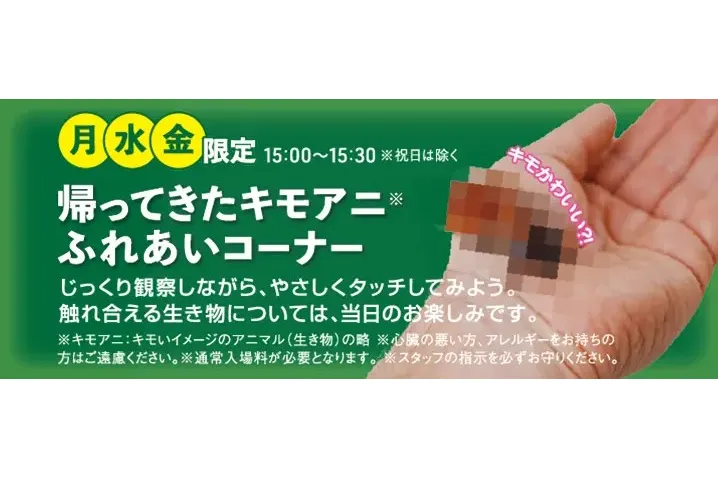
Available Mondays, Wednesdays, and Fridays from 15:00 to 15:30, this limited-duration program offers direct encounters with “Kimo-Ani” (Kimochi-warui Animals). Check schedules in advance, as this opportunity operates for only thirty minutes on select days.
Edible Insect Sales Corner
The specialized brand TAKEO operates a retail area selling edible insect products, providing a practical extension of the exhibition’s theme regarding alternative food sources and entomophagy.
Detailed programming information is available through the official website.
Visiting Information
Venue Location
Tokyo Solamachi, 5th Floor, Space 634
1-1-2 Oshiage, Sumida-ku, Tokyo 〒131-0045
Nearest Stations: Tokyo Skytree Station / Oshiage <Skytree-mae> Station
MAP
Dates and Hours
- Period: May 23, 2026 (Saturday) – July 5, 2026 (Sunday)
- Hours: 11:00 – 19:00 daily
- Final Day: July 5 closes at 18:00
- Last Entry: 30 minutes before closing time
Admission
- Adults (Junior high school students and above): ¥1,200
- Children (Elementary school students and below): ¥800
- Toddlers (3 years old and under): Free
- Tax included in all prices
Contact
Kimoi Exhibition Secretariat
Email: [email protected]
Official Website: https://kimoiten.jp/kimo2026/site_tokyo.html
Exhibition content is subject to change. Please verify current information through the official venue and organizer websites.




What is Kimoi?
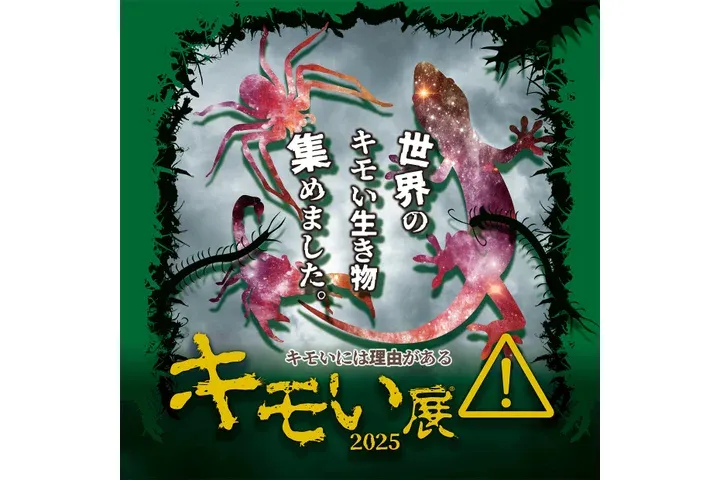
Kimoi (キモい) derives from kimochi warui (気持ち悪い), meaning “unpleasant” or “gross.” The word pins down a specific biological fascination: animals that trigger immediate physiological revulsion yet hold our attention through sheer mechanical oddity.
Consider the blobfish, whose gelatinous body—adapted to high deep-sea pressure—collapses into a sagging mask when brought to the surface; the hagfish, which coats itself in defensive slime and ties its eel-like form into reversible knots to escape predators; or the Surinam toad, whose eggs embed in the skin of her back and hatch directly through. These creatures violate mammalian standards of bodily integrity: the sealed envelope of skin, symmetrical proportions, clear boundaries between interior and exterior. Deep-sea species compound this with translucent flesh, exposed needle teeth, and bioluminescent lures that look like engineered traps rather than organic growth.
This reaction has roots in disease avoidance. Human disgust evolved to detect corruption, parasitism, and boundary violations—signals that something is consumable, contaminated, or unsafe. Yet the same features that trigger recoil often mark extreme specialization. The lamprey’s circular sucker mouth, lined with concentric teeth of cartilage, efficiently anchors the parasite to host fish. The bone-eating worm Osedax extends acid-secreting “roots” into whale skeletons, dissolving collagen and lipids in an energy-scarce abyss. These are not evolutionary errors but precise solutions to specific environmental constraints.
Japanese popular culture has mapped this duality onto consumer aesthetics. Where kawaii culture privileges infantile proportions and softened features, kimoi encompasses the asymmetrical, the porous, and the incomplete. Blobfish plush toys and hagfish keychains share shelf space with traditional cute merchandise, suggesting that biological ingenuity can generate affection without requiring aesthetic comfort. The Kimoi Exhibition relies on this premise: by presenting these animals without sanitizing their strangeness—displaying the intestinal papillae of the hairworm or the prolapsed stomach of the starfish—it allows visitors to move past visceral reaction into an examination of how life actually functions when shaped by pressure, darkness, and scarcity rather than by human preferences for symmetry and fur.
