
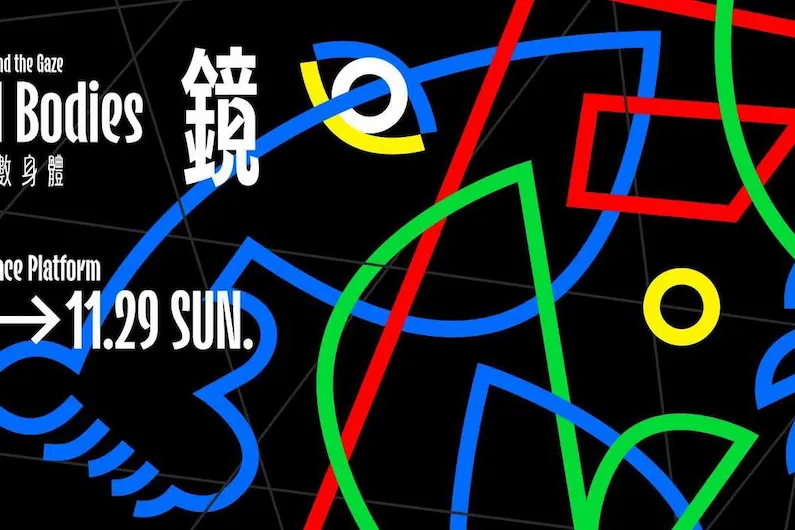
2026 Taiwan Dance Platform
Cross. Mirror—Plural Bodies
When watching is no longer just gazing, but becomes an act of crossing; when seeing does not only point outward, but transforms into a mirror reflecting the interior, the “body” is no longer stable within a single existence.
“Cross. Mirror—Plural Bodies” takes the transformation of language as a starting point, borrowing the phonetics of the word “seeing” (kan-jian) in Minnan language to turn “see” (kan) into “cross” (kua) and “seeing” (jian) into “mirror” (jing), opening a sensory field of watching, penetrating, and reflecting. This is not wordplay for its own sake; the phonetic shift carries conceptual weight. If seeing can become crossing, then the distance between audience and stage collapses into an act of passage. If seeing can become mirroring, then observation turns inward, producing a reflection not only of the work, but of the one who watches.
Here, watching is a transgression of boundaries, reflection is a process of becoming, and the body—amidst constant refraction and translation—manifests as a plural state of existence.
An International Field of Inquiry
The 2026 Taiwan Dance Platform uses “Cross. Mirror—Plural Bodies” as its curatorial theme, gathering artists from Taiwan, Thailand, Singapore, South Korea, Japan, Israel, the United States, Canada, and Germany. Through dance and cross-disciplinary creation, they unfold multiple dialogues between the body and the other, reality and virtuality, technology and life. In such intertwined relationships, the stage is no longer just a site of representation, but becomes a fluid mirror, making watching an act of crossing, and allowing the body—through continuous reflection, refraction, and deformation—to be deconstructed and reorganized.
The geographic breadth of the lineup is not incidental. Each participating artist works within distinct cultural conditions, histories of movement, and technical vocabularies, yet the curatorial frame does not ask them to stand for their origins. Instead, it brings their practices into relation, allowing the works to reflect, challenge, and amplify one another across the shared space of the platform. What emerges is less a survey of styles than a field of correspondences, where questions about the body’s limits, extensions, and transformations circulate across national and disciplinary boundaries.
The Body as an Open System
This curation uses the body as a lead-in, focusing on its fluidity and variability within contemporary contexts. The body is no longer seen as a single and stable subject, but is constantly dismantled, translated, and reorganized amidst technological intervention, cultural intersection, and sensory extension. It drifts between body and technology, body and life, body and the other, and body and culture, forming an open and generative plural state. The body on stage thus becomes a system carrying multiple relationships and perceptions, serving as both an extension of the senses and a projection field for the imagination.
For audiences, the implications are experiential as much as conceptual. The works gathered under this theme are less concerned with presenting bodies as coherent, unified figures than with exposing them as processes—bodies that morph, multiply, fragment, and recombine in response to the forces exerted upon them. Whether through the integration of digital media, the layering of cultural codes, or the intensification of physical limits, the choreography treats the body as a question rather than an answer, a material to be worked through rather than a meaning to be delivered.
Watching as an Act of Creation
Within the act of watching, we gaze upon abstract scenes that are difficult to articulate, projecting our own experiences and inner desires onto them, gradually sketching a fluid portrait that reflects the self. Art here is not only a mirror reflecting the body, but also the multiple realities refracted through countless shards after the mirror shatters. Much like the “plural bodies” themselves, they exist between differences and gaps, continuously developing new ways of watching and paths of understanding amidst instability and generation.
The viewing experience thus becomes part of the work itself. What the audience brings—memories, expectations, desires, even uncertainty—enters the field of the performance and shapes what is seen. This is the “mirror” of the curatorial title in action: not a passive surface, but an active one, transforming the material it reflects even as it reflects it. The audience is not asked to decode a fixed message, but to participate in the ongoing construction of meaning.
“Cross. Mirror—Plural Bodies” does not attempt to provide a definition of the body, but rather invites the viewer to enter a constantly shifting process of watching—between crossing and reflecting, amidst fragmentation and reorganization, to rethink how we see the body, and how, in the act of watching, we see ourselves.


What is the Taiwan Dance Platform?
The Taiwan Dance Platform is a curatorial initiative that gathers contemporary dance artists, companies, researchers, and international dance professionals in Taiwan. It is not a conventional festival but a structured meeting ground where new choreographic ideas are introduced, discussed, and developed. Its purpose is to broaden the reach of Taiwanese contemporary dance at home and abroad by supporting exchange across cultures and helping dance works travel to different contexts.
The platform’s core assumption is that dance is a form of knowledge: a way of thinking through bodies in relation to history, society, and imagination. Audiences are offered a spectrum of movement practices, from rigorously physical concert work to experimental performances that blur genre boundaries. Artists are offered a professional environment for presenting their work to international festival directors, curators, and co-producers. Programs usually combine main-stage performances, shorter showcase formats, artist talks, and industry exchanges. Together these activities provide a working picture of the contemporary dance field in Taiwan—what is being made, how it is received, and how it engages with broader questions.
The 2026 edition, “Cross. Mirror—Plural Bodies,” investigates how bodies cross boundaries and mirror one another, and what it means to move together in a world of multiple identities, abilities, and experiences. The theme reflects a field no longer defined by a single tradition or aesthetic. Taiwanese contemporary dance today is plural: different voices, bodies, and narratives coexist and sometimes conflict. The platform does not attempt to resolve that plurality into a single statement. It treats these differences as material for discussion and for future work. In that sense, it is a working site for contemporary dance—not only a place where finished works are shown, but also a place where their conditions are examined.
