
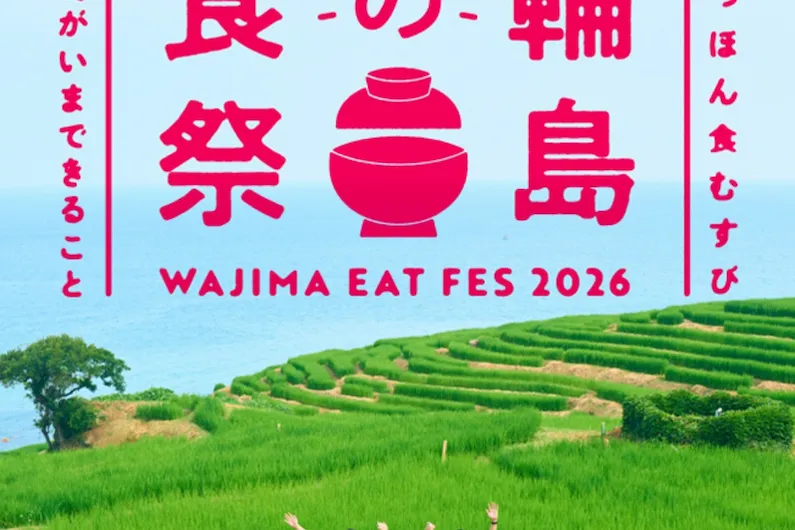
Nippon Food Musubi: “Wajima Food Festival” — What Wajima Can Do Now

Approximately three years after the Reiwa 6 (2024) Noto Peninsula Earthquake, the third Wajima Food Festival will be held at Hanshin Umeda Main Store in Osaka. The event responds to the feelings of the people of Wajima, who continue to move forward with two intentions: to do what they can do now, and to create opportunities for artisans to be active.
This year, the festival moves beyond the framework of reconstruction support, aiming for a transition to connect to the future as equal partners with the region. A total of 11 lacquerware and food shops will participate.

For visitors in Osaka, the festival is a chance to encounter Wajima’s food and craft culture without traveling to the Noto Peninsula. The lineup includes lacquerware from two studios, plus food vendors covering dried fish, creative cuisine, Japanese cuisine, bread, craft beer and soy sauce, sake, wine, rice flour sweets, and meat and egg buns.
List of Exhibitors
| Shop | Description |
|---|---|
| Wajima Kirimoto | Lacquerware |
| Wajima Kogei Sando | Lacquerware |
| mebuki | Creative cuisine |
| Minamitani Yoshie Shoten | Dried fish and other processed seafood products |
| so/s/KAWAHIGASHI | Japanese cuisine |
| Rapport du Pain | Bread |
| Tanigawa Brewing | Craft beer, soy sauce |
| Shirafuji Sake Brewery | Sake |
| Heidi Winery | Wine |
| Kome to Wato Bagel | Rice flour sweets |
| Wajima Morning Market Alley | Meat buns, egg buns |
Event overview
| Item | Details |
|---|---|
| Period | Wednesday, 2026/10/21 – Monday, 2026/10/26 |
| Hours | 10:00 – 20:00 |
| Venue | Hanshin Umeda Main Store, 1st Floor, Shokusai Terrace (1-13-13 Umeda, Kita-ku, Osaka City) |
| Admission | Free |
| Official website | Event information |
What is Wajima?
Wajima is a city on the northern coast of the Noto Peninsula in Ishikawa Prefecture. Its most prominent craft is Wajima-nuri, a lacquerware tradition that has been practiced locally for more than six hundred years. The technique requires many thin coats of urushi lacquer over a wooden base, with some undercoats containing a fine powder made from local stone. Once the lacquer has cured, the surface is polished by hand until it has a deep, even shine. Because of this labor-intensive method, Wajima-nuri is dense and holds up well under daily use.
The Wajima Morning Market has operated for centuries along a street near the port. Vendors sell seafood brought in overnight, dried goods, vegetables, and locally made crafts. The surrounding waters also define much of the local diet: oysters, yellowtail, and squid are common, and are usually prepared in simple ways to preserve their flavor. For visitors, the workshops and market stalls offer a straightforward view of a long-established coastal community.
