Gimje Horizon Festival
🗓️ 2026.10.01 ~ 2026.10.05
The following information regarding food at the festival grounds is based on the previous year’s (2025) festival; information for the 2026 festival is currently being updated.
Set against the vast golden fields of Gimje, the Gimje Horizon Festival is the only honorary representative cultural tourism festival in Korea, as designated by the Ministry of Culture, Sports and Tourism, to be built around traditional farming culture. Its main stage is Byeokgolje, the oldest and largest irrigation facility in the country, and the festival draws on this heritage to offer visitors a full immersion in rural life: cooking rice on a traditional hearth, catching grasshoppers, harvesting rice, and threshing grain by hand. The program also includes the nation’s first Presidential Cup National Nongak (farmers’ music) Competition, along with time-honored folk events such as the Twin Dragon Play, rooted in the legend of Byeokgolje, and the Ipseok Tug-of-War, a ritual prayer for a bountiful harvest—both of which welcome on-site participation.
Main Programs
Presidential Cup Horizon National Nongak Competition
The only Presidential Cup competition among national festival competitions, where nongak teams representing their regions from across the country come together to compete. Visitors can feel the essence of traditional Korean farmers’ music in a single venue, as the country’s finest performers of this vibrant folk tradition vie for the highest honor.
Byeokgolje Legend Twin Dragon Play
A representative traditional event and cultural performance based on the twin dragon legend associated with Byeokgolje, the very stage on which the Gimje Horizon Festival unfolds. The play features situational play performances with the participation of residents from Buryang-myeon, Gimje-si, lending the retelling of the ancient story a distinct local authenticity.
Bountiful Harvest Prayer Ipseok Tug-of-War
A representative traditional event and cultural performance operated with the participation of residents from Gyowol-dong, Gimje-si. Based on a traditional folk game performed to pray for a bountiful harvest on the first full moon of the lunar year, it invites festival-goers to join the pull and take part in the collective wish for abundance.
Experience Programs
Land Art Zipline Experience
A unique leisure sports experience crossing over the large-scale land art (rice paddy experience center) created at Byeokgolje. It pairs the thrill of ziplining with sweeping views of the festival’s iconic rice paddy artworks.
Cooking Rice in a Traditional Hearth
A hands-on experience where families cook cauldron rice in a small traditional hearth and sit down to eat it together. It offers a genuine taste of everyday farming life, equal parts educational and heartwarming.
Horizon Kite Flying
The largest kite-flying program in the country, in which various kites are flown simultaneously across the open field. The sight of countless kites rising into the sky captures the festival’s expansive, horizon-wide spirit.
Side Programs
LED Land Art
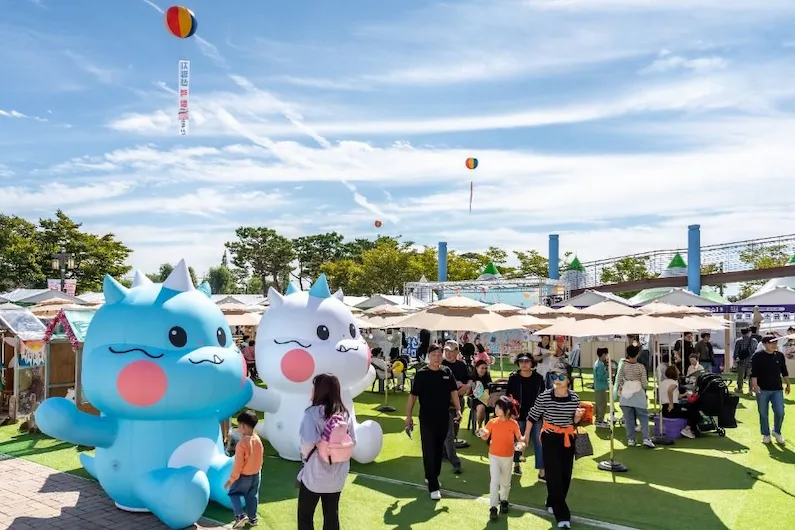
At nightfall, the land art—which depicts Ssarikong-i, the festival’s character, wearing Hanbok—becomes a glowing landscape, illuminated with lighting that matches the festival’s theme. It welcomes visitors with the abundance and warmth of the horizon after dark.
Ssarikong-i Bale Art Exhibition
A bale art exhibition that conveys the festival’s sensibility, displaying a range of drawings from the Ssarikong-i character to popular characters. The straw-bale artworks add a rustic, playful character to the festival grounds.
Horizon Final Fantasy Show
The highlight of the festival night: a grand media show combining lasers, lighting, fireworks, and multimedia. It serves as a spectacular closing attraction that brings each day of the festival to a memorable end.
Food and Other Information
- Regional Specialized Food Booths: Representative foods from Gimje’s towns, townships, and villages, along with dishes from top local restaurants selected through the ‘Matbo-jago Competition’—an initiative to identify Gimje’s best restaurants and eradicate poor-quality food at regional festivals.
- Horizon Majung Street: Snack booths catering to the younger generation, offering a lively street-food experience on the festival grounds.
- Agricultural and Special Products Direct Market: A market selling raw agricultural, livestock, and fishery products, processed goods, and special products produced in Gimje, allowing visitors to take home a taste of the region.
📍 Address: 442 Byeokgolje-ro, Buryang-myeon, Gimje-si, Jeonbuk Special Self-Governing Province
🛏️ Accommodation near the event
💰 Fee: Free (Some programs have a fee)
📞 Inquiry: 063-540-3172
⭐️ Instagram: https://www.instagram.com/gimjehorizonfestival/
🖥️ Website: http://festival.gimje.go.kr/
Gimje, a city in North Jeolla Province, sits at the center of one of South Korea’s main rice-producing regions. The Gimje Plain, one of the country’s largest areas of continuous farmland, has long been cultivated through irrigation systems and coordinated village labor. The plain’s broad, flat fields give the city its nickname—often rendered as the “granary of Korea”—and provide the setting for the annual Horizon Festival.
Farming traditions are still visible in Gimje. Local events preserve practices such as juldarigi, a tug-of-war game, and the use of durumi, traditional weeding tools. Rice-planting and harvest songs are performed during the farming calendar, and the Dongjin River continues to supply water to the surrounding fields. In autumn, the ripened rice turns the plain golden, a seasonal change that attracts visitors and photographers.
The city also maintains physical evidence of its agricultural history. Irrigation ponds, dikes, and historical farming implements are displayed at local museums and heritage sites, offering a concrete record of how the region adapted to its environment. For visitors, Gimje provides an unpolished view of rural life in Korea: agriculture sets the rhythm of daily work, and the landscape itself reflects that labor.
