
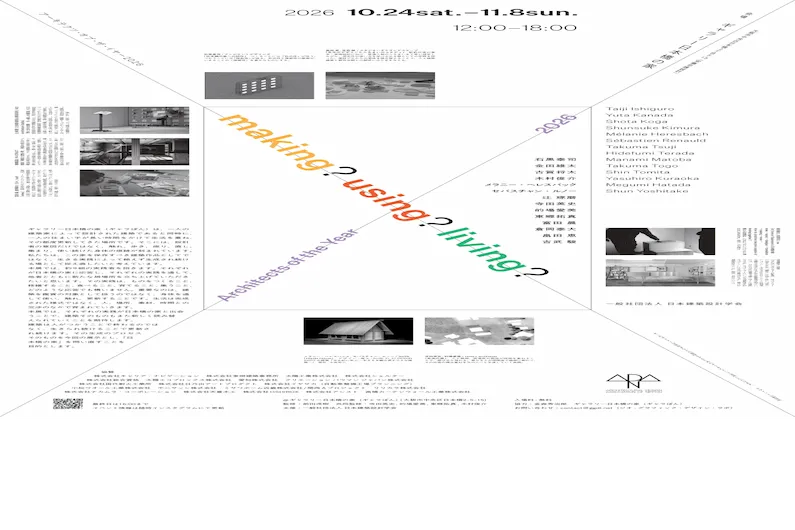
Architects of 2026: Making? Using? Living?
What if architecture were not a finished object but a continuous activity? The exhibition “Architects of 2026: Making? Using? Living?” takes up precisely this question at Gallery Nihonbashi House (Gyara-pon), a building whose character has been shaped not only by its original architect but by the everyday lives of the people who have inhabited it over time. Rather than presenting architecture as something to be admired from a distance, the exhibition reframes it as a place that is constantly generated through the practice of living. Approximately nine practitioners, including Taiji Ishiguro and Yuta Kaneda, have been invited to establish new relationships with architecture through diverse practices such as making, repairing, dining, and gathering. It is a rare opportunity to directly experience the rich process in which space and body intersect.
The venue itself embodies the exhibition’s theme. Gallery Nihonbashi House — affectionately nicknamed “Gyara-pon” — is a masterpiece of architectural design that has been transformed by the lives of its residents over time. It stands as a living example of the idea that a building is never truly complete, but evolves with each repair, each shared meal, and each gathering held within its walls. In this sense, the exhibition does not merely occupy the space; it continues the very process the event sets out to explore.
The exhibition brings together practitioners working across architecture, design, and related disciplines. The full lineup includes Taiji Ishiguro, Yuta Kaneda, Shota Koga, Shunsuke Kimura, Melanie Heresbach, Sebastian Renault, Takuma Tsuji, Eishi Terada, Manami Matoba, Takuma Togo, Shin Tomita, Yasuhiro Kuraoka, Megumi Hatakeda, and Shun Yoshitake. The event is supervised by Shigeki Maeda, with co-supervisors Eishi Terada, Manami Matoba, Takuma Togo, and Shunsuke Kimura, and is organized by the General Incorporated Association, Society of Japanese Architectural Design.
Through the acts of making, repairing, dining, and gathering, visitors are invited to reconsider the boundaries between architecture and the people who use it. The result is not a static display but a living process — a space that reveals itself through use, time, and human presence. For anyone interested in how buildings come alive through daily life, this exhibition offers a direct and immersive look at architecture in motion.
Event details
- Period: 2026/10/24 (Sat) – 11/8 (Sun)
- Hours: 12:00 – 18:00
- Location: Gallery Nihonbashi House (Gyara-pon), 2-5-15 Nihonbashi, Chuo-ku, Osaka City
- Admission: Free
- Inquiries: [email protected]
- Website: Instagram
What is Gallery Nihonbashi House (Gyara-pon)?
Gallery Nihonbashi House, or Gyara-pon, is an independent architecture gallery in Osaka’s Nihonbashi district. It is housed in a renovated townhouse rather than a purpose-built exhibition hall. The rooms are small, with low ceilings, narrow stairs, sliding doors, and an irregular layout. Spaces open into each other in ways that are not immediately obvious, and the building’s age is visible in its materials and surfaces.
This is not a neutral backdrop for exhibits. The structure affects how work is seen and how visitors move through the rooms. Exposed beams and plaster, worn flooring, and windows that look onto the street remain part of the experience. A model sits on a low table. A material study is pinned beside a doorway. The scale of the rooms keeps the viewer close to the work, and the sequence of spaces gives the visit a particular rhythm.
The current exhibition, “Architects of 2026,” uses this setting directly. Drawings, prototypes, and material studies are placed throughout the house, so they are seen in relation to the building itself. The effect is that the exhibition reads as an extension of the architecture rather than a separate collection of objects. That approach suits the gallery’s subject: architecture that continues to change after construction, and the decisions and revisions that happen along the way. Gallery Nihonbashi House offers a way of looking at those processes at close range.
