Bupyeong Pungmul Grand Festival
🗓️ 2026.10.02 ~ 2026.10.04
The food information for the festival below is from the previous year’s (2025) festival; the content for the 2026 festival is currently being updated.
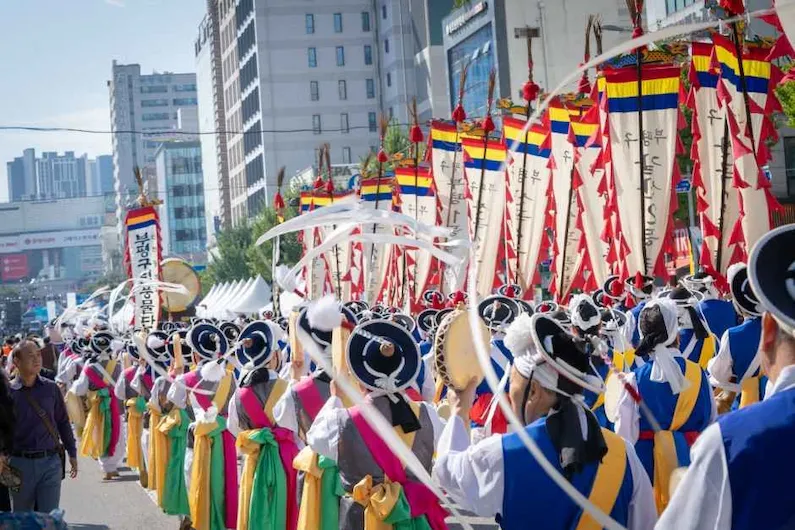
The 30th Bupyeong Pungmul Festival is a venue for the thirtieth celebration of excitement and harmony resonating within the city center. Pungmul is a Korean folk performance tradition combining percussion, dance, and song, and this festival brings that communal energy into the heart of Bupyeong. The festival, a traditional cultural arts event representing not only Incheon but the Republic of Korea, has already reached its meaningful 30th anniversary.
Since taking its first steps in 1997, the Bupyeong Pungmul Festival has grown into a large communal gathering where citizens and artists become one through the rhythms of tradition. At the core of the festival are the 22 neighborhood Pungmul groups, whose performances have served as a strong foundation that connects residents across Bupyeong as one.
The 30th edition, held for three days from October 2 to October 4, 2026, is expected to unfold on a larger and more splendid scale than ever before. It carries the special meaning of looking back on the pulse of tradition continued over the past 30 years and celebrating the new future ahead. The festival space will also be expanded to the Gulpocheon Stream area, a symbol of Bupyeong’s urban regeneration, to showcase new and diverse content.
Programs
- Main Programs: Opening and Closing Ceremonies, Bupyeong Daedong Parade, Bupyeong Manmanse, etc.
- Side Programs: Korea Creative Pungmul Contest, Bupyeong Living Culture Festival, Pungmul Festa, National Student Pungmul Competition, etc.
Food
As there are no food booths within the festival grounds, please use restaurants in the nearby area.
Event Information
📍 Address: 34-1 Bupyeong-daero, Bupyeong-gu, Incheon (Bupyeong-dong)
🛏️ Accommodation near the event
💰 Fee: Free
📞 Inquiry: 032-509-7516
⭐️ Instagram: https://www.instagram.com/bbb_ppp_fff/
🖥️ Website: https://portal.icbp.go.kr/bpf/
What is pungmul?
Pungmul is a Korean folk tradition that combines percussion music, dance, and procession. The name comes from pung (“wind”) and mul (“water”), reflecting the natural elements most relevant to the agricultural society in which the tradition developed.
Pungmul was originally performed by farming communities. It served several functions: marking the seasons, requesting good harvests, and celebrating completed work. The music also made labor more bearable. Playing and moving together gave villagers a shared focus, and the repetition of the rhythms fitted the repetitive work of planting and harvesting. In this way, pungmul was not simply entertainment; it was tied to the practical and social needs of rural life.
The ensemble is built around four instruments:
- Kkwaenggwari (small gong) – the lead instrument. Its high, piercing sound sets the tempo and directs the other players.
- Jing (large gong) – provides a low, resonant tone that anchors the rhythm and marks the end of musical phrases.
- Buk (barrel drum) – supplies a steady, grounded pulse.
- Janggu (hourglass drum) – the most flexible instrument, with two heads producing a high “ka” and a low “kung.” Its patterns are more varied than the other instruments’ and weave in and out of the main rhythm.
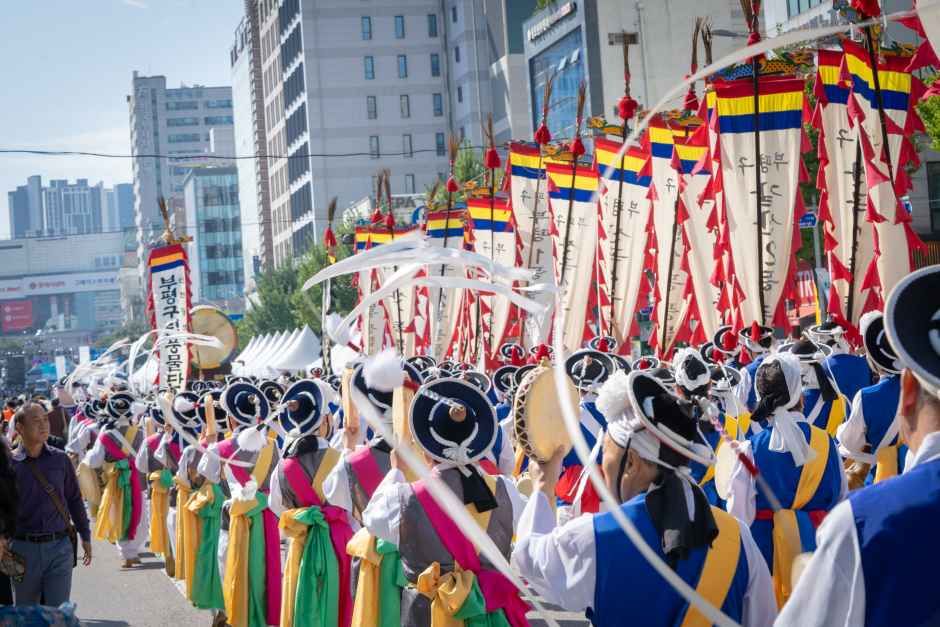
The visual aspect is as important as the sound. Performers wear colorful clothing, and some wear sangmo — hats with long ribbons attached to the crown. Spinning the hat sends the ribbon in wide arcs; this requires practiced control and is one of the most recognizable elements of pungmul. Other performers take on stock characters such as the mock bride, the shaman, and the nobleman. These figures move through the group, interacting with the musicians and adding a theatrical layer to the performance.
Pungmul is no longer limited to farming villages. It is now performed at festivals, cultural events, and political gatherings, both in South Korea and abroad. It has also influenced modern genres such as samulnori, which adapts the percussion repertoire for the concert stage. For many participants, pungmul remains a way to maintain local traditions and pass them on to younger generations.
At the 30th Bupyeong Pungmul Grand Festival 2026, the music will be presented alongside the movement, costumes, and ritual roles that define it. The aim is to show pungmul as what it is: a practiced, communal art form with deep roots in Korean history and a continuing presence in contemporary life.
