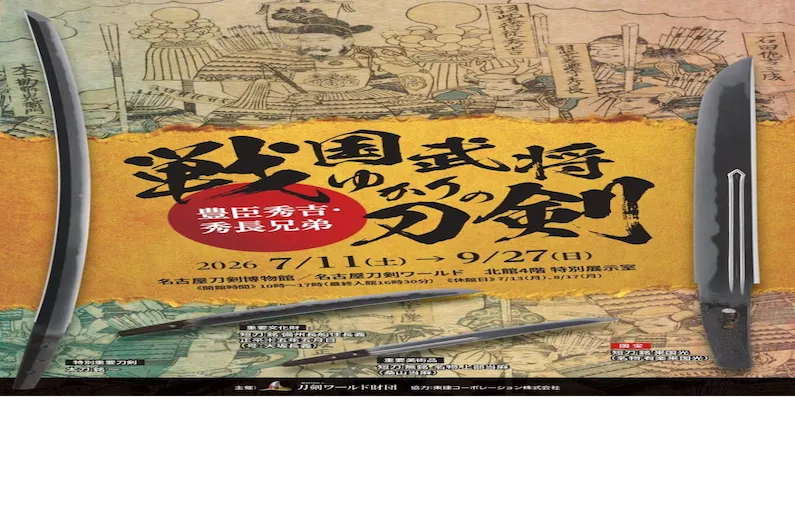
The Nagoya Sword Museum “Nagoya Token World” hosts a special exhibition from July 11 to September 27, 2026, examining the military culture of Japan’s unification through the specific lens of the Toyotomi brothers. “Swords Associated with Sengoku Warlords: The Toyotomi Hideyoshi and Hidenaga Brothers” brings together National Treasures, Important Cultural Properties, matchlock firearms, and ukiyo-e prints to document the transition from civil war to centralized rule under these two warlords.
Unlike general surveys of Sengoku-period weaponry, this exhibition focuses specifically on artifacts linked to Hideyoshi—the low-born warlord who completed the unification begun by Oda Nobunaga—and his elder brother Hidenaga, who served as both deputy and administrative anchor. The display includes blades certified as National Treasures and Important Cultural Properties, offering direct physical connection to the military elite who ended the Warring States period. Matchlock guns supplement the sword collection, illustrating the evolution of Japanese warfare during the late 16th century, while contemporary ukiyo-e prints demonstrate how later generations visualized these decisive historical figures.
The exhibition emphasizes not merely the martial aspect of these artifacts but the political relationship between the siblings. While Hideyoshi commanded the battlefield and the capital, Hidenaga managed crucial domains and campaigns, including the Kyushu conquest. Their collaboration established the administrative foundation that would last—briefly—until the Tokugawa succession. Visitors can examine how the personal bonds between warlords manifested in material culture, from presentation swords to campaign armaments, and consider how these objects mediated power during the realm’s unification.
The museum occupies a position of particular historical resonance along Sakae’s “Honmachi-dori,” the main thoroughfare constructed during the early Edo period to connect Nagoya Castle with Atsuta Jingu. This 400-year-old corridor anchored Nagoya’s urban development since the castle’s construction, making it an apt setting for examining artifacts from the immediate pre-Edo period of warlord consolidation.
Exhibition Details
Dates and Periods
The exhibition runs in two segments:
- First Period: Saturday, July 11 – Sunday, August 16, 2026
- Second Period: Tuesday, August 18 – Sunday, September 27, 2026
While the museum normally closes on Mondays, it will remain open throughout the exhibition run except for Monday, July 13 and Monday, August 17 (the closure between periods). Note that the museum will be closed for installation July 8–10 and for dismantling September 28–30.
Hours
10:00–17:00 (last admission 16:30)
Admission Fees
- General: 1,200 yen
- Seniors (65 and older): 1,000 yen
- University/High school students: 500 yen
- Junior high/Elementary school students: 300 yen
- Preschool children: Free
- Group Discount (20+ persons): 300 yen off general admission / 100 yen off other categories
- Persons with disabilities (including one accompanying person): Free (disability certificate required)
Location and Access
Nagoya Sword Museum “Nagoya Token World”
- 10-minute walk from Yabacho Station (Meijo Line)
- 9-minute walk from Osu Kannon Station (Tsurumai Line)
- 12-minute walk from Fushimi Station (Higashiyama Line)
Contact Information
- Homepage: https://www.meihaku.jp/event-hideyoshi-hidenaga/
- Email: [email protected]
- Telephone: 052-262-6000
- View spot details
- 🛏️ View hotels near the event
What is the Nagoya Sword Museum?
The Nagoya Sword Museum (Nagoya Tōken Hakubutsukan) occupies a distinct position among Japanese cultural institutions, focusing specifically on the evolution of nihontō in the Tokai region rather than presenting a general survey of the craft. Located in Nagoya’s Naka Ward, the museum opened in 1980 to consolidate the preservation of blades and materials from the former Owari Domain, a territory that served as the Tokugawa power base for centuries.
The collection spans the Kamakura through Edo periods, with particular depth in materials from the Muromachi and Azuchi-Momoyama eras. Owari smiths developed identifiable regional characteristics—straight shinogi-ji, active midare hamon, and a preference for itame hada—shaped by the domain’s control of trade routes and the Tokugawa family’s patronage of specialized metalworkers. The galleries include works by Masamine, Kanesada, and other smiths active in Nagoya and surrounding castle towns. Exhibits trace the full technical sequence: tamahagane smelting in tatara furnaces, the folding process that creates the steel’s grain structure, yakiba hardening through differential clay application, and the abrasive polishing that finalizes the blade’s geometry. Examples of koshirae mountings demonstrate the shift from practical wartime gear to the decorative arts of the Edo-period peace.
Research activities occupy much of the museum’s capacity. Staff metallurgists conduct non-invasive analysis of blade composition, maintaining databases that track ore sources and forging techniques across centuries. The archives hold production registers from Edo-period guilds, documenting specific commissions from the Tokugawa household and provincial temples.
In 2026, the museum will present an exhibition on blades associated with Toyotomi Hideyoshi and his younger half-brother Hidenaga. Hideyoshi was born in 1537 at Nakamura, then a modest settlement in the Owari region and now incorporated into Nagoya’s Nakamura Ward. The exhibition will display blades donated by the Toyotomi family to local shrines, alongside comparative pieces showing the metallurgical shift from Sengoku-period field swords to the refined work of the unification era. The curatorial approach examines how blade quality served as a marker of political legitimacy during the transition from fragmented domains to centralized rule.
