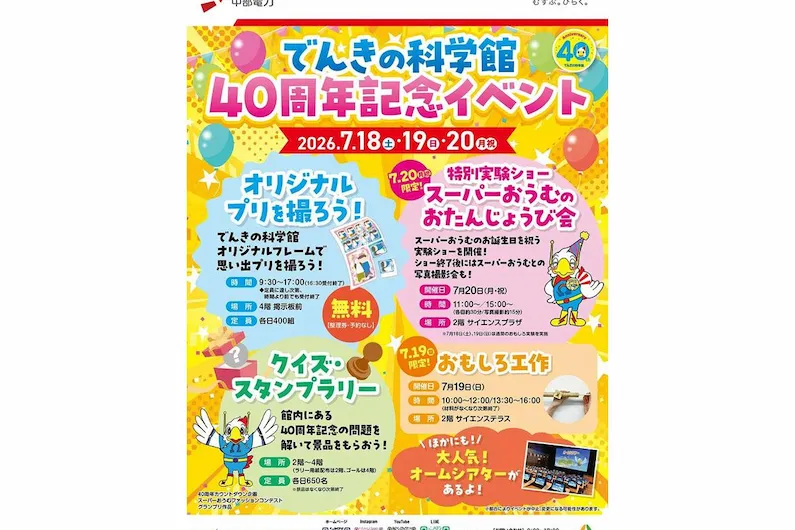
Four decades of public operation will be commemorated this July when Denki no Kagakukan (Electricity Museum) marks the 40th anniversary of its opening on July 20, 1986. The museum has structured a three-day program running from Saturday, July 18th through Monday, July 20th—a public holiday—offering extended opportunities for visitors to engage with interactive exhibits that have defined the institution since its inception.
The anniversary event distinguishes itself from standard museum operations through a curated series of participatory activities designed to reward sustained engagement across the venue. Attendees can test their knowledge through themed quizzes, navigate the facility via a stamp rally—collecting commemorative impressions at various checkpoints—and observe special experiment shows demonstrating electrical principles. These elements introduce structured activities to the educational experience, encouraging visitors to explore exhibition halls while learning about conductivity, magnetism, and power generation through direct interaction.
Event Details
Dates: Saturday, July 18th – Monday (Public Holiday), July 20th, 2026
Time: 9:30 AM – 5:00 PM
Location: Denki no Kagakukan
(2-2-5 Sakae 2-chome, Naka-ku, Nagoya City)
Fee: Free
Contact: Denki no Kagakukan
TEL: 052-201-1026
Website URL: https://www.chuden.co.jp/e-museum/
Access: 2-minute walk east from Exit 4 of “Fushimi” Station on the Subway Higashiyama and Tsurumai Lines
Denki no Kagakukan—the Nagoya City Electricity Museum—opened in Nagoya’s Naka Ward near Fushimi in 1986 as an educational facility operated by Chubu Electric Power Company. The four-story building houses experimental stations for investigating electrical principles and energy systems. As the museum approaches its fortieth anniversary in 2026, it continues to offer free admission, functioning as a public resource for understanding electricity through direct interaction with equipment.
The exhibits progress from fundamental concepts to infrastructure applications. Visitors operate hand-crank generators that require measurable physical exertion to illuminate bulbs of varying wattage, arrange conductive components to complete circuits, and manipulate plasma globes containing inert gases to observe electrical field behavior. The upper floors address Japan’s electrification history, displaying early vacuum tubes, electromechanical meters, and documentation of rural grid expansion alongside contemporary renewable technologies including photovoltaic arrays and wind turbine engineering models.
A dedicated theater hosts high-voltage demonstrations using Tesla coils to generate visible electrical arcs, illustrating principles of atmospheric conductivity and insulation breakdown. Unlike conventional museum displays, most exhibits remain operable and accessible without glass barriers; visitors handle the equipment directly while staff provide safety guidance. The collection includes working historical hardware alongside modern smart-grid demonstrations showing load balancing and distributed generation networks.
The facility serves school groups, families, and independent visitors, with technical content sufficient to engage those with engineering backgrounds. Demonstration schedules and educational programming adjust seasonally, with expanded availability during school holidays.
