
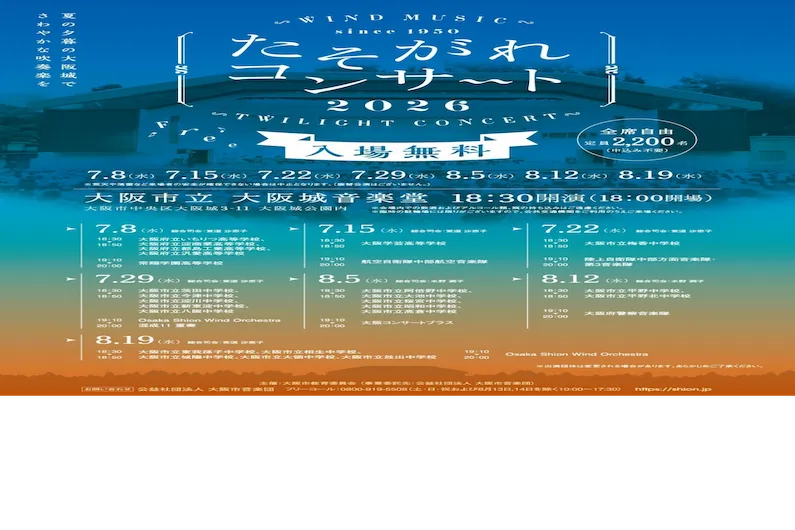
Twilight Concert 2026

Osaka City will once again host the “Twilight Concert 2026,” a free wind orchestra series that has remained a staple of the local summer calendar since its inception in 1950. Set against the historic backdrop of Osaka Castle, the event invites attendees to experience the refreshing sounds of wind instrument ensembles during the atmospheric transition of the summer twilight.
The event is distinguished by its diverse range of performers, bridging the gap between aspiring young musicians and seasoned professionals. The lineup features a spectrum of talent, from the wind orchestra clubs of city junior high schools and high schools to prestigious military music bands from the Air and Ground Self-Defense Forces. A primary highlight is the participation of the Osaka Shion Wind Orchestra—an ensemble that claims the longest history and deepest tradition of any symphonic wind orchestra in Japan.


Performance Schedule
The concert series takes place over seven consecutive Wednesdays, with each evening featuring a combination of student ensembles and professional orchestras.
Wednesday, July 8
General MC: Saeko Kakudo
- 18:30–18:50: Osaka Prefectural Ichiritsu High School, Osaka Prefectural Yodo Commercial High School, Osaka Prefectural Miyakojima Technical High School, and Osaka Prefectural Hanai High School
- 19:10–20:00: Josho Gakuen High School
Wednesday, July 15
General MC: Saeko Kakudo
- 18:30–18:50: Osaka Gakugei High School
- 19:10–20:00: Japan Air Self-Defense Force Central Air Band
Wednesday, July 22
General MC: Saeko Kakudo
- 18:30–18:50: Osaka City Umeka Junior High School
- 19:10–20:00: Japan Ground Self-Defense Force Central Army 3rd Band
Wednesday, July 29
General MC: Saeko Kakudo
- 18:30–18:50: Osaka City Ibarada Junior High School, Osaka City Imazu Junior High School, Osaka City Yodogawa Junior High School, Osaka City Shinhigashiyodo Junior High School, and Osaka City Yasaka Junior High School
- 19:10–20:00: Osaka Shion Wind Orchestra Mixed 11-piece Ensemble
Wednesday, August 5
General MC: Junko Mizuno
- 18:30–18:50: Osaka City Abeno Junior High School, Osaka City Oike Junior High School, Osaka City Sakuranomiya Junior High School, Osaka City Showa Junior High School, and Osaka City Takakura Junior High School
- 19:10–20:00: Osaka Concert Brass
Wednesday, August 12
General MC: Junko Mizuno
- 18:30–18:50: Osaka City Hirano Junior High School and Osaka City Hirano-kita Junior High School
- 19:10–20:00: Osaka Prefectural Police Band
Wednesday, August 19
General MC: Saeko Kakudo
- 18:30–18:50: Osaka City Higashimago Junior High School, Osaka City Aioy Junior High School, Osaka City Joyo Junior High School, Osaka City Oryo Junior High School, and Osaka City Hanaten Junior High School
- 19:10–20:00: Osaka Shion Wind Orchestra
Event Details
| Category | Information |
|---|---|
| Event Period | Every Wednesday from July 8, 2026, to August 19, 2026 (7 dates total) |
| Event Time | Doors open at 18:00; Performances begin at 18:30 |
| Venue | Osaka Castle Music Hall (Inside Osaka Castle Park, 3-11 Osaka-jo, Chuo-ku, Osaka City) |
| Admission Fee | Free (No advance application required) |
| Contact | 0800-919-5508 (Osaka City Music Association, Public Interest Incorporated Association; Toll-free / 10:00–17:30, excluding weekends, holidays, and August 13–14) |
| Official Website | https://shion.jp/ |
Toyotomi Hideyoshi built Osaka Castle in 1583 on the site of the Ishiyama Hongan-ji, a fortified temple that had resisted his predecessor Oda Nobunaga for ten years. Hideyoshi intended the castle to anchor his new capital, constructing it with unprecedented speed—some stone walls rose fifty feet in months—using materials and labor drafted from across western Japan. The castle fell to Tokugawa forces in 1615, was rebuilt, then struck by lightning and burned in 1665. The concrete reconstruction completed in 1931 restored the exterior to its Momoyama-period appearance: five visible stories with white plaster walls and green copper roofs topped by gold shachi, the tiger-headed carp ornaments intended to ward off fire.
The castle sits on two tiers of massive granite walls, quarried from sites across Japan and fitted without mortar. Moats encircle the inner citadel, with the outer dry moat stretching over a kilometer. Osaka Castle Park encompasses 106 hectares of lawns and groves built atop these defensive earthworks. The Nishinomaru Garden occupies the former western citadel, its sloping landscape preserving the original ramparts while facing the keep across open ground. Over 600 cherry trees line the paths, planted when the military grounds transferred to public control in the early twentieth century. Evening illumination highlights the keep’s gold ornaments against the dark stonework, drawing visitors after sunset when the park extends its summer hours.
The reconstructed keep functions as a museum across seven floors, displaying Edo-period screen paintings of the 1615 siege, replicas of Hideyoshi’s golden tea room, and artifacts recovered from the original foundations. An eighth-floor observation deck looks across the Osaka plain toward the Ikoma and Kongosanchi ranges. The surrounding park remains freely accessible; visitors can examine the intricate masonry, trace the moat segments, or walk the esplanade where Toyotomi and Tokugawa armies clashed. Archaeologists continue excavating beneath the modern pathways, uncovering the original complex’s foundations and artifacts.
