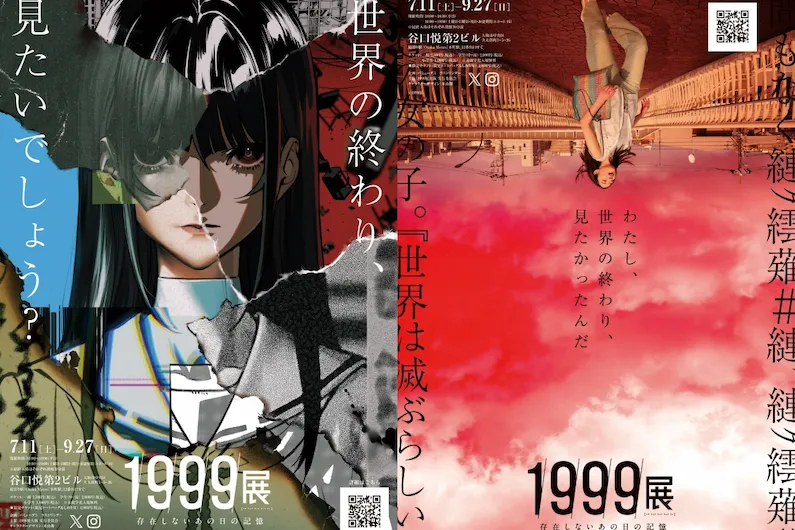
1999 Exhibition—Memories of That Day That Never Existed—
The “1999 Exhibition,” which generated significant attention during its run in Roppongi, Tokyo last summer and drew approximately 100,000 visitors, has arrived in Osaka for its first regional showing.
In 1999, Nostradamus prophesied that “the world would end.”
We are now living in that “future that did not perish.”
But did the world truly not end on “that day”?
You will now witness “that day” of 1999 that never came.
—Won’t you come to see the end of the world?—
(The above photos are from the Tokyo venue)
What if the world really had ended in July 1999?
This horror experiential exhibition invites visitors to trace the prophesied “end of the world” while immersed in the distinctive atmosphere of anxiety and anticipation that preceded 1999. The narrative unfolds through the guidance of the “Girl of the Apocalypse,” a character created specifically for this exhibition.
The project was developed by Bermuda 3, a three-person creative unit: Sesuji, a horror novelist whose works including “About a Certain Place in the Kinki Region” have sold over 1.5 million copies; Naoko Sato, screenwriter of the cult horror game “SIREN”; and Masaki Nishiyama, an emerging horror film director. The exhibition features a newly illustrated “Girl of the Apocalypse” by the popular illustrator Mai Yumeumi, and visitors will receive an original short story written by Sesuji as a complimentary benefit.
Exhibition Details
| Period | July 11 (Saturday) – September 27 (Sunday), 2026 |
| Weekday Hours | 10:00–18:00 |
| Weekend/Holiday Hours | 10:00–19:00 (Saturdays, Sundays, holidays, and Obon period: August 8–16) |
| Final Entry | 30 minutes before closing |
| Location | Taniguchi Etsu Second Building, 3-5-26 Kyutaromachi, Chuo-ku, Osaka City |
Admission Fees
| Category | Price |
|---|---|
| General | ¥2,500 |
| Junior/Senior High School Students | ¥2,000 |
| Elementary School Students | ¥1,000 |
| Preschoolers | Free |
Important Notes:
- Junior high and high school students must present a student ID
- Elementary school students must present identification or a student ID
- Persons with disabilities require a ticket, though one accompanying caregiver may enter free of charge
- Same-day tickets are available at the venue (Taniguchi Etsu Second Building) via cashless payment only
- Date-and-time reservations are required for Saturdays, Sundays, holidays, and the Obon period (August 8–16)
Contact Information
- Inquiries: [email protected] (1999 Exhibition Osaka Secretariat)
- Official Site: www.tv-osaka.co.jp/event/1999ten/
- Official X: x.com/1999_kioku_26
What was the Y2K problem?
In the late 1990s, a quirk in computer programming drove widespread concern about what would happen when the year 2000 arrived. The issue stemmed from how early systems stored dates. Throughout the 1960s and 1970s, programmers routinely abbreviated four-digit years to two digits to conserve limited memory. “1999” became “99.” The worry was that when systems rolled over to “00,” they would interpret it as 1900 rather than 2000—potentially causing errors in calculations, record-keeping, and system operations.
The scope of potential disruption was genuinely significant. Financial institutions relied on date-sensitive interest calculations. Industrial control systems, transportation networks, and government databases all depended on accurate date processing. The fear that these systems might fail simultaneously led to substantial preparation efforts. Governments and corporations worldwide spent between $300 and $600 billion on code remediation, system testing, and contingency planning. Some individuals prepared personally, stocking supplies or reinforcing homes against possible utility failures.
The response was not uniform. Critics questioned whether the expenditure matched the actual risk, pointing out that many systems would simply process incorrect dates without catastrophic failure. Others noted that the problem had been understood and worked on for years before it reached public attention. The alarm itself became a subject of debate—was it prudent preparation or a self-perpetuating panic amplified by media coverage and commercial interests in selling solutions?
When January 1st, 2000 arrived, the transition was largely uneventful. Reported failures were minor: some parking meters, videocassette rental systems, and small business accounting programs showed date errors. The absence of major disruption suggested that preparation had worked, that the risk had been overstated, or both. The debate has never fully resolved.
What remains of Y2K is instructive. It demonstrated how technical debt—compromises made for immediate convenience—can accumulate systemic risk over decades. It showed how information about technical risk spreads unevenly through public and institutional channels, sometimes amplifying and sometimes attenuating accurately. And it established a pattern for how societies respond to predicted technological crises: mobilization, expenditure, and retrospective argument about proportionality. Subsequent events, from pandemic preparation to climate policy, have echoed this dynamic in different forms.
The Y2K incident also preserved a snapshot of computing at its transition from specialized infrastructure to omnipresent utility. The systems being corrected were often decades old, written in languages now obsolete, maintained by programmers who had retired or died. The urgent need to understand them created temporary demand for obsolete expertise and focused attention on how organizations had quietly become dependent on software they no longer fully comprehended. This condition—technological opacity combined with infrastructural dependence—has only intensified in the years since.
