
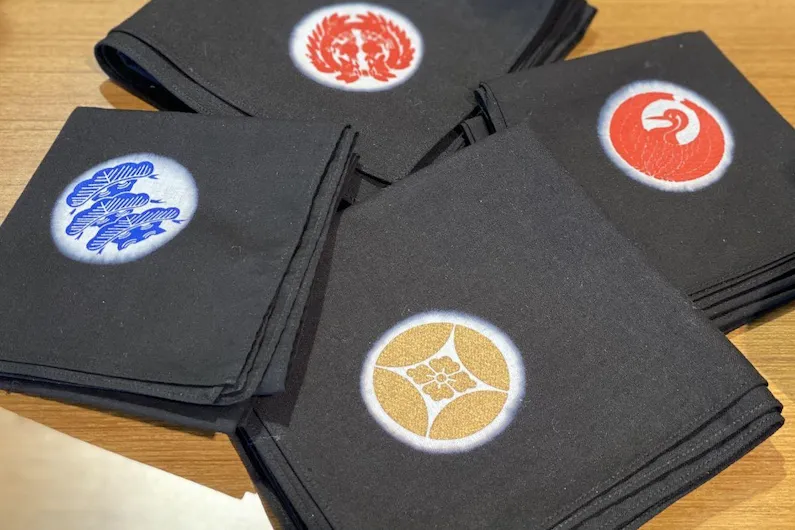
Oasis 21 i-Center Experience Event <Family Crest Printing>
When you want to enjoy Nagoya even more, why not experience traditional crafts at Oasis 21?
Dyeing has been deeply rooted in Nagoya since ancient times, including “Arimatsu and Narumi Shibori-zome,” “Nagoya Kuro-montsuki-zome,” and “Nagoya Yuzen.” The Oasis 21 i-Center is holding a “Kamon-zuri” (family crest printing) experience event where you can feel the joy of dyeing. Small children are also very welcome, and English support is available.
<h2 id=”reservation”>About Reservations</h2>
Reservation Start Date and Time
November reservations start: November 2 (Monday) from 10:00 AM
Oasis 21 i-Center
- Phone: 052-963-5252
- Reception hours: 10:00 AM – 8:00 PM
Internet Application Form
Internet Application Form
- Reservations are prioritized; if there are vacant seats on the day, participation is possible.
- We cannot accept any reservations if you contact us before the reservation start date and time.
- Each reservation covers a maximum of 30 minutes and one piece per person for the experience.
Please choose from the following start times.
Morning Session: 11:00 / 11:30 / 12:00 / 12:30
Afternoon Session: 14:30 / 15:00 / 15:30 / 16:00
- In the event of traffic disruptions due to bad weather, etc., on the day of the event, the experience event will be canceled. In such cases, we will contact those who have made reservations, so please be sure to provide your name and contact information at the time of reservation. In the event of cancellation, information will be provided in the “News” section of this site and on this “Event Page.”
- If you wish to cancel your reservation, please contact the Oasis 21 i-Center (Phone: 052-963-5252).
Request for Cooperation
- Hand sanitization
- Submission of name and contact information
These will be discarded after one month. Personal information provided will not be used except in emergencies such as bad weather. - Photos will be taken during the workshop for recording purposes, ensuring faces are not identifiable.
- Experiences using techniques other than those specified will be declined.
- Participation will be declined for those with a fever of 37.5 degrees or higher on the day.
<h2 id=”event”>Kamon-zuri Experience</h2>
Choose your favorite family crest and color to create an original family crest handkerchief, bandana, or tenugui (hand towel). Approximately 40 types of family crests are available, including famous crests and those of military commanders.
- Required time: 15 minutes
- Instructor: Mr. Takehiro Nakamura, Yamakatsu Senko Co., Ltd.
The fee depends on the item you choose to dye:
- Handkerchief: 1,000 yen
- Bandana: 1,200 yen
- Tenugui: 1,500 yen
Event Details
- Date: November 16, 2026 (Monday)
- Location: In front of Oasis 21 i-Center (Oasis 21 Basement 1st Floor)
- Fee: Handkerchief 1,000 yen / Bandana 1,200 yen / Tenugui 1,500 yen
- Contact: Oasis 21 i-Center (Reception hours 10:00 AM – 6:00 PM)
- TEL: 052-963-5252
- Access:
- Get off at “Sakae” Station on the Subway Higashiyama Line and Meijo Line, immediately upon exiting the East Ticket Gate (directly connected to the station).
- Get off at “Sakaemachi” Station on the Meitetsu Seto Line, immediately upon exiting the ticket gate (directly connected to the station).
What is a kamon, and what role do Japanese family crests play in the culture?
A kamon is a Japanese family crest: a small, stylized design used to identify a family, clan, or house. The motifs are usually geometric or borrowed from nature — paulownia, chrysanthemum, wisteria, and arrow feathers are common examples. For centuries, kamon have served much the same purpose as surnames. They appeared on clothing, banners, weapons, and buildings, allowing onlookers to identify a person’s family or political ties at a glance.
The use of crests became more formal in the Heian period, when noble families marked their carriages and garments. In later periods, samurai families used kamon on armor and battle flags to identify their forces. Over time, the practice spread beyond the warrior class. Merchants and farmers adopted crests for ceremonial dress, grave markers, and family documents. By the late Edo period, many commoner families had their own crests, often with local variations.
Kamon still appear at formal events today. They are embroidered on wedding and funeral kimono, printed on paper decorations at shrines, and used as markers on family graves. The use is largely customary rather than strictly legal: wearing a crest is a way of acknowledging family history, not a claim to noble status. In many cases, the same design is shared by unrelated families, or modified by branches over time.
Kamon-zuri is the craft of printing crests onto cloth, traditionally with carved wooden blocks. Workshops that practice it produce items such as tenugui towels, bags, and furoshiki wrapping cloth, giving visitors a practical way to engage with the motifs. The craft is a reminder that kamon are not abstract symbols from the past; they are still made, worn, and used in everyday objects.
