Mamoru Hosoda’s Origins / Exhibition

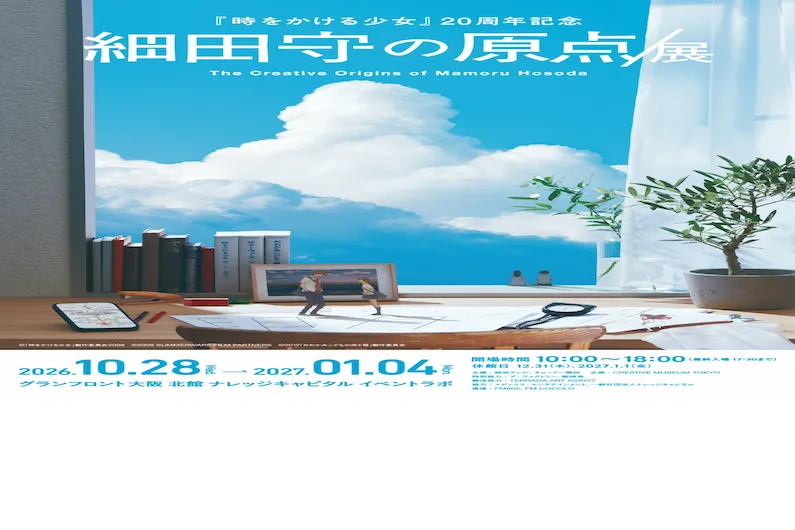
To commemorate the 20th anniversary of the release of The Girl Who Leapt Through Time, the largest exhibition to date for animation director Mamoru Hosoda will be held. Centering on The Girl Who Leapt Through Time, Summer Wars, and Wolf Children, the exhibition will display precious production materials such as storyboards, layouts, original drawings, and background art across a large space. It does not stop at the famous films, though. By tracing back to Hosoda’s work as a stage director, his independent animations from his student days, his oil paintings, and the original experiences in his hometown of Toyama, the exhibition unravels the origins of the director’s creativity and the essence of his visual direction alongside numerous famous scenes.
Event details
- Period: Wednesday, October 28, 2026 – Monday, January 4, 2027
- Closed: Thursday, December 31, 2026, Friday, January 1, 2027
- Hours: 10:00–18:00 (Last entry until 17:30)
- Location: Grand Front Osaka North Building, Knowledge Capital Event Lab (3-1 Ofukacho, Kita-ku, Osaka City)
- Fees: General/University Students 2,300 yen, Middle/High School Students 1,300 yen, Elementary School Students 700 yen *Preschool children free
- Inquiries: 0570-200-888 (12:00–17:00 *Closed on weekends and holidays)
- Website: https://www.ytv.co.jp/event/contents/hosodagenten-exhibit.html
Mamoru Hosoda is an animation director from Toyama Prefecture, born in 1967. He began his career at Toei Animation, working on series such as Dragon Ball Z and Sailor Moon, then moved into feature films. His credits include The Girl Who Leapt Through Time, Summer Wars, Wolf Children, The Boy and the Beast, Mirai, and Belle. In 2011, he co-founded Studio Chizu with producer Yuichiro Saito.
His films are usually built around family relationships and the difficulties of growing up. Several also involve digital or virtual worlds, but these are treated as extensions of the characters’ lives rather than replacements for them. The animation itself is precise: backgrounds are detailed, movement is natural, and fantasy elements are introduced without undermining the realism of the everyday scenes around them.
An upcoming exhibition in Osaka will present concept art, storyboards, and production material from Hosoda’s major works. It will show how settings were designed, how character expressions were developed, and how the studio translated scripts into finished scenes. The exhibition is aimed at both longtime viewers and newcomers. It is less about celebrating Hosoda’s reputation than about showing the craft behind his films.
