
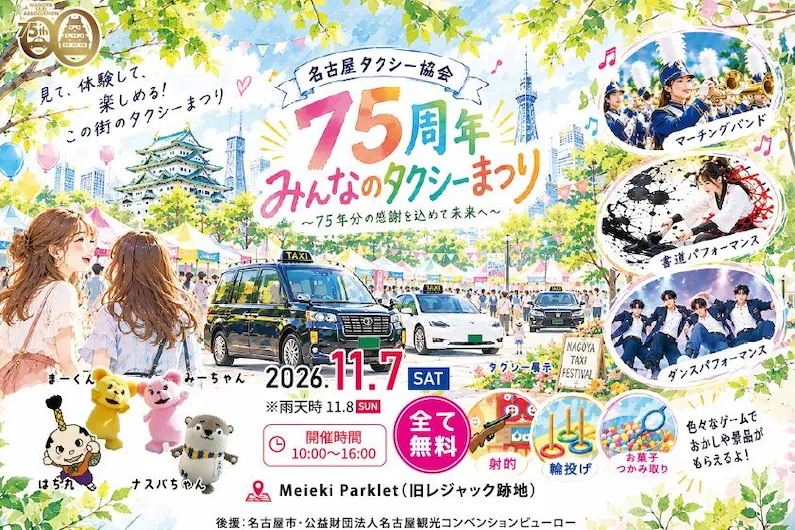
Nagoya Taxi Association 75th Anniversary: Everyone’s Taxi Festival – With 75 Years of Gratitude, Toward the Future
The Nagoya Taxi Association is marking its 75th anniversary with “Everyone’s Taxi Festival,” an event designed to express gratitude and open a conversation about the future of local mobility. The festival will be held on November 7, 2026, from 10:00 to 16:00, at Meieki Parklet (Former Lejac site) in Nagoya.
What to expect
The venue will be filled with a variety of attractions, including powerful calligraphy performances, marching band performances, and dance performances. Visitors can also get a close look at exhibits of taxi vehicles. The event offers a chance to understand how taxis support daily life in the community and to learn about the industry’s social contribution initiatives, all while enjoying an entertaining day out.
Fun for the whole family
There will be plenty for younger visitors and families to enjoy as well. Children can take part in games that reward participants with sweets, and a stamp rally will let attendees collect stamps and win prizes. With a mix of live performances, vehicle exhibits, and hands-on activities, the festival is designed so that adults and children can enjoy it together.
Event details
- Date: November 7, 2026
- Time: 10:00–16:00
- Location: Meieki Parklet (Former Lejac site), 1-25-2 Meieki Minami, Nakamura-ku, Nagoya City
- Access: 3 minutes walk
- Contact: Nagoya Taxi Association, TEL: 052-871-0601
- Website: https://www.meitakyo.com/75th/index.html
Everyone is invited to bring the whole family and join the celebration.
Meieki Parklet is a small public seating area located next to Nagoya Station, one of central Japan’s main transport hubs. It follows the parklet model: a low-cost, open-air structure that repurposes street space for pedestrians. The space is equipped with planters, benches, and a paved surface, and it functions primarily as a place where people can sit briefly, wait, or meet without having to enter a nearby building.
Because the parklet is at street level and open on all sides, it is easy to pass through or stop at. Its position near the station’s exits and transit connections makes it convenient for commuters, while its flexible layout also allows it to serve as a small event venue. The planters and benches can be rearranged to create space for stalls, performances, or informal gatherings. The taxi association’s anniversary festival is one example of this: the parklet was used for exhibits and a stage while still leaving enough room for visitors to move between the event and the surrounding shops and station entrances.
The design is deliberately minimal. There are no permanent structures or complex landscaping, and the parklet does not try to imitate a conventional park. What it provides is a modest amount of seating and open ground in a dense commercial district, along with a central, accessible site for organizations that need a public space in the immediate vicinity of the station. Its usefulness comes from that simplicity and location, not from any special amenities.
