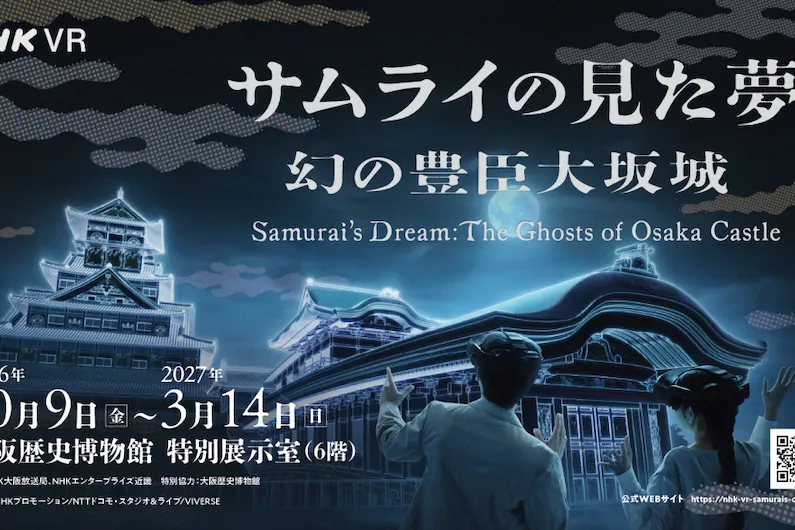
NHK VR “A Samurai’s Dream: The Phantom Toyotomi Osaka Castle” Osaka Venue


Historical entertainment where you walk and float through a famous castle built by the ruler of the realm! The phantom Toyotomi Osaka Castle, which currently hides its form deep underground, is revived after 400 years.
When you put on the VR goggles, the Osaka Castle built by Toyotomi Hideyoshi—praised as “unrivaled among the three kingdoms”—appears before your eyes. The experience moves from the view from the keep as seen by the ruler himself to encounters with exotic animals from foreign lands that terrified the samurai, and then to the “Siege of Osaka,” one of the largest battles of the Warring States period.
At the Osaka venue, additional content appears: the Golden Tea Room, where Hideyoshi himself prepared tea to entertain guests, and the offensive and defensive battles at “Sanada-maru” during the Siege of Osaka. You experience the ruler’s omotenashi (hospitality) in one scene and the battle in the next. The result is an immersive 40-minute experience of the phantom Toyotomi Osaka Castle from a realistic perspective unique to VR.
Event information
Event Period: 2026/10/9 (Fri) – 2027/3/14 (Sun)
Closed: Tuesdays (the following day if Tuesday is a public holiday), year-end and New Year holidays (12/28 – 1/4)
Hours: 9:30 – 17:00 (Admission until 16:00)
Duration: Approx. 50 minutes (Experience: approx. 40 minutes + 10 minutes for explanations and fitting, etc.)
Location: Osaka Museum of History, 6th Floor Special Exhibition Room (4-1-32 Otemae, Chuo-ku, Osaka City)
Fees: Advance reservation and date-and-time specified tickets are required
- Weekdays: Adults 3,500 yen, Elementary/Junior High/High School students 1,500 yen
- Weekends/Holidays: Adults 4,000 yen, Elementary/Junior High/High School students 2,000 yen
Please note that children under 7 years old and individuals who fall under the descriptions in the NHK VR Terms of Use cannot experience the VR content.
Inquiries: 050-5541-8600 (Hello Dial, open daily 9:00 – 20:00)
Website: https://nhk-vr-samurais-dream.jp/
Who was Toyotomi Hideyoshi?
Toyotomi Hideyoshi (1537–1598) ended a long period of civil war in Japan by completing the country’s reunification. He was born in Owari Province to a peasant family, and his rise from that background to the highest levels of power is often treated as remarkable. It owed much to the opportunities created by the wars of the 16th century, as well as to his own abilities.
He first served Oda Nobunaga, the warlord who began the campaign to unify Japan, as a low-ranking soldier. Over time he rose to become one of Nobunaga’s senior generals, primarily through a combination of tactical skill and an understanding of how to manage men and alliances. After Nobunaga was killed in 1582, Hideyoshi moved quickly against his rivals and won a series of engagements that left him as the most powerful figure in the country.
By 1590 he had defeated or neutralised the remaining independent warlords and brought Japan under a single authority for the first time since the early 16th century. His birth prevented him from taking the traditional title of shōgun, which was reserved for families of recognised samurai lineage. The imperial court instead gave him the title of kanpaku, or regent, and later taikō, a term for a retired regent. These titles gave him formal legitimacy without requiring a noble ancestry.
Hideyoshi made Osaka Castle the centre of his administration. He ordered its construction in the 1580s, and it functioned both as a fortress and as a residence that displayed his authority. The castle remained politically significant after his death and was fought over repeatedly in later conflicts.
His domestic policies were extensive. The “sword hunt” of 1588 required farmers to surrender weapons, and it was followed by regulations that defined the social boundary between samurai and commoners. These measures helped consolidate control over the countryside and shaped the status system of the Edo period. In his final years, however, Hideyoshi overreached. He launched two invasions of Korea, in 1592 and 1597, which failed after heavy losses and put severe strain on his regime. He died in 1598, leaving a young heir. The resulting power struggle culminated in the Battle of Sekigahara in 1600, which brought Tokugawa Ieyasu to power.
The NHK VR experience, A Samurai’s Dream: The Phantom Toyotomi Osaka Castle, presents a reconstruction of Hideyoshi’s castle and the world around it. It offers a way to examine the built environment of the period rather than a biographical portrait of the man himself.
