Cheongwon Life Festival
🗓️ 2026.10.02 ~ 2026.10.11
The Cheongwon Life Festival has been a representative festival themed around eco-friendliness since 2008. At its heart is the Cheongwon Life brand, a line of luxury agricultural products that derives its value from the purity of the natural environment in which it is grown. The festival translates that focus into a ten-day event—running from October 2 to October 11, 2026—that pairs themed exhibitions with experiential programs and cultural performances.
The festival’s ambitions, however, extend beyond spectacle. It serves as an educational venue where students can experience the present and future of agriculture alongside a range of cultural traditions. Through direct exchanges between local farmers and consumers, it promotes the excellence of local agricultural products and the principles of eco-friendly farming. For family visitors, the program mix offers both entertainment and insight into healthy food and sustainable agriculture. In doing so, the festival spreads the public value of agriculture while establishing itself as Cheongju City’s representative festival, contributing to the revitalization of the local economy and the development of rural culture.
1. Official Programs
The festival’s official schedule is built around an opening ceremony, an opening event, and celebratory performances, all bookended by a closing ceremony at the end of the ten-day run. These anchor the program and give each visit a defined sense of occasion, whether visitors arrive on the first day or the last.
2. Performance Programs
The performance lineup is led by a super concert, the festival’s largest musical draw, complemented by a laser show that adds a visual centerpiece to the evening hours. Local art groups and busking performers share the stage as well, giving the entertainment schedule a balance of large-scale production and grassroots local talent.
3. Participation Programs
For visitors who prefer to take part rather than watch, the participation programs offer the festival’s most hands-on experiences. Citizen harmony orienteering sends teams across the festival grounds in a test of navigation and teamwork. The retro DJ box brings a nostalgic sound to the event, while the sweet potato harvesting experience and traditional agricultural culture experience introduce families to farming practices directly. Children & family experiences round out the lineup for younger visitors.
These activities double as the festival’s educational core, giving school-age visitors a tangible sense of agriculture’s history and future without resorting to a classroom format.
4. Sales Programs
The sales area is where the festival’s agricultural mission becomes tangible. Agricultural and livestock products are available directly from local farms, alongside goods produced by social enterprises and youth startup companies. The arrangement allows consumers to meet producers face-to-face, reinforcing the values of transparency and sustainability that the Cheongwon Life brand represents.
5. Food Programs
Food is treated with the same commitment to local production. The bonfire grilling zone lets visitors cook their own ingredients over open flames, a fitting activity for an eco-friendly festival. The Cheongju gourmet zone showcases regional specialties, while the Cheongwon-gol Makgeolli tavern serves traditional rice wine in a dedicated setting. Food trucks add convenient options for those moving between programs.
Visitor Information
- 📍 Address: 99 Mirae-jiro, Ochang-eup, Cheongwon-gu, Cheongju-si, Chungcheongbuk-do
- 🛏️ Accommodation near the event
- 💰 Fee: Paid (₩5,000)
※ Free admission for children, adolescents, pregnant women, and the elderly - 📞 Inquiry: 043-201-0254
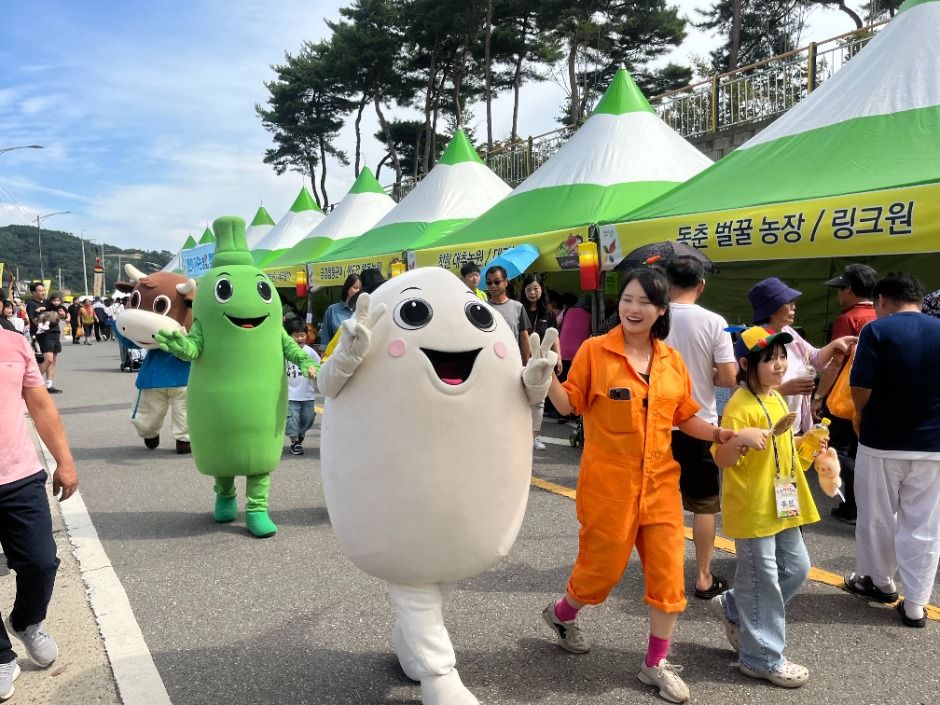
Cheongwon is a rural district in Cheongju, a city in North Chungcheong Province, South Korea. It surrounds the more urbanized center of Cheongju and consists largely of farmland, orchards, and small farming villages. The name suggests open countryside, and the landscape matches: rice paddies, vegetable fields, and fruit trees spread across gently rolling land.
Administratively, Cheongwon was a separate county until 2014, when it was merged into Cheongju. It now functions as a district of the city, but its character remains predominantly agricultural. Much of the produce sold in Cheongju’s markets is grown here: rice, peppers, apples, grapes, and other seasonal crops. The area is marked by small family farms, country roads shaded with persimmon trees, and village community centers that continue to serve as gathering places for residents.
For visitors, what is most visible is simply that farming is an active part of daily life. You can walk past working fields, watch farmers preparing land or harvesting crops, and notice how the calendar shapes local routines. The Cheongwon Life Festival makes direct use of this setting, with events held in and around farmlands and village spaces. Its focus is on agricultural practice, local food, and rural culture—without needing to dress them up as something more exotic than they are.
