Bupyeong Pungmul Grand Festival
🗓️ 2026.10.02 ~ 2026.10.04
The 30th Bupyeong Pungmul Festival carries a special weight: it is the thirtieth celebration of excitement and harmony resonating within the city center. Since taking its first steps in 1997, the festival has grown from a local gathering into a traditional culture and arts festival representing not only Incheon but all of South Korea. What began as a modest community event now stands as a massive communication space where citizens and artists become one, breathing the country’s unique traditional rhythms into the heart of the urban landscape.
At the core of the festival are the 22 neighborhood Pungmul groups, whose collective rhythms have served as its foundation for three decades. These groups, drawn from districts across Bupyeong-gu, connect residents as one through the driving beats of janggu, buk, jing, and kkwaenggwari—percussion instruments rooted in Korean folk and agricultural tradition. Pungmul is not merely a performance genre; it is a participatory practice, and the festival’s structure reflects that ethos, inviting audiences to step into the rhythm rather than simply observe it.
This year’s edition, held for three days from October 2 to 4, 2026, arrives on a larger and more magnificent scale than ever before. It carries the dual task of reflecting on the lineage of tradition maintained over the past 30 years and celebrating the new future to come. A notable expansion is the addition of the Gulpocheon area, a symbol of Bupyeong’s urban regeneration, as part of the festival grounds. The new venue will host fresh, diverse content, broadening the festival’s reach beyond its familiar downtown footprint.
Festival Programs
Main Programs
- Opening and closing ceremonies
- Bupyeong Daedong Parade
- Bupyeong Manmanse
Side Programs
- Korea Creative Pungmul Competition
- Bupyeong Life Culture Festival
- Pungmul Festa
- National Student Pungmul Competition
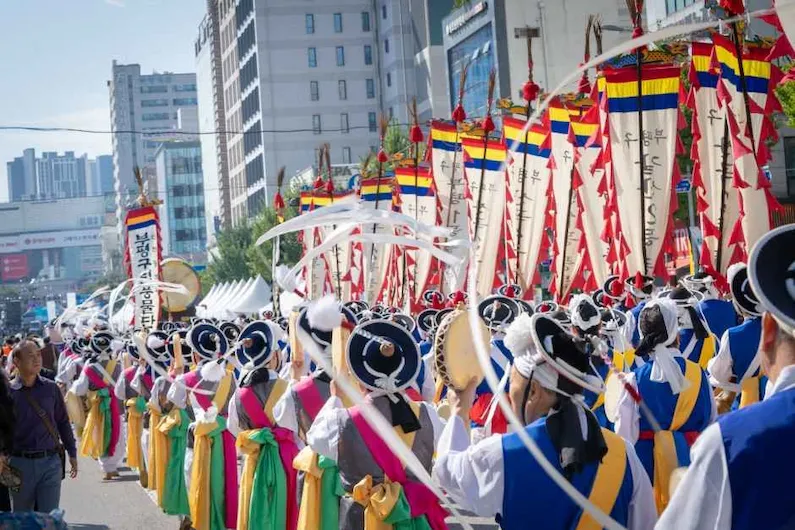
The Daedong Parade and Bupyeong Manmanse, in particular, embody the festival’s communal spirit—streets filled with rhythmic ensembles and collective celebration that turn the city center into an open-air stage.
Visitor Information
📍 Address: 34-1 Bupyeong-daero, Bupyeong-gu, Incheon (Bupyeong-dong)
🛏️ Accommodation near the event
💰 Fee: Free
📞 Inquiry: 032-509-7516
⭐️ Instagram: @the_official_bpf
🖥️ Website: Bupyeong Pungmul Festival
What is pungmul?
Pungmul is a traditional Korean percussion performance that comes from farming communities. It combines drumming, dance, and theatrical display. Farmers played these rhythms while planting and harvesting, both to coordinate the work and to pray for good harvests. As village customs expanded, pungmul became a form of street entertainment, with improvised gestures and comic exchanges mixed into the music.
The ensemble is led by the kkwaenggwari, a small gong with a sharp, penetrating tone. It sets the tempo and directs changes. The jing, a large gong, gives a deeper, longer sound, and the buk (barrel drum) and janggu (hourglass drum) lay down the main rhythmic pattern. The instruments are played together in a dense, steady rhythm that keeps the performers synchronized.
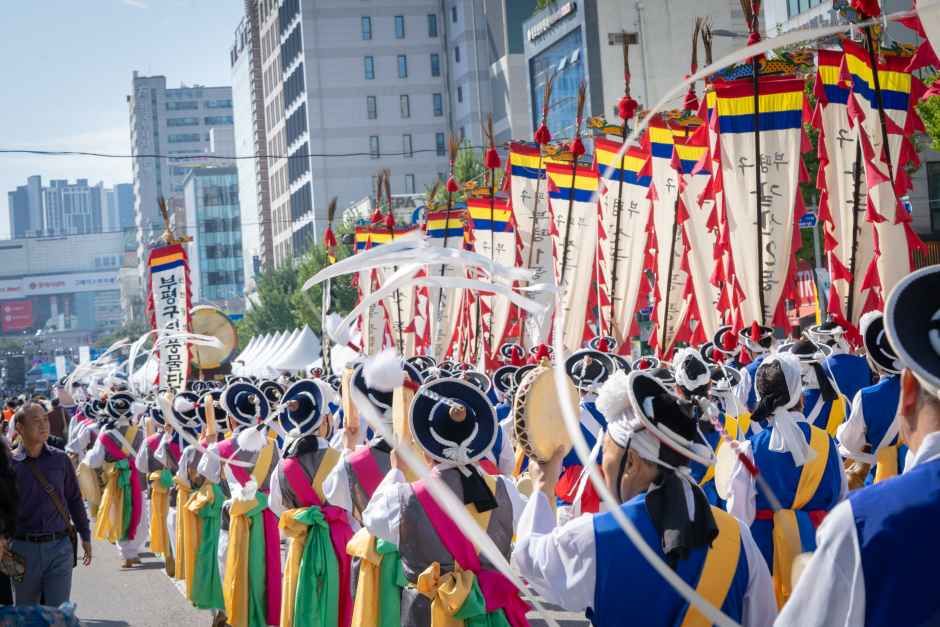
The visual part of pungmul is equally controlled. Performers dress in colorful clothes, and those wearing sangmo hats spin long ribbons by turning their heads at precise moments. The ribbons trace wide circles in the air, and the motion is tied to the rhythm of the music. The head movements are athletic and carefully timed; they are not decoration added after the fact but part of the performance.
Pungmul has always been a communal practice. It was played during collective labor, village rites, and seasonal festivals, and those settings still shape the way it is performed. The music gives a group a common tempo and a common task. At the Bupyeong Pungmul Grand Festival, that tradition is presented on a larger stage, keeping the music and its village origins in view.
