The 7th Gochang Nongak Flower Festival
🗓️ 2026.08.28 ~ 2026.08.30
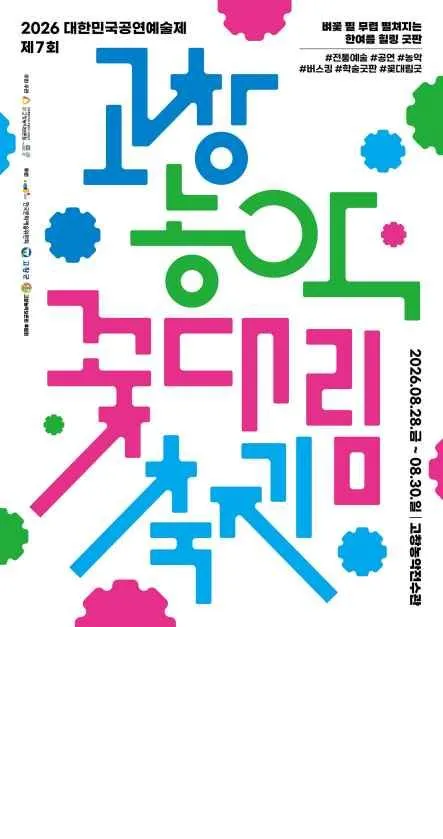
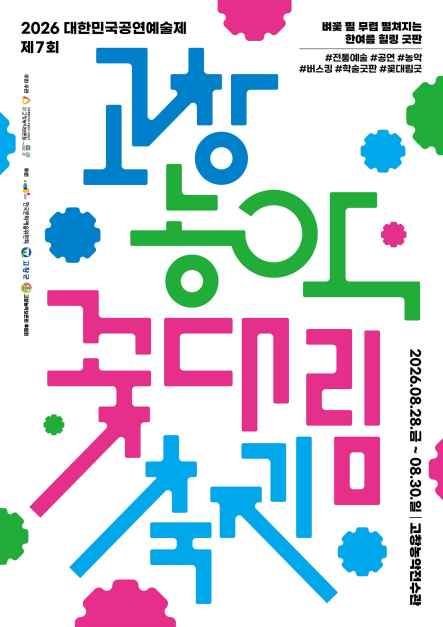
The Gochang Nongak Kkotdaerim Festival is a performing arts festival built on the community spirit of Gochang Nongak, an intangible heritage of Jeonbuk State. At its center is the Kkotdaerim-gut, a village ritual traditionally held around Chilseok, the seventh day of the seventh lunar month, when residents come together to perform a gut, release the hardships they have accumulated, and pray for abundance for the rest of the year. The festival reinterprets that ritual for a contemporary audience while keeping its communal core intact.
What makes this edition distinctive is the range of formats in a single program. The lineup moves from the foundational forms of Gochang Nongak—Pungjang-gut, Mun-gut, and Pan-gut—to invited works across music, sound, and entertainment. It also includes market, exhibition, academic, and exchange programs. By placing traditional performance arts alongside hands-on activities, the festival brings visitors, cultural artists, local residents, Nongak enthusiasts, and researchers into the same space. The 7th edition runs for three days, from August 28 to 30, 2026, around the Gochang Nongak Training Center. Admission is free.
Main Programs
The festival opens with Kkotdaerim Dangsan-gut and the Kkotdaerim Opening Ceremony, then concludes with the Kkotdaerim Closing Ceremony. The rest of the program unfolds between those.
Performance Plaza
- Performance Plaza _ Gochang Nongak Pungjang-gut
- Performance Plaza _ Gochang Nongak Trainees Gutpae – Pan-gut and Japsaek
- Performance Plaza _ National Intangible Heritage Baltal
- Performance Plaza _ Gumi Mueul Nongak
- Gut-jaeng-i Exhibition
Performance Stage
- Performance Stage _ Kim Bo-ra ‘Fire, Rice, Water, Pot, Steam’
- Performance Stage _ Bang Ji-won and Gutpae ‘East Sea UNIVERSE-Gochang’
- Performance Stage _ Seedless Watermelon Kim Dae-jung ‘The Undutiful Child Plays’
- Performance Stage _ Park In-seon and Generals
Special and International Programs
- Kkotdaerim Ball _ DJ Peggy Gut
- Special Stage _ Korea-Japan International Exchange Cooperation Performance ‘One Origin: Accompanying (同行)’
- Special Stage _ Nenbutsu Kenbai Participatory Workshop
Side Events and Programs
For visitors who want to take part rather than simply watch, the festival offers several participatory formats and market activities:
- Our Flea Market
- Cute Rain Boot Headbands
- Our Kkotdaerim-gut
- ‘Cham-Cham-Cham’ (Busking), a true gut gathering where participants take part
- Show Me the Nori – Individual Play Battle
These side events reinforce the festival’s stated purpose: expanding the transmission base of Gochang Nongak and connecting the region’s traditional culture with contemporary performing arts.
Visitor Information
The festival takes place around the Gochang Nongak Training Center in Gochang-gun, Jeonbuk State.
📍 Address: 106 Hyangsan 1-gil, Seongsong-myeon, Gochang-gun, Jeonbuk State
🛏️ Accommodation near the event
💰 Fee: Free
📞 Inquiry: 063-562-2044
🖥️ Homepage: Official Website
Official Instagram
What is Nongak?
Nongak is a traditional Korean performing art that developed among farming communities. It combines percussion, wind, dance, and ritual, and was commonly performed to pray for good harvests, to mark seasonal events, and to strengthen village ties. In the past, most participants were farmers, and the music was played outdoors, often while moving through fields or village lanes.
The ensemble is built around four percussion instruments: the buk (barrel drum), the jing (large hanging gong), the kkwaenggwari (small gong), and the janggu (hourglass drum). A taepyeongso, a conical double-reed instrument, adds melody over the percussion. Dancers and flag bearers accompany the band. Some dancers wear sangmo, hats with long ribbons that are spun in circular motions. The choreography includes walking formations, jumps, turns, and acrobatic elements.
Nongak also has a ritual function. In traditional performances, a ceremony might begin with purification of the village, move to a parade through the fields, and conclude with a communal meal. The exact sequence varies by region.
Today, nongak is staged at festivals and can be studied as a performing art. It was inscribed on UNESCO’s Representative List of the Intangible Cultural Heritage of Humanity in 2014. At the Gochang Nongak Flower Festival, audiences can watch performances by local and invited groups. The event provides an opportunity to see the music, dance, and ritual elements in one place, and to learn about the regional history that shaped them.
