Janghang Maekmundong Flower Festival
🗓️ 2026.08.28 ~ 2026.08.30
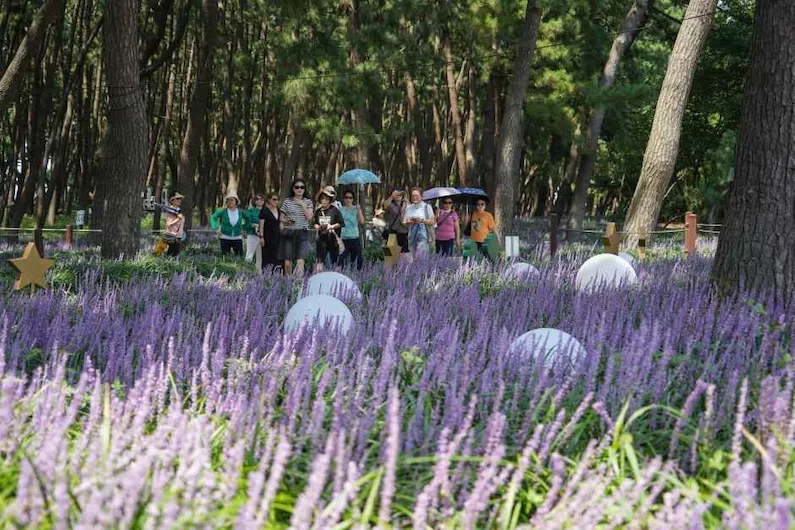
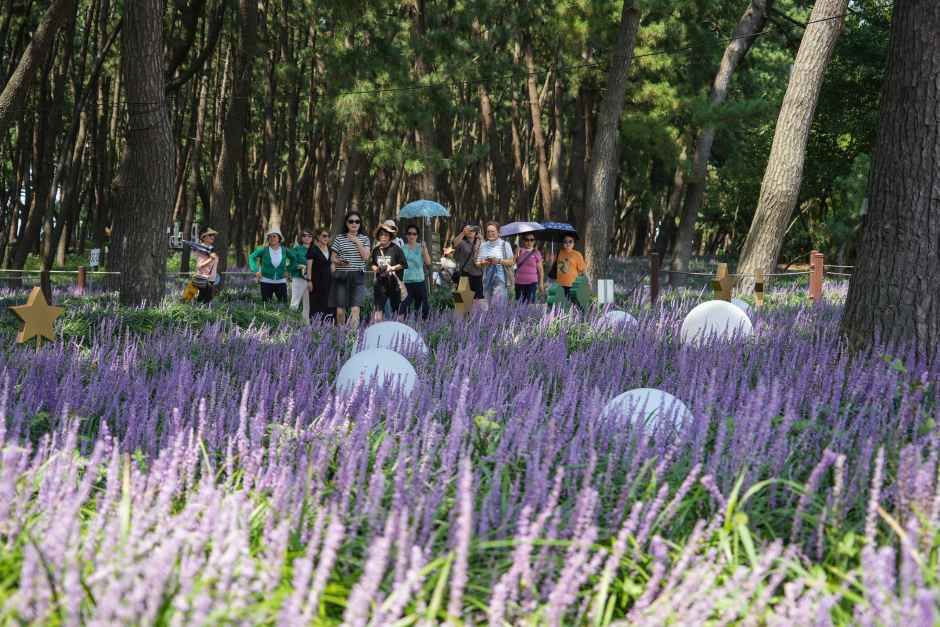
Janghang Songrim Natural Recreation Forest draws roughly one million visitors each year and hosts the largest colony of Maekmundong (Liriope)—known also by its Korean name Maekmundong—anywhere in the country. Six million of these perennial plants spread across approximately 280,000 square meters of coastal pine forest, creating a sea of purple that blooms in late August. The forest itself sits adjacent to the West Coast, offering the rare combination of dense woodland, flowering understory, and open ocean views within a single setting.
The Janghang Maekmundong Flower Festival builds directly upon this landscape. Rather than importing temporary structures or artificial decorations, the event extends what the forest already provides: a seasonal spectacle of color that lasts roughly two weeks at peak bloom. Programming incorporates the surroundings through guided walks, photography points positioned among the flowers, and activities that use Maekmundong or native pine materials. The result is a regional festival where the natural calendar determines the schedule, and human programming merely amplifies what’s already occurring.
Programs and Activities
Performance Programs
- Opening ceremony performance and Healing Festa
- Senior fashion show
Participation Events
- Maekmundong lucky draw
- Dress code Purple Day (visitors wearing purple receive additional benefits)
Experience and Activity Programs
- Maekmundong playground (children’s activity area)
- Maekmundong little water playground
- Maekmundong ice foot bath
- Terrarium diffuser making workshop
- Solbaram (pine breeze) doll making workshop
- Maekmundong experience outing (guided forest walk)
- Maekmundong forest cookie baking class
Exhibition Programs
- Seocheon tourism souvenirs and traditional craft contest exhibition
Food
- Youth food truck operation
Practical Information
📍 Address: San 58-48, Songrim-ri, Janghang-eup, Seocheon-gun, Chungcheongnam-do
🛏️ Accommodations near the event
💰 Admission: Free
📞 Inquiries: 041-950-4256
⭐️ Instagram: https://www.instagram.com/mmd__festival/
🖥️ Homepage: http://mmdfestival.kr/
What is maekmundong?
Maekmundong (Liriope muscari), also known as lilyturf or big blue lilyturf, is a perennial flowering plant native to East Asia, where it has grown for centuries in shaded woodlands and mountain valleys. Despite its common English name, it is not a true lily but belongs to the asparagus family, with grass-like foliage that stays green through most of the year.
The plant is valued for its late-summer flowers: dense spikes of small, bell-shaped blossoms in violet and purple, rising on slender stalks above the arching leaves. These flowers produce glossy black berries that remain through winter, giving the plant presence across seasons.
In Korea, maekmundong carries particular cultural weight. Its tuberous roots have long appeared in traditional medicine, used for respiratory conditions and general health. The plant’s ability to grow in difficult, shaded sites has made it a symbol of persistence in Korean folklore. Gardeners have grown it for generations as ground cover beneath trees and along paths, but the plant shows a different character when left to spread. At sites like Janghang, where it blooms across hillsides in late August and September, the massed purple spikes can transform the forest floor—an effect that draws visitors and photographs poorly because scale and density matter more than individual flowers.
The plant’s practical strengths explain its persistence in cultivation. It tolerates dry shade, poor soil, and root competition from established trees. It spreads slowly by rhizome, filling ground without becoming invasive in most conditions. The evergreen foliage gives structure to winter gardens, and the flowers attract bees at a season when fewer plants are in bloom. These qualities have kept it in use through changing fashions in garden design, from the structured plantings of the Joseon period to contemporary naturalistic landscaping.
Identification requires some care. Liriope muscari differs from Liriope spicata, a more aggressive spreader with narrower leaves and paler flowers, and from Ophiopogon japonicus, a similar evergreen groundcover with fibrous rather than tuberous roots. The specific name muscari refers to the flower’s supposed resemblance to grape hyacinth, though the spikes are looser and the individual flowers more open. Proper naming matters in horticulture and in medicine, where different species carry different chemical profiles and different traditional applications.
The roots contain saponins, the compounds responsible for their traditional use in treating cough and lung inflammation. Modern research has examined these compounds for antioxidant and anti-inflammatory properties, though clinical evidence remains limited. The plant thus occupies a familiar position—valued through long practice, plausible in its mechanisms, not fully validated by contemporary standards. This does not diminish its cultural role, but it does shape how one might describe its benefits.
As a garden plant, maekmundong works best where its habits are suited to the site: beneath deciduous trees, along north-facing foundations, on slopes where mowing is difficult. It does poorly in full sun and wet soil, and the foliage can look ragged by late winter, needing shear-back before spring growth. These are manageable constraints for a plant that asks little and returns reliably. The massed bloom at Janghang and similar sites happens where conditions—shade, drainage, absence of competition—allow the plant to reach densities difficult in managed gardens. The effect is worth seeking out, and difficult to replicate.
