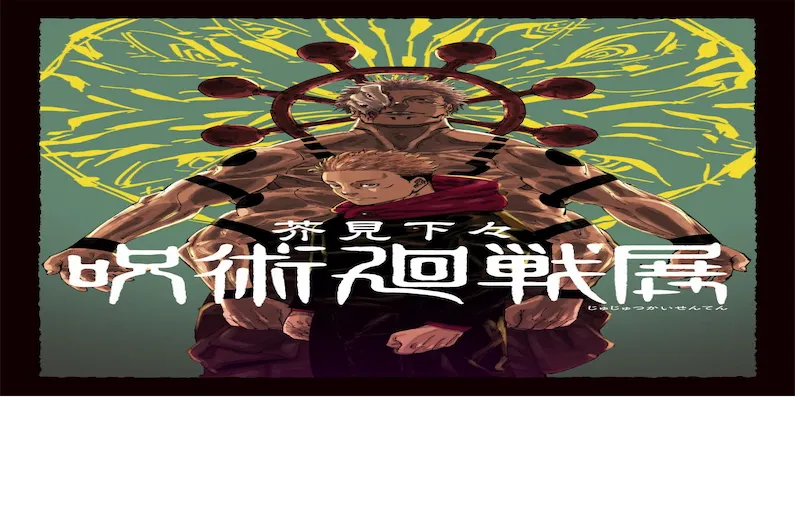
“Jujutsu Kaisen,” a dark fantasy unleashed upon the modern era by a singular talent. Since its serialization began in Weekly Shonen Jump, the work has drawn significant attention and generated a substantial response through its TV anime series and theatrical anime films. The fast-paced story, written by Gege Akutami, holds readers through a deliberately structured narrative that shifts between despair and hope. This exhibition reveals the detailed creative process behind Jujutsu Kaisen through digital methods, accompanied by the author’s own explanations.
The exhibition takes a different approach from the standard manga retrospective, where original manuscripts and printed panels dominate the display. Here, the focus falls on process: how the series’ precise paneling, expressive character work, and the escalating conflict between curses and sorcerers are constructed on the page. Akutami’s commentary, presented throughout the exhibition, offers direct insight into the storytelling decisions that have defined the series since its debut. For readers who have followed the manga from the beginning, and for those who arrived through the anime adaptations, the presentation provides a closer look at the machinery behind one of Weekly Shonen Jump‘s defining modern works.
©Gege Akutami / Shueisha
Event Details
- Dates: Saturday, July 4, 2026 – Sunday, August 30, 2026
- Closed: Open throughout the exhibition period
- Hours: 10:00 AM – 6:00 PM (Entry until 5:30 PM)
- Location: Matsuzakaya Art Museum, Matsuzakaya Nagoya Store, South Building 7th Floor
Admission Fees
| Ticket Type | Price |
|---|---|
| General | 2,000 yen |
| Middle/High School Students | 1,500 yen |
| Age 4 to Elementary School Students | 1,000 yen |
| With goods (limited quantity) | 4,200 yen |
Visitor Bonus
One “Commemorative Sticker” will be given to customers who enter with a ticket during the exhibition period.
Access
- Directly connected to Yabacho Station on the Subway Meijo Line via underground passage (Exits 5 and 6)
- 5-minute walk south from Exit 16 of Subway Sakae Station
Contact & Links
- Inquiries: Matsuzakaya Art Museum
- TEL: (Main) 050-1782-7000
- Homepage: https://www.matsuzakaya.co.jp/nagoya/museum/jujutsuten/
- X: https://x.com/museum_matsu
Notes: Please be sure to check the precautions on the official homepage before visiting.
Gege Akutami and Jujutsu Kaisen
Gege Akutami is the pen name of the manga artist who created Jujutsu Kaisen. Born in Iwate Prefecture in 1992, Akutami grew up with Dragon Ball and Yu Yu Hakusho, and has cited Tite Kubo as a major influence. After the one-shots Kamishiro Sousei and No.9, Akutami started Jujutsu Kaisen in Weekly Shonen Jump in March 2018. The manga ran until 2024 and was adapted into anime and feature films, with a readership spread across Japan and abroad.
Akutami does not appear in public. The artist is represented by a small drawn self-portrait: a compact figure with a sly expression, usually accompanied by dry, offhand captions. Details such as legal name and gender have not been officially confirmed. The pseudonym seems less about building an image than about letting the work stand separately from its creator. In the short author comments that run alongside the manga, Akutami tends to be deadpan and rarely explanatory.
The manga rewards the same attention. Its power system is built around cursed energy, generated from negative emotions and used through techniques with defined conditions and tradeoffs. The rules draw on Buddhist concepts, Japanese folklore, and the idea that power always has a cost. The plot is dense in a similar way. Early scenes and minor details can carry weight hundreds of chapters later, and the series asks readers to keep track of shifting allegiances and layered explanations. It is not a background read.
The art is similarly deliberate. Akutami can draw clean, expressive faces for ordinary scenes and switch to distorted, grotesque bodies during combat. Action sequences are put together with abrupt cuts and changing angles, while quieter moments use uncomfortable framing and pauses. Original pages show dense hatching, irregular panel borders, and hand-drawn sound effects. The result is a graphic style that feels constructed by hand rather than polished into a standard product.
The 2026 exhibition at Matsuzakaya Art Museum in Nagoya will show storyboards, drafts, notes, and sketches from the production of Jujutsu Kaisen. It will not answer the identity question with a face or a name. Instead it will show the process: how a long serialized work takes shape, and how horror, death, and power became the recurring material of Akutami’s manga.
