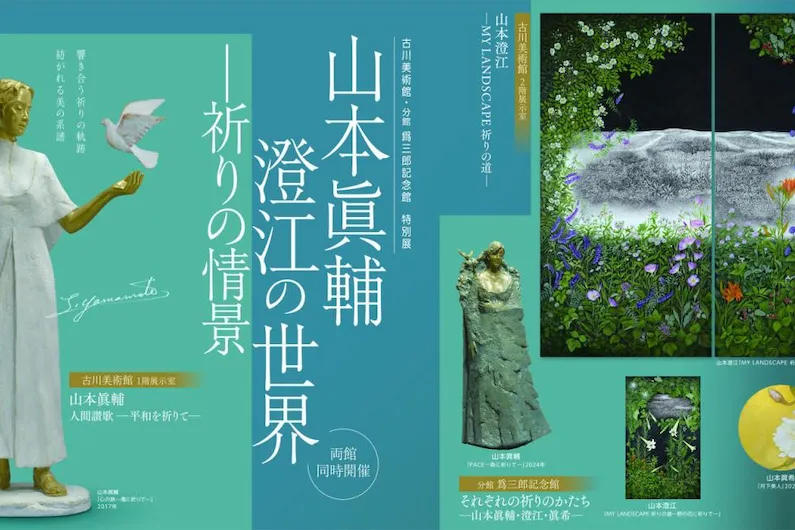
Furukawa Art Museum / Tamesaburo Memorial Museum (Annex) Special Exhibition: “The World of Shinsuke and Sumie Yamamoto — Scenes of Prayer”
The Furukawa Art Museum and its annex, the Tamesaburo Memorial Museum, present a contiguous survey of three distinct artistic practices bound by blood and spiritual inquiry. “The World of Shinsuke and Sumie Yamamoto — Scenes of Prayer” gathers the work of sculptor Shinsuke Yamamoto, Western-style painter Sumie Yamamoto, and their daughter Maki Yamamoto—a practitioner of Nihonga—across two exhibition spaces, offering visitors a rare opportunity to observe how a single family articulates beauty through divergent media and generational perspectives.
At the Furukawa Art Museum proper, the exhibition centers on Shinsuke Yamamoto’s transparent female figures—sculptural works characterized by an ethereal, almost weightless presence that seems to dissolve the boundary between solid form and surrounding space—displayed alongside Sumie Yamamoto’s serene landscapes. Sumie’s canvases depict flowers and plants overlaid with mental imagery, creating compositions where observed nature and interior consciousness merge into contemplative visions that resist simple categorization as either purely representational or abstract.
The Tamesaburo Memorial Museum (Annex) shifts focus to the next generation, presenting Maki Yamamoto’s Japanese paintings of flowers executed with soft, deliberate brushwork. Here, the exhibition constructs a dialogue between the Yamamoto parents and their daughter, positioning Maki’s intimate studies of flora against the elder Yamamotos’ respective investigations of the human form and psychological landscape. This spatial division—sculpture and Western painting in the main hall, Nihonga in the annex—creates a curated trajectory that invites comparison between Western and Japanese aesthetic traditions as filtered through one family’s sustained artistic dialogue.
The exhibition title references “prayer” not as overt religious devotion but as an attunement to subtle transience and ephemeral beauty—a sensibility evident in Shinsuke’s translucent sculptural materials, Sumie’s layered pictorial spaces, and Maki’s delicate pigment application. Visitors traversing both venues will encounter how three individuals negotiate the act of seeing and representing the natural world, from mineral pigment on silk to molded synthetic resins and oil on canvas.
Exhibition Details
Dates: Friday, May 22, 2026 – Monday (Public Holiday), July 20
Closed: Mondays (however, open on the final day, July 20)
Hours: 10:00–17:00 (Last admission at 16:30)
Venue:
Furukawa Art Museum and Tamesaburo Memorial Hall (Annex)
Admission:
- General: ¥1,200
- High school/College students: ¥500
- Elementary/Junior high school students and younger: Free
Various discounts available.
Access:
Five minutes east from Exit 1 of “Ikeshita” Station on the Nagoya City Subway Higashiyama Line.
Contact:
Furukawa Chishokukai Public Interest Incorporated Foundation
Furukawa Art Museum, Branch Tamesaburo Memorial Hall
Telephone: (052) 763-1991
Facsimile: (052) 763-1992
Website: https://www.furukawa-museum.or.jp/
Shinsuke (1918–2004) and Sumie Yamamoto (1922–2011) were Nihonga painters who worked as a husband-and-wife team for seven decades, documenting the religious architecture and daily rituals of postwar Japan. Working primarily in mineral pigments on silk and paper, they based themselves in Kyoto while traveling extensively to produce an archive of Japanese spiritual practice during a period of rapid social change.
Shinsuke trained in traditional ink painting under masters of the Kyoto School. His subjects were the architectural elements of religious spaces: temple gates, shrine corridors, and the specific quality of light passing through shoji screens. He rendered these with attention to structural geometry and the material facts of timber, stone, and paper, avoiding both romantic idealization and stark modernist abstraction.
Sumie’s given name referenced the ink wash technique (sumi-e) fundamental to their practice. Her work focused on human presence within these spaces: hands positioned in gassho, visitors bowing before roadside jizo statues, monks engaged in meditation. Where Shinsuke documented the spatial context of worship, Sumie recorded the physical gestures and worn garments of the people who performed it.
They avoided depictions of clergy or ceremonial spectacle, concentrating instead on anonymous lay practitioners. Their paintings register specific physical details—the grain patterns of old wood, the behavior of incense smoke in still air, the varying textures of seasonal vestments—as evidence of how religious practice integrates into ordinary life rather than existing as separate performance.
The couple shared a studio near Kyoto’s Tetsugaku-no-michi (Philosopher’s Path). They worked on separate canvases simultaneously, often depicting the same locations from different vantage points. Their palettes relied on subdued mineral pigments—malachite, azurite, cinnabar, and carbon-based blacks—rather than the brighter synthetic colors increasingly common in contemporary Nihonga. Compositions typically employ asymmetrical arrangements that leave significant areas of the picture plane empty, a technique derived from Zen ink painting traditions that focuses attention on the relationship between depicted forms and surrounding space.
Early in their careers they exhibited separately. Beginning in the 1960s, they developed a practice of paired installations, hanging Shinsuke’s architectural views adjacent to Sumie’s figure studies. This format creates visual sequences that move from spatial environment to human action, asking the viewer to consider how physical settings shape bodily behavior.
The Furukawa Art Museum’s 2026 exhibition marks the first major retrospective to examine their work as a sustained collaboration. The exhibition traces how their distinct but complementary approaches produced a cumulative record of Japanese religious life across the late twentieth century, capturing both the permanence of sacred architecture and the transient human activity that activates these spaces.
