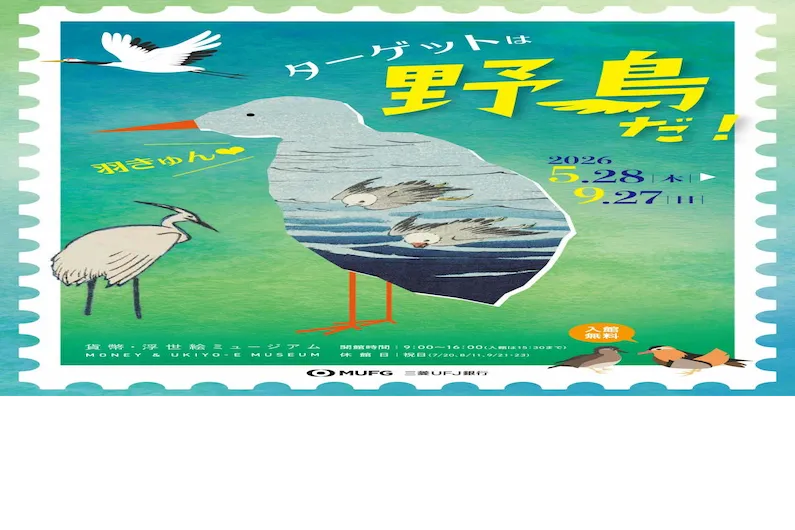
Target: Wild Birds! Wing-Kyun♥
Frolicking with Flowers, Singing to the Wind
Long before the “Wing-Kyun” of a charm trend entered modern lexicon, the Japanese archipelago sustained a profound, complicated kinship with its avian populations. Whether regarded with longing or utility, admiration or appetite, birds have occupied a singular position in the cultural imagination—simultaneously quotidian and divine. Ancient belief systems elevated them as messengers of the gods, their graceful trajectories across the sky interpreted as communication between earthly and celestial realms; poetry layered human joys and sorrows onto the contours of their songs, creating a literary tradition where the nightingale’s call or the pheasant’s cry became vessels for existential reflection.
This relationship crystallized into distinct cultural forms during the Edo period (1603–1868), when urbanization and economic growth generated new arenas for artistic expression and leisure. Bird-keeping transcended class boundaries, with shoguns and commoners alike participating in competitive song contests, while ukiyo-e artists documented both rare imported species and native birds with scientific precision and aesthetic sensitivity. Culinary traditions incorporated game birds into haute cuisine, and falconry remained a samurai prerogative that demanded lifelong mastery.
The exhibition Target: Wild Birds! Wing-Kyun♥ examines this multifaceted heritage through the specific lens of wild birds—that is, those creatures soaring beyond the cage, defying domestication—tracing their presence across tangible and visual cultures. Rather than presenting ornithological specimens in isolation, the curators have organized the experience as a journey through four interconnected realms: the practical economies of traditional cormorant fishing and falconry, where human and bird operate as hunting partners; the decorative arts, wherein avian patterns migrated from nature studies onto textiles and fashion objects; the material history of pigments and dyes extracted from plumage; and optical perspectives that attempt to visualize terrain as seen through avian eyes—scales of vision inaccessible to terrestrial observers.
Central to the exhibition are the works of Utagawa Hiroshige, the ukiyo-e master whose landscapes frequently positioned birds as compositional anchors or atmospheric elements. His prints serve not merely as artistic centerpieces but as documentary evidence of how Edo-period observers situated birds within specific topographies and seasonal moments.
Practical Information
Dates: Thursday, May 28, 2026 – Sunday, September 27, 2026
Closed: Public holidays
Hours: 9:00–16:00 (Entry until 15:30)
Location: MUFG Bank Currency-Ukiyoe Museum
Admission: Free
Contact:
MUFG Bank Currency-Ukiyoe Museum
TEL: 052-300-8686 (English inquiries not available)
Website: https://www.bk.mufg.jp/currency_museum/index.html
Access:
- Approximately 5 minutes walk from Exit 3 of “Fushimi Station” on the Subway Higashiyama Line
- Approximately 5 minutes walk from Exit 8 of “Sakae Station” on the Subway Higashiyama Line
Important Note: There is no parking available. Please use public transportation.
The MUFG Bank Currency-Ukiyoe Museum occupies a limestone building in the basement level of Mitsubishi UFJ Financial Group’s headquarters, just south of the Bank of Japan. The space displays corporate collections accumulated since the bank’s earliest predecessors opened in the 1880s: currency artifacts on one side, ukiyo-e woodblock prints on the other, with no admission fee.
The numismatic holdings trace Japanese money from the oval koban gold coins of the Tokugawa period through the rectangular silver pieces that predated decimalization. Cases display minting plates, early checks, and the steel dies used to print Meiji-era banknotes. These industrial objects sit near the ukiyo-e collection, which includes recognized works by Hokusai and Hiroshige alongside anonymous prints depicting the Nihonbashi commercial district and the entertainment quarters where banking families spent their leisure.
The museum makes no artificial distinction between these materials. Currency design required the same engraving skills used in woodblock printing; both involved anti-forgery measures, serial numbering, and the calculation of production costs per impression. Ukiyo-e artists documented the same financial districts where the bank’s predecessors operated, and merchant collectors stored prints in the same fireproof chests used for cash reserves.
The 2026 exhibition on avian imagery maintains this practical curatorial stance. It examines how bird illustrations moved from natural history manuals onto banknote designs and into luxury prints commissioned by banking families, treating these connections as historical facts rather than philosophical revelations. The museum simply presents the artifacts side by side, allowing visitors to observe how Japan’s financial and visual cultures developed through shared techniques, patronage, and daily necessity.
