Lemon Afternoon Tea at Kichijoji Excel Hotel Tokyu
An afternoon wrapped in refreshing acidity during summer in Kichijoji. “Lemon Afternoon Tea” is being held, featuring tea leaves from a local Kichijoji specialty tea shop.
As summer heat intensifies, Kichijoji Excel Hotel Tokyu offers a seasonally limited afternoon tea built around the aroma and sharpness of lemon. The menu delivers exactly what the season demands: visually cooling sweets and light-tasting savories that satisfy without weighing you down in humid weather.
What Sets This Apart
Most hotel afternoon teas in Tokyo follow a predictable formula—heavy on cream, chocolate, and richness. This summer iteration deliberately inverts that approach. The partnership with Tea Market Giclef Kichijoji Main Store, a respected local specialty shop operating in the neighborhood, gives guests access to carefully sourced leaves that change character with temperature and steeping time. The atrium space on the hotel’s second floor provides natural light and vertical breathing room rarely found in central Tokyo hotel lounges.
The Menu
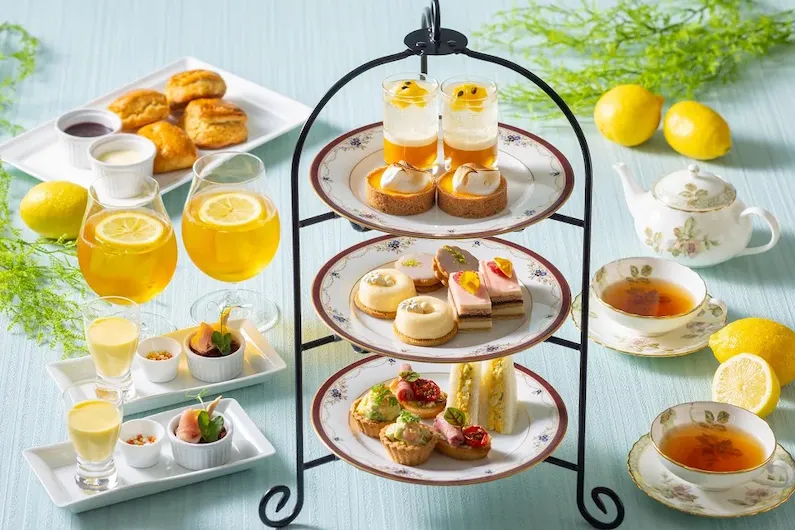
Sweets are arranged to move through different expressions of citrus:
- Verrine: Layered mango passion fruit jelly, panna cotta, and lemon jelly with aloe—textural contrast in a glass
- Citron Tart: Sharp acidity as the dominant note
- Lemon Opera-style cake: Lemon buttercream meeting chocolate’s depth
- Lemon Vanilla Mousse: Gentle sweetness with a mellow finish
- Lemon Cream Cookie Sandwich: Light, handheld, approachable
Savories are calibrated for summer appetite:
- Chickpea hummus with fragrant spices and prosciutto
- Chilled corn soup (served separately)
- Smoked salmon and avocado tart
- Cold beef canapé with remoulade sauce
- Egg sandwich
The welcome drink—sparkling lemon tea with active carbonation—cleans the palate before the tiered service begins.
Scones arrive with clotted cream and mixed berry jam: plain and tea varieties.
Beverages pull from Tea Market Giclef’s selection: Darjeeling, Assam, Jasmine, Earl Grey, Classic Chai, Darjeeling Earl Grey Blend, Rooibos Classic, Lemon Garden, plus Organic Forest Coffee, Café Latte, and Espresso. Unlimited refills and exchanges are permitted.
Service Details
| Venue | Kichijoji Excel Hotel Tokyu, Lounge & Dining “SORAE” (2nd Floor) |
| Nearest Station | Kichijoji Station, 8-minute walk |
| Address | 〒180-0004, 2-4-14 Kichijoji Honcho, Musashino-shi, Tokyo [MAP] |
| Period | June 1 – August 31, 2026 |
| Time | 14:30–17:30 (L.O. 17:00), 2-hour seating |
| Capacity | Weekdays: 15 servings / Weekends & holidays: 20 servings |
| Evening Session | 17:30–21:00 (L.O. 20:30), weekdays only, except Wednesdays, 6 servings |
| Price | ¥6,000 per person (includes 12% service charge and 10% consumption tax) |
| Reservations | Required |
Photos are for illustrative purposes. Menu subject to change based on ingredient availability. Guests with food allergies should inform staff in advance. Alcohol service declined to drivers and those under 20, per legal requirements.
![Lemon Afternoon Tea [Kichijoji Excel Hotel Tokyu]_1](https://rstatic.enjoytokyo.jp/assets/images/event/6f/2068087/img_1.jpg?1779706609&p=t&w=1800)
![Lemon Afternoon Tea [Kichijoji Excel Hotel Tokyu]_2](https://rstatic.enjoytokyo.jp/assets/images/event/6f/2068087/img_2.jpg?1779706609&p=t&w=1800)
![Lemon Afternoon Tea [Kichijoji Excel Hotel Tokyu]_3](https://rstatic.enjoytokyo.jp/assets/images/event/6f/2068087/img_3.jpg?1779706609&p=t&w=1800)
![Lemon Afternoon Tea [Kichijoji Excel Hotel Tokyu]_4](https://rstatic.enjoytokyo.jp/assets/images/event/6f/2068087/img_4.jpg?1779706609&p=t&w=1800)
![Lemon Afternoon Tea [Kichijoji Excel Hotel Tokyu]_5](https://rstatic.enjoytokyo.jp/assets/images/event/6f/2068087/img_5.jpg?1779706609&p=t&w=1800)
![Lemon Afternoon Tea [Kichijoji Excel Hotel Tokyu]_6](https://rstatic.enjoytokyo.jp/assets/images/event/6f/2068087/img_6.jpg?1779706609&p=t&w=1800)
![Lemon Afternoon Tea [Kichijoji Excel Hotel Tokyu]_7](https://rstatic.enjoytokyo.jp/assets/images/event/6f/2068087/img_7.jpg?1779706609&p=t&w=1800)
![Lemon Afternoon Tea [Kichijoji Excel Hotel Tokyu]_8](https://rstatic.enjoytokyo.jp/assets/images/event/6f/2068087/img_8.jpg?1779706610&p=t&w=1800)
![Lemon Afternoon Tea [Kichijoji Excel Hotel Tokyu]_9](https://rstatic.enjoytokyo.jp/assets/images/event/6f/2068087/img_9.jpg?1779706610&p=t&w=1800)
![Lemon Afternoon Tea [Kichijoji Excel Hotel Tokyu]_10](https://rstatic.enjoytokyo.jp/assets/images/event/6f/2068087/img_10.jpg?1779706610&p=t&w=1800)
The posted content may have changed. Please check the official website of the venue or organizer for the latest information.
What is Kichichijoji?
Kichijoji sits in western Tokyo, about fifteen minutes from Shinjuku on the JR Chuo Line. It has become something of a benchmark for livability in the city—frequently topping resident surveys while remaining relatively low-key compared to its eastern counterparts.
The neighborhood organizes itself around Inokashira Park, a substantial green space built around a pond that serves multiple purposes depending on the season. In early April, the cherry Blossom trees draw substantial crowds for hanami, while the rest of the year sees a steadier stream of joggers, musicians, and families. The Ghibli Museum sits within the park grounds, designed specifically to house the studio’s work without the conventional layout of a traditional animation museum—no fixed route, no photography, an admission system that requires advance tickets purchased through specific convenience store chains.
The retail and food landscape in Kichijoji operates on several registers simultaneously. Sun Road provides the covered arcade experience common to Japanese suburbs, functional and unpretentious. Harmonica Yokocho, by contrast, retains the physical footprint of its postwar black market origins—narrow passages between compressed structures now housing roughly sixty bars and restaurants, most with fewer than ten seats. The concentration of vinyl record dealers, small publishers, and independent clothiers in the surrounding blocks is not accidental; several date to the 1960s and 1970s, predating the current wave of interest in such businesses.
What distinguishes Kichijoji from comparable neighborhoods is not any single amenity but the persistence of its irregular built environment. Height restrictions have prevented the tower development visible in Shibuya or Ikebukuro, and the street grid retains enough inconsistency to accommodate unexpected structures. This has attracted a particular demographic mix—families who have owned property for decades, students from the nearby university district, and more recent arrivals working in creative fields or remote arrangements. The resulting atmosphere has been durable enough to function as a recognizable setting in film and television, typically shorthand for a certain manageable pace of urban life.
