2026 Prayer for Fortune and Shared Blessings: The Holy Mother’s Peace Tour
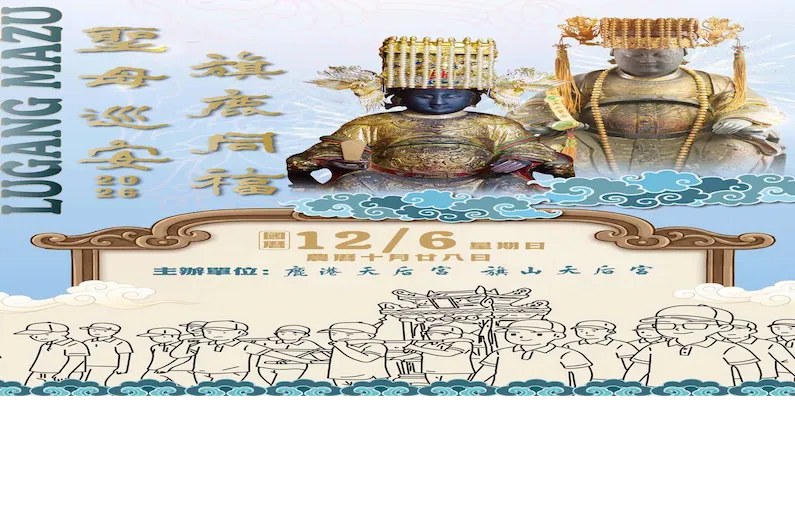
On Sunday, December 6, 2026, Mazu’s palanquin will travel south from Lukang, Changhua, to Qishan, Kaohsiung, for a joint pilgrimage that brings together two of Taiwan’s most venerated goddess statues. The day is framed as a prayer for fortune and shared blessings, with the Holy Mother’s Peace Tour bringing her protection to the streets of Qishan. Believers from all over Taiwan are invited to Qishan Tianhou Temple to welcome the holy procession and take part in a rare blessing ritual.
A Four-Hundred-Year Legacy
The Lukang Tianhou Temple was founded during the Wanli era of the Ming Dynasty. More than four hundred years later, its incense offerings remain thriving, and the Mazu faith has been passed down from generation to generation. The temple is now a precious National Historic Site, recognized as one of Taiwan’s most representative centers of Mazu worship.
The Heavenly Holy Mother Lukang Mazu enshrined here is known for her compassion in saving the world and protecting all people. Over many years, she has received devout worship from believers across Taiwan and overseas, with the incense fire continuing unabated.
A Joint Pilgrimage of Two Mazu
On the day of the event, the Heavenly Holy Mother Lukang Mazu will visit the Qishan Tianhou Temple. There, she will also go on a joint pilgrimage with the Heavenly Holy Mother Qishan Mazu—a rare occasion when two storied goddess statues share a single route. The joint procession is meant to extend blessings to the surrounding community and to every pilgrim who comes to witness it.
The Jiao-Jiao Blessing
Specific locations will be open for believers to crawl under the palanquin, a ritual commonly known as jiao-jiao. During this practice, the deity’s palanquin passes directly over the kneeling or prostrate faithful, offering a deeply physical form of prayer. For many attendees, this is the most anticipated moment of the day—a direct encounter with the goddess’s presence.

Event Information
| Item | Detail |
|---|---|
| Date | December 6, 2026 (Sunday) |
| Location | Qishan Tianhou Temple, Qishan, Kaohsiung |
| Event | The visit of Lukang Mazu to grant blessings and the joint pilgrimage of the two Mazus |
| Prayer | Specific locations will be open for believers to crawl under the palanquin (jiao-jiao) |
Mazu is a Chinese sea goddess whose worship is especially prominent in Taiwan. She is often referred to as the Holy Mother or Goddess of the Sea. According to traditional accounts, she was born Lin Moniang on Meizhou Island in the tenth century. She is credited with calming storms and saving ships, and over time fishermen, sailors, and coastal communities came to regard her as their protector.
In Taiwan, the scope of Mazu’s significance extends well beyond maritime concerns. Her temples, of which there are more than five hundred on the island, function as local religious and civic centers. During her festivals, statues of Mazu are carried through the streets, and these processions draw large numbers of participants who come to pay respects and to take part in a shared public event. For many communities, the procession is one of the most important occasions of the year.
The joint appearance of Lukang’s and Qishan’s Mazu statues in Kaohsiung is unusual because it brings together two important images that are normally kept in separate temple complexes. Such an event allows devotees in the region to venerate both statues at once and to attend ceremonies outside the regular annual calendar. The 2026 Holy Mother’s Peace Tour, which includes the joint appearance, has been organized with the cooperation of local temples and civic groups. For many Taiwanese, Mazu is not simply a figure from the past but a continuing presence in contemporary religious life, and events of this kind are among the most visible expressions of that practice.
