
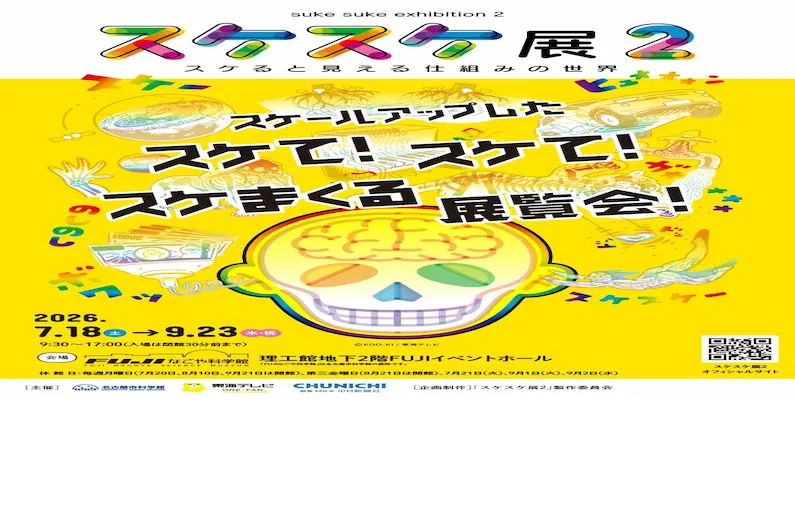
Special Exhibition “Sukesuke Exhibition 2: The World of Mechanisms Revealed Through Transparency”
Modern technology increasingly conceals its workings behind sleek, impenetrable exteriors, rendering the internal mechanisms that power our world invisible to casual observation. The Sukesuke Exhibition addresses this growing opacity through the Japanese concept of “sukeru”—becoming transparent—offering visitors a systematic examination of biological and mechanical interiors typically hidden from view. By deploying digital visualization technologies alongside meticulously crafted cross-sectional models and high-definition video content, the exhibition transforms opaque surfaces into windows, revealing the structural logic and intricate relationships between external form and internal function that remain inaccessible through surface inspection alone.
This methodology yields genuine discoveries that external observation cannot anticipate. Visitors encounter the unexpected complexity concealed within familiar objects and organisms, fostering renewed attention toward the engineering and anatomical architectures surrounding us daily. By illuminating the dialogue between exterior containment and interior mechanism, the exhibition stimulates intellectual curiosity across demographic boundaries, providing substantive engagement for children encountering these concepts for the first time while offering sufficient technical depth to satisfy adult inquiry.
Building upon its predecessor’s foundation, Sukesuke Exhibition 2 establishes two distinct thematic zones: “Nature Sukesuke” and “Invisible Sukesuke.” These additions expand the exhibition’s analytical scope, applying transparency methodologies to biological systems and phenomena imperceptible to the unaided eye. While the original iteration established the fundamental vocabulary of visual transparency through mechanical objects, this sequel extends those principles into natural history and invisible forces—suggesting an evolution in both conceptual breadth and technical implementation that should prove particularly illuminating for returning visitors.
Exhibition Details
Dates:
Saturday, July 18, 2026 – Wednesday, September 23, 2026 (Public Holiday)
Closed:
Every Monday (exceptions: open July 20, August 10, and September 21)
Third Friday of each month (exception: open August 21)
Additionally closed: Tuesday, July 21; Tuesday, September 1; and Wednesday, September 2
Hours:
9:30 – 17:00 (Last admission at 16:30)
Venue:
FUJI Nagoya Science Museum
Science and Engineering Building B2F, FUJI Event Hall
Admission
Paid Admission (Same-day tickets):
- General: 1,800 yen
- University students: 1,000 yen
- Elementary/Junior High/High School students: 500 yen
Advance tickets provide a 200 yen discount off each category.
Free Admission:
- Preschool children
Ticket Purchase:
- ● Purchase tickets here ●
- Asoview!
- Museum Ticket
- Lawson Ticket (L-code: 43145)
Important Notes:
- High school and university students must present valid student identification.
- The above fees include access to the FUJI Nagoya Science Museum’s permanent exhibition rooms (planetarium excluded).
- Visitors presenting physical disability certificates receive 50% off same-day admission (certificate required; applies to up to two accompanying persons).
- Groups of 30 or more receive 100 yen off the same-day fee.
- Presenting a “One-day Pass,” “Donichi Eco Kippu,” or “Subway All-line 24-hour Pass” issued by the Nagoya City Transportation Bureau on the day of visit entitles you to 100 yen off same-day admission.
- Discounts cannot be combined.
Contact & Access
Contact:
FUJI Nagoya Science Museum
TEL: 052-201-4486
FAX: 052-203-0788
Homepage: https://sukesuketen.jp/
Access:
- Subway: 5-minute walk south from exits 4 and 5 of “Fushimi” Station (Higashiyama and Tsurumai Lines)
- City Bus: 5-minute walk south from “Hirokoji Fushimi” stop
- Meitetsu Bus: 5-minute walk north from “Shirakawa Koen-mae” stop
Sukesuke (透け透け) is a Japanese term describing transparency so complete that light passes through to reveal what lies beneath. While it literally refers to physical translucency, the word also captures a particular approach to observation: removing barriers between viewer and internal structure to examine how components relate within a complete system.
In biological contexts, sukesuke describes preservation techniques that render organisms transparent while keeping tissues intact. By fixing specimens in organic solvents—often glycerol or benzyl alcohol/benzyl benzoate mixtures that match the refractive index of biological tissue—researchers create preparations where skin and muscle become virtually invisible. Staining agents like alizarin red for bone or Alcian blue for cartilage highlight specific structures against the cleared matrix. The result preserves three-dimensional relationships that dissection destroys; observers can trace how the ulnar nerve detours around the humerus, or how the vitelline artery branches across a chick embryo yolk sac, without the spatial distortion caused by cutting and pinning.
The same principle applies to engineering and architecture through transparent working models. Acrylic engine blocks, lucite gearboxes, and glass-enclosed hydraulic systems allow direct observation of mechanical function. During the design phase, transparent prototypes reveal manufacturing tolerances and stress concentrations that CAD models miss. In education, watching a valve train operate through a clear cylinder head makes cam timing immediately comprehensible in ways that diagrams cannot. Structural engineers use acrylic models to visualize load paths through trusses; watching stress patterns propagate through transparent resin helps validate finite element analysis against physical reality.
Whether examining a cleared fish specimen or a prototype pump housing, sukesuke prioritizes structural understanding over surface appearance. The technique recognizes that comprehension often requires seeing internal geometry—how parts fit, move, and bear load within the complete assembly. This visibility serves specific practical ends in medical training, quality control, and engineering design, where the spatial relationship between internal components determines function more than external form.
