
Play and Learn Science Lab 2026 SUMMER at Tokyo University of Science
An Experiential Event to Support Summer Vacation Independent Research
For families navigating the annual challenge of summer vacation independent research projects, the “Play and Learn Science Lab” offers a practical solution that transforms obligation into genuine discovery. Hosted collaboratively by the Asahi Elementary School Newspaper, AERA with Kids, and Kids Net, this single-day event at the Tokyo University of Science Katsushika Campus provides elementary school students and their guardians with direct access to hands-on scientific experiences, expert guidance, and the specific “seeds of research” necessary to create compelling independent study projects.
Unlike standard science fairs that prioritize exhibition over education, this event focuses specifically on the research process itself—providing children with experiential learning opportunities that generate authentic questions and hypotheses. Through interactive booths, structured workshops, and stage presentations, participants encounter scientific concepts not as abstract theories but as tangible problems requiring investigation.
What Distinguishes This Year’s Program
The 2026 summer iteration distinguishes itself through the sheer breadth of industry involvement and the integration of financial literacy with traditional scientific inquiry. Fifteen diverse companies and organizations—including Ezaki Glico, Mitsubishi UFJ Financial Group, Seiko Group, Seven Bank, The Japanese Institute of Certified Public Accountants, the Expanded Polystyrene Association, and Morinaga & Co.—have developed proprietary workshops that connect commercial industries to academic research methods.
This cross-sector approach allows children to investigate questions ranging from the physics of timekeeping to the microbiology of digestive health, while simultaneously exploring how scientific principles operate within economic systems. For instance, participants can construct original desk clocks while learning about horological history, or operate simulated hamburger shops while studying accounting systems and monetary flow—a combination rarely found in conventional children’s science events.
Workshop Programming
The event organizes approximately thirty distinct workshops across two registration categories, ensuring accessibility for both planners and spontaneous attendees. Each workshop operates with specific capacity limitations, necessitating early arrival or advance registration for popular sessions.
Advance Registration Workshops
The following workshops require prior web reservation through the official application portal:
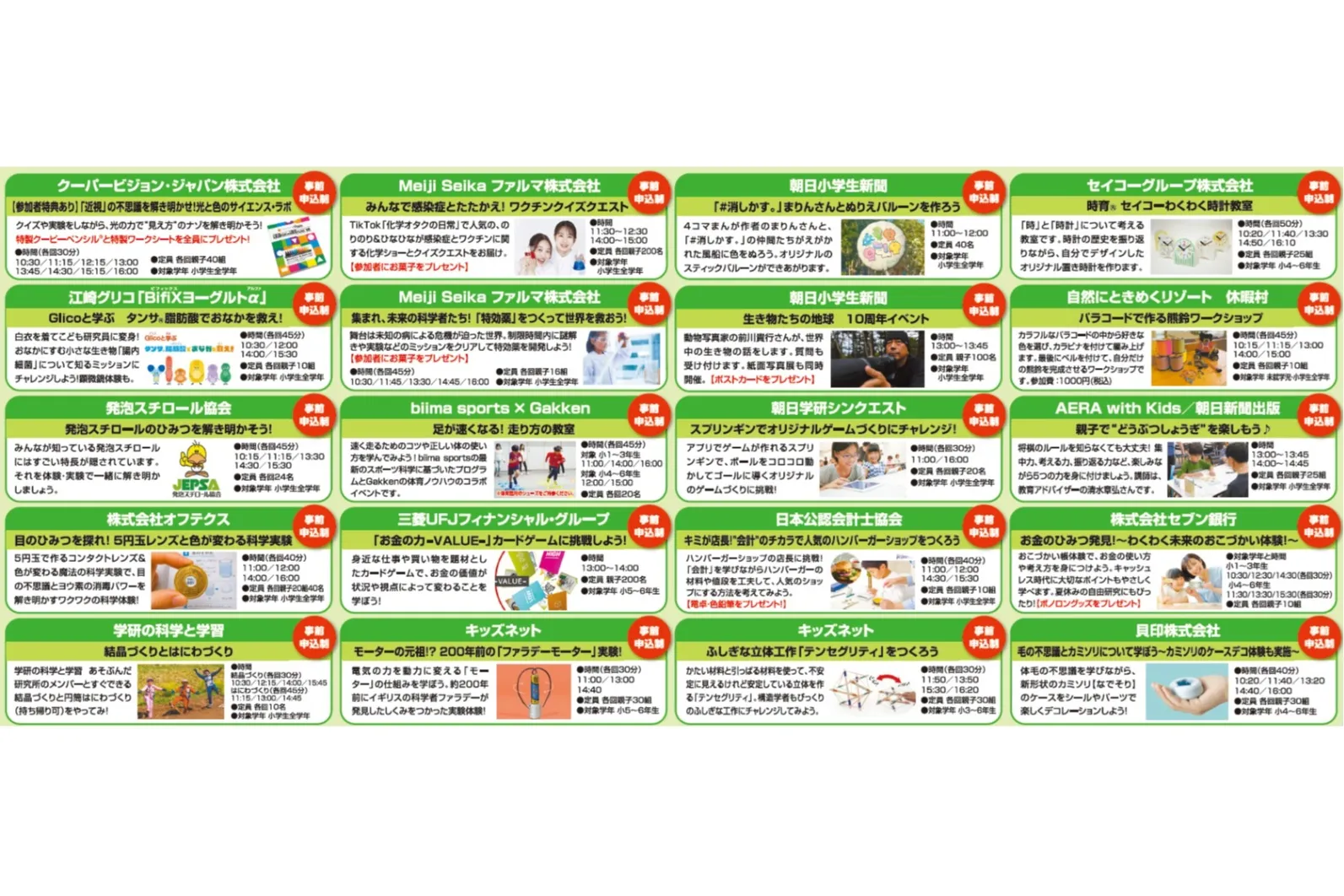
- Unravel the mystery of “myopia”! Light and Color Science Lab (Provided by: CooperVision Japan)
- Let’s fight infectious diseases together! Vaccine Quiz Quest (Provided by: Meiji Seika Pharma)
- Toki-iku® Seiko Exciting Clock Classroom (Provided by: Seiko Group)
- Learn with Glico: Save your stomach with Tansan® fatty acids! (Provided by: Ezaki Glico “BifiX Yogurt α”)
- Gather, future scientists! Let’s make a “magic bullet” and save the world! (Provided by: Meiji Seika Pharma)
- Paracord Bear Bell Workshop (Provided by: Nature-Inspiring Resort Kyukamura)
- Let’s unravel the secrets of expanded polystyrene! (Provided by: Expanded Polystyrene Association)
- Become faster! Running Method Classroom (Provided by: biima sports × Gakken)
- Explore the secrets of the eyes! 5-yen coin lens and color-changing science experiments (Provided by: Optex Co., Ltd.)
- Try the “Power of Money -VALUE-” card game! (Provided by: Mitsubishi UFJ Financial Group)
- You are the store manager! Create a popular hamburger shop with the power of “accounting” (Provided by: The Japanese Institute of Certified Public Accountants)
- Discover the secrets of money! ~Exciting Future Allowance Experience!~ (Provided by: Seven Bank, Ltd.)
- Learn about the wonders of hair and razors ~Razor case decoration experience also available~ (Provided by: Kai Corporation)
- “#Eraser-dust.” Let’s make coloring balloons with Marin-san (Provided by: Asahi Elementary School Newspaper)
- Creatures’ Earth 10th Anniversary Event (Provided by: Asahi Elementary School Newspaper)
- Challenge yourself to make an original game with Springin! (Provided by: Asahi Gakken Shinquest)
- Enjoy “Animal Shogi” with your parents and children♪ (Provided by: AERA with Kids/Asahi Shimbun Publications)
- Crystal making and bonsai making (Provided by: Gakken Science and Learning)
- The original motor!? 200-year-old “Faraday Motor” experiment! (Provided by: Kids Net)
- Let’s make a mysterious 3D craft “Tensegrity” (Provided by: Kids Net)
Same-Day Registration Workshops
These sessions accept participants on a first-come, first-served basis during the event:
- Body Hair Bodyguard Investigation Team ~The secrets of the hair that protects you~ (Provided by: Kai Corporation)
- Challenge! Cacao Quest ~Collect the pieces of chocolate~ (Provided by: Morinaga & Co., Ltd.)
- Deer Antler Keychain Workshop (Provided by: Nature-Inspiring Resort Kyukamura)
- Just choose and fit the dots! Let’s make your first dot art! (Provided by: Yanoman Co., Ltd.)
- Eat whale to grow big and healthy! ~Know, learn, and taste the secrets of whales~ (Provided by: Japan Whaling Association)
- Turn play into learning! Let’s play with puzzles♪ (Provided by: AERA with Kids/Asahi Shimbun Publications)
- Physical fitness test measurement experience (Provided by: Asahi Gakken Shinquest)
- Early experience session for a full-scale card game where various professions are active! (Provided by: Asahi Gakken Shinquest)
- Battle Ringin: Game creation battle live show with an app (Provided by: Asahi Gakken Shinquest)
- News Dojo & Junior High School Entrance Exam Dojo open simultaneously! Challengers wanted☆ (Provided by: Asasho Plus/Asahi Mitsukaru Navi)
- Asasho Room (Provided by: Asahi Elementary School Newspaper Editorial Department)
- Find your destinado company! Job Diagnosis (Provided by: Job Museum)
Stage Programs and Symposiums
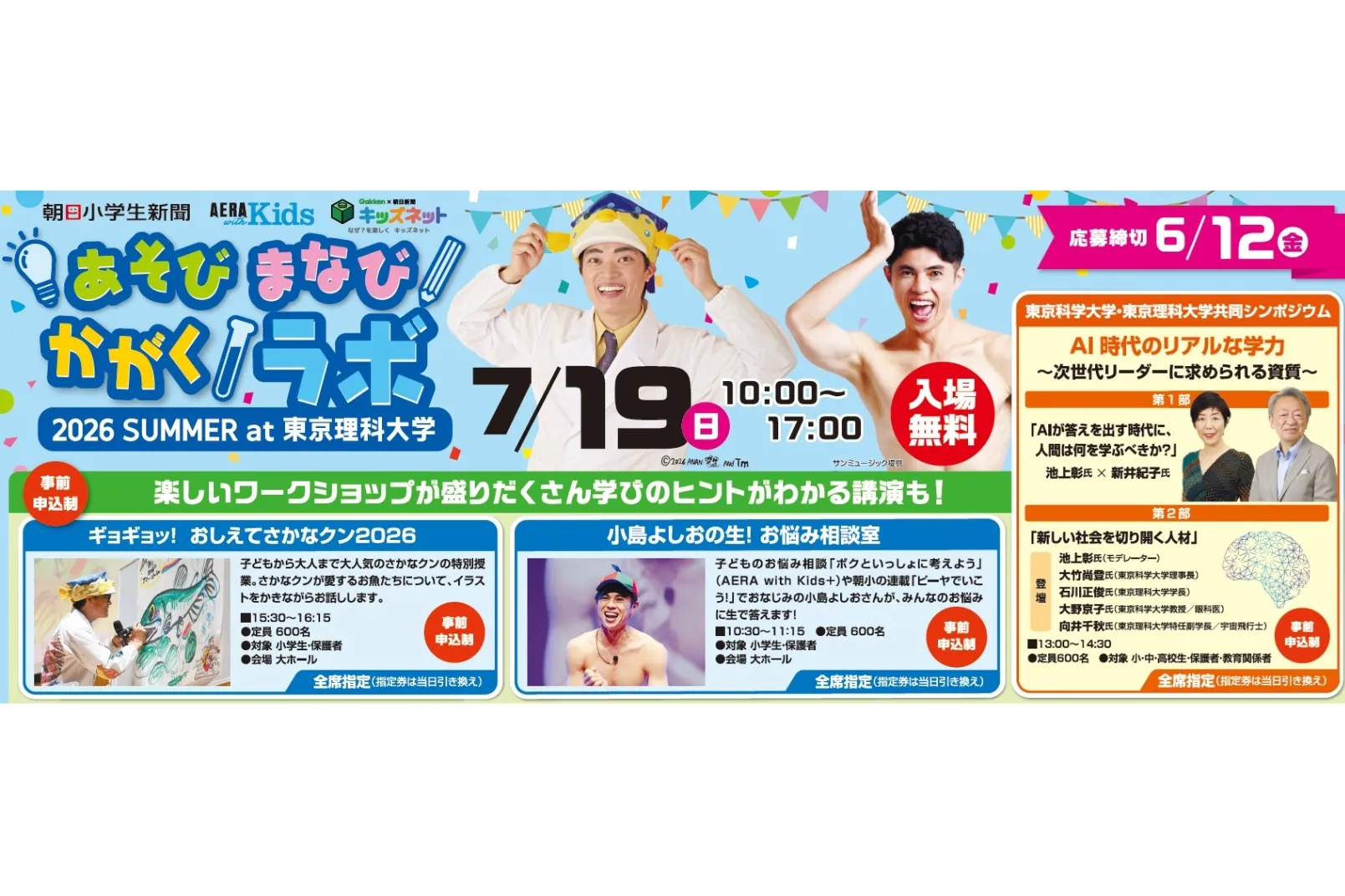
The main hall features appearances by prominent science communicators. Yoshiio Kojima, who has serialized columns in both the Asahi Elementary School Newspaper and AERA with Kids+, will host his “Live! Trouble Counseling Room,” offering direct guidance on research-related dilemmas. Additionally, Sakana-kun—celebrating his 25th year of serialization in Asasho—will present “Gyogyo! Tell me, Sakana-kun 2026,” providing marine biological insights applicable to ecological research projects.
Concurrently, the Tokyo Institute of Science and Tokyo University of Science will host a joint symposium titled “Real Academic Ability in the AI Era ~Qualities Required for Next-Generation Leaders~,” addressing the evolving nature of scientific literacy in an increasingly automated world.
Additional Event Features
Beyond the structured workshops and stage presentations, the event incorporates supplementary programming designed to sustain full-day participation. Stamp rallies encourage comprehensive exploration of the venue, while book sales corners provide reference materials for ongoing research. The university cafeteria will offer special menus, and food trucks will provide additional dining options—allowing families to maintain energy throughout the seven-hour program without leaving the campus.
Practical Information
Venue / Access
Tokyo University of Science Katsushika Campus
Nearest Stations: Kanamachi Station / Keisei-Kanamachi Station
Address
〒125-8585
6-3-1 Shinjuku, Katsushika-ku, Tokyo
MAP
Date and Time
2026/07/19 (Sunday)
10:00 – 17:00
Target Audience
Elementary school students and their guardians
Note: Each workshop maintains individual capacity limits.
Admission
Free
Registration
Some workshops require advance web reservation.
Click here for advance application
The listed content may be subject to change. Please check the official website of the venue or organizers for the latest information.
What is the Tokyo University of Science?
The Tokyo University of Science (TUS) is a private institution dedicated exclusively to science and technology. Founded in 1881 as the Tokyo Physics School by 21 graduates of the Imperial College of Engineering, it began with evening lectures in physics and mathematics for working students who could not attend day classes. Today, TUS operates three campuses—in Kagurazaka, Katsushika, and Noda—enrolling over 9,000 students in undergraduate and graduate programs. What began as a small technical school has grown into a university with seven undergraduate faculties, yet it maintains its original specificity: every program concentrates on scientific and technical disciplines.
Unlike Japan’s national universities, which combine science faculties with extensive liberal arts programs, TUS commits its resources entirely to technical and scientific education. This concentration shapes both the curriculum and the research environment. The university maintains over 70 specialized laboratories across fields including materials science, pharmaceutical chemistry, aerospace engineering, and artificial intelligence. These facilities serve dual purposes: they support graduate research and provide undergraduate students with early exposure to laboratory work. The university’s connections with Japanese manufacturing and technology firms date back to its early decades, creating direct links between academic research and industrial application.
The emphasis on laboratory work defines TUS’s approach at every level. The curriculum minimizes passive lecture time in favor of experimental work, beginning in the first year of undergraduate study. This philosophy extends beyond the university’s enrolled students. Faculty members regularly organize outreach programs that give primary and secondary school students access to working laboratories. The premise is straightforward: understanding scientific method requires handling instruments, making observations, and accounting for experimental error—not just reading about results.
The “Play and Learn Science Lab 2026” applies this approach to science education for children. Faculty from seven undergraduate faculties—Chemistry, Engineering, Pharmaceutical Sciences, and others—work with undergraduate students to develop experiments that suit younger age groups while using proper research protocols. Children work in active university laboratories, handling the same microscopes, spectroscopy equipment, and data sensors that TUS researchers use daily. The experiments require participants to collect data, note sources of error, and understand why controls matter. By giving young learners access to working laboratory equipment and standard research practices, the program treats scientific methodology as a specific set of skills rather than abstract knowledge.
