2026 National Marine Sports Festival in Geoje: Experience the Best of Korea’s Ocean Sports and Leisure Activities

2026 National Marine Sports Festival in Geoje: Experience the Best of Korea's Ocean Sports and Leisure Activities

National Ocean Sports Festival

🗓️ 2026.08.27 ~ 2026.08.30

The 18th National Marine Sports Festival is the largest comprehensive marine sports festival in Korea. It is held to increase public interest in marine sports and to expand the base of marine leisure culture. The event is hosted by the Ministry of Oceans and Fisheries and operated jointly by the host city and related organizations. Official competitions and exhibition matches bring marine sports athletes and enthusiasts from across the country to a different location each year. This year, the 18th edition will take place in Geoje-si, Gyeongsangnam-do, featuring yachting, canoeing, underwater/fin swimming, and triathlon.

The festival is designed as a festive venue where athletes, citizens, and tourists can all participate and enjoy themselves. Alongside the official events, there are marine leisure experience programs such as banana boats, kayaks, and SUP paddleboards, plus cultural performances and side events. With sports, tourism, and experiences gathered against the backdrop of Geoje’s marine environment, it offers a full itinerary for visitors who want to watch or try something new.

Official Ceremonies

  • Opening Ceremony: Pre-ceremony performance, opening ceremony, post-ceremony performance, etc.
  • Closing Ceremony: Handing over of the competition flag, farewell address, closing declaration, post-ceremony performance, etc.

Official Sports

  • Yachting
  • Canoe
  • Underwater/Fin Swimming
  • Triathlon

Exhibition Events

  • Dragon Boat
  • Rubber Boat
  • Flyboard

Marine Experience Events

  • Dragon Boat
  • Rubber Boat
  • Banana Boat
  • Flying Fish
  • Peanut Boat
  • Kayak (2-seater)
  • SUP Paddleboard
  • Marine Adventure

Marine Cultural Events

  • Drawing ocean postcards
  • Ocean Love five-line poems
  • Fashion tattoos
  • Making keyrings
  • Digital photo printing
  • Making paracord bracelets
  • etc.

Practical Information

📍 Address: 15-44 Jisepho-haean-ro, Ilun-myeon, Geoje-si, Gyeongsangnam-do

🛏️ Accommodation near the event

💰 Fee: Free

📞 Inquiry: 055-639-4182~6

🖥️ Website: www.geoje.go.kr/marinesports/index.geoje

National Marine Sports Festival

Geoje is a city in South Gyeongsang Province, on Geoje Island, South Korea’s second-largest island after Jeju. The island sits off the southern coast, between Busan and Tongyeong. Its coastline is a mix of rocky headlands, beaches, and small harbors. Inland, the terrain is hilly and forested, with walking trails crossing the island.

Maritime industries have shaped Geoje for decades. Large shipyards operate along the eastern shore, and fishing villages remain active in the smaller coves. In recent years, the same waters have come to be used for recreation—kayaking, paddleboarding, yacht tours, and diving are now standard offerings.

Geoje’s existing marine infrastructure, along with its beaches and sheltered coastal waters, makes it suited to host a multi-event sports festival. The 2026 National Marine Sports Festival will take place there.

Yeongyang Red Pepper H.O.T Festival 2026: Seoul City Hall Guide to Korea’s Largest Farm-to-Table Agricultural Event

Yeongyang Red Pepper H.O.T Festival 2026: Seoul City Hall Guide to Korea's Largest Farm-to-Table Agricultural Event

Yeongyang Red Pepper H.O.T Festival

🗓️ 2026.08.27 ~ 2026.08.29

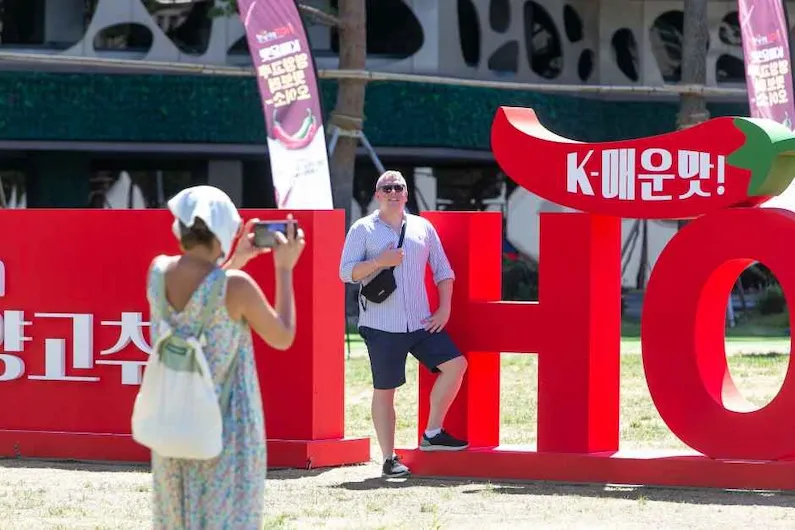
The Yeongyang Red Pepper H.O.T Festival distinguishes itself as Korea’s largest single-item agricultural festival focused on direct producer-to-consumer transactions. While other regional festivals typically stay local, this event relocates to Seoul City Hall Plaza—a deliberate choice that brings Yeongyang’s prized red peppers directly to metropolitan consumers rather than waiting for tourists to travel to the countryside. This inversion of the usual festival model matters: it transforms a regional agricultural celebration into an urban-rural bridge where farmers and consumers negotiate prices, share knowledge, and build relationships without intermediaries.

The festival’s structure reflects this dual purpose. Visitors encounter the peppers through multiple channels—cultural performances that embed the crop in regional identity, hands-on experiences that teach traditional processing methods, and direct sales that eliminate distribution markups. For participating farm households, the math is straightforward: each direct sale represents revenue that would otherwise be absorbed by supply chains. For Seoul residents, the transaction offers freshness verification and provenance transparency rarely available in conventional retail.

What to Expect

Main Programs

  • Opening Ceremony — Formal launch with regional dignitaries and agricultural officials
  • Special Live Broadcast (6 o’clock My Hometown) — Televised segment connecting Seoul with Yeongyang
  • K-Yeongyang Chili Ssang-Ssang Live Show — Interactive entertainment centered on red pepper culture
  • Cultural Arts Performances — including Yeongyang Won-noreum (traditional masked dance-drama), Youth Boy Band, and Housewife Band

Side Programs

  • Promotion and Exhibition Hall — Agricultural displays and regional product showcases
  • Food Dimibang / Sales and Experience Booths — “Dimibang” refers to a traditional Korean cookbook; here, applied to cooking demonstrations and prepared food sales
  • Traditional Folk Games, Market Street Experience, etc. — Interactive cultural activities

Consumer Participation Programs

  • K-Yeongyang Chili Challenge — Three-track competition: making gochujang (fermented red pepper paste), speed-eating spicy peppers, and a “Housewife Triathlon” combining agricultural tasks
  • Promotion Envoy Parade / Mission Game (Beat the Envoy!) — Gamified exploration of festival grounds
  • Receipt Event / Reward Event — Purchase-based prize drawings
  • “Jup-jup” (Pick-up) Event — Opportunity to collect fresh peppers directly
  • Chili Plant Pot Giveaway Event — Take-home cultivation starter
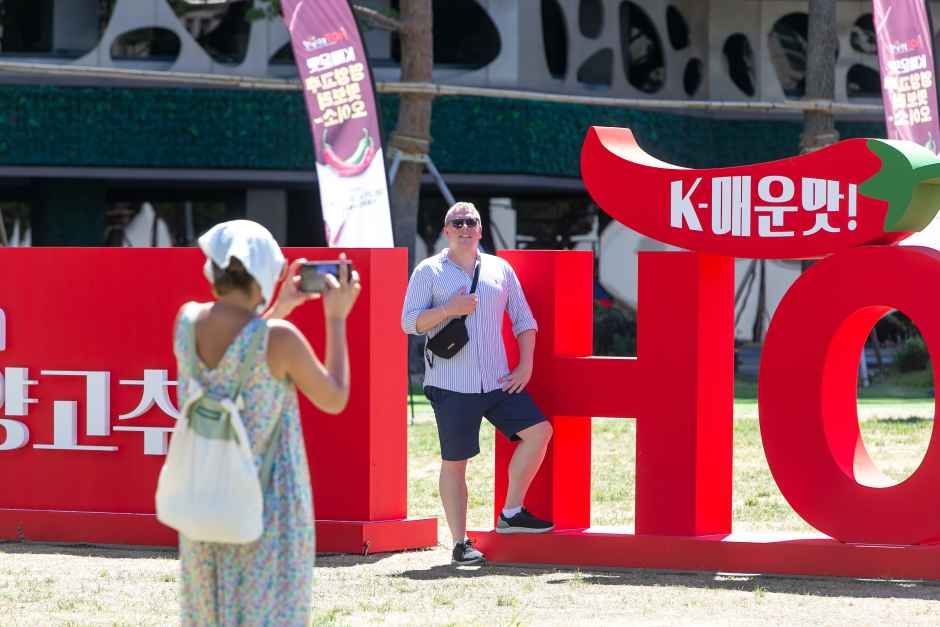
  • Photo Zones, etc. — Instagram-ready installations

Practical Information

📍 Address: B12, Eulji-ro, Jung-gu, Seoul (Eulji-ro 1-ga) — City Hall Plaza location, accessible via multiple subway lines

🛏️ Accommodations near the event

💰 Fee: Free

📞 Inquiry: 054-680-6381

🖥️ Website: https://www.영양고추.com/

Yeongyang Chili H.O.T Festival

What is Yeongyang?

Yeongyang sits in the northeastern corner of North Gyeongsang Province, where the Taebaek Mountains break into terraced valleys. With roughly 18,000 residents, it is Korea’s least populated county. The small population has kept traditional agriculture viable rather than driving it to extinction.

The land itself governs what can be grown here. Elevations range from 600 to 1,300 meters, and temperatures swing sharply between day and night. These conditions stress the plants just enough to concentrate their flavors without killing them. The soil is thin and rocky, scraped from mountainsides rather than deposited by rivers. Farmers work narrow plots cut into slopes by hand, as machinery cannot climb or turn on grades this steep.

Yeongyang produces a significant portion of Korea’s dried red peppers despite its size. Workers harvest the fruit at full ripeness and dry it on bamboo screens, exposing it to mountain air and low wood smoke. This taeyangcho method preserves volatile compounds that industrial dehydrators destroy. Laboratory analysis confirms what tasters have long noted: peppers dried this way retain distinct capsaicin profiles that differ measurably from factory-processed alternatives.

The county’s villages follow the terrain rather than flattening it. They cluster on ridge lines and at valley junctions, connected by roads that were impassable in winter until the 1990s. This isolation once limited economic opportunity. It now attracts a different kind of interest from chefs and food researchers who need sources uncontaminated by industrial methods. Whether this attention will sustain the county’s population or merely document its decline remains an open question.

NCT DREAM 10th Anniversary Party 〈The Sweet Dream Hotel〉 2026: Ticket Guide, Schedule, and Venue Tips for INSPIRE Arena

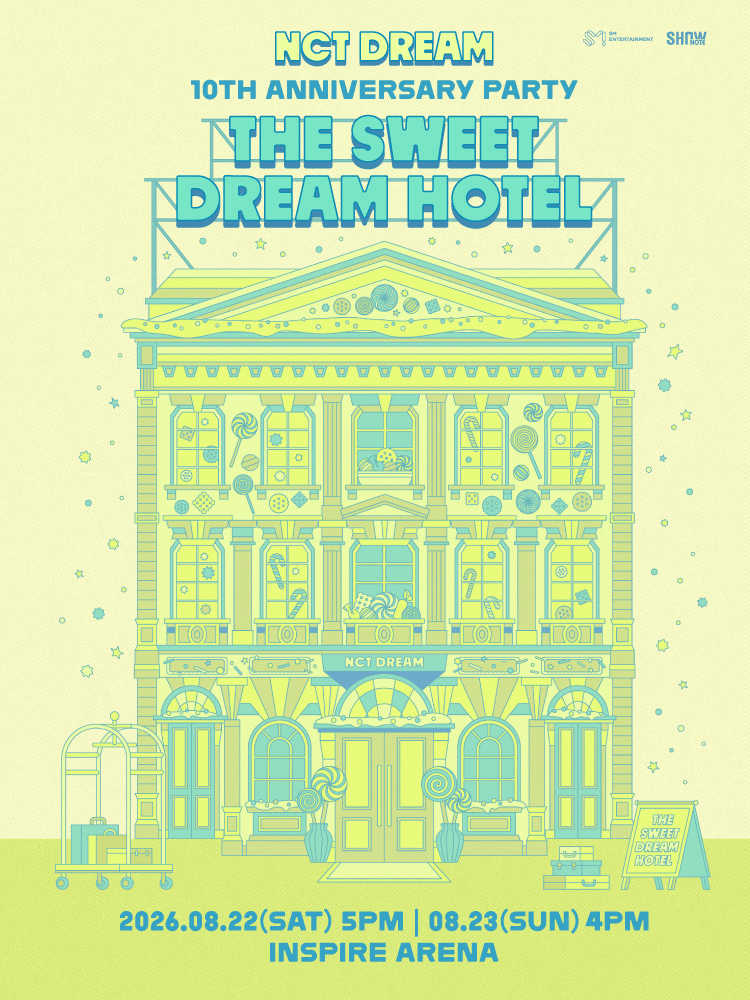
Poster

A decade marks a substantial milestone in the lifecycle of any musical act—sufficient time to refine a distinctive sonic identity while cultivating a dedicated following that spans continents. NCT DREAM commemorates this ten-year journey with the NCT DREAM 10th Anniversary Party 〈The Sweet Dream Hotel〉, a two-day event that transforms the INSPIRE Arena into an immersive hospitality-themed experience. Unlike conventional concerts where the audience faces a single proscenium, this production positions the stage at the venue’s center, creating a 360-degree environment that fundamentally altered the traditional performer-viewer dynamic.

Event Information

Schedule

The event unfolds across two distinct sessions, with timing adjusted to accommodate both weekend scheduling and potential travel constraints for international attendees:

(1st Session) Saturday, August 22, 2026, 5:00 PM (KST)
(2nd Session) Sunday, August 23, 2026, 4:00 PM (KST)

Ticket Pricing and Seating

  • Standard Seat (General): 121,000 KRW

The central stage configuration—while offering unprecedented proximity to the performers—introduces specific viewing considerations. Depending on the artist’s position during particular segments, some seats may experience conditions typically associated with rear seating, and sightlines may be restricted due to height differences among surrounding spectators, viewing angles, structural elements, camera equipment, or production necessities.

Transportation and Logistics

▶ Go to Queen’s Smile Shuttle Bus (Metropolitan/Regional) (Click link)

For those traveling from Seoul or surrounding regions, organized shuttle services operate between metropolitan centers and the venue, mitigating the complexities of Incheon’s transportation infrastructure during major event periods.

Ticketing Timeline and Pre-Sale Verification

Securing entry requires navigating a tiered verification and sales system that distinguishes between domestic (Korean) and international purchasers, with separate timelines for fan club members and general admission:

※ Domestic page fan club pre-verification period ▶ Monday, June 15, 2026, 2:00 PM (KST) ~ Tuesday, June 23, 11:59:59 PM (KST)
※ Global page fan club pre-verification period ▶ Monday, June 15, 2026, 2:00 PM (KST) ~ Wednesday, June 24, 11:59:59 PM (KST)
※ Domestic page fan club pre-sale period ▶ Tuesday, June 23, 2026, 8:00 PM ~ 11:59:59 PM (KST)
※ Global page fan club pre-sale period ▶ Wednesday, June 24, 2026, 8:00 PM ~ 11:59:59 PM (KST)
※ Wheelchair seat fan club pre-sale period ▶ Tuesday, June 23, 2026, 10:00 AM ~ Wednesday, June 24, 2026, 5:59:59 PM (KST)
※ General sale period ▶ Friday, June 26, 2026, 7:00 PM (KST) ~
※ Wheelchair seat general sale period ▶ Friday, June 26, 2026, 10:00 AM (KST) ~

Payment and Delivery Specifications

To accommodate the digital ticketing infrastructure and shipping logistics, several operational constraints apply. Bank transfer payments (virtual account) will be restricted among payment methods until Friday, July 3, 11:59:59 PM (KST); during this restriction period, alternative payment methods must be used. For bank transfers specifically, payment must be completed by 11:59:59 PM on the reservation day—failure to complete payment within this window results in automatic cancellation (note that payment closing times may vary by financial institution).

Physical ticket logistics follow a strict cutoff: reservations with payment completed by Thursday, July 23, 2026, 9:59 AM (KST) will be shipped sequentially to the registered address. Reservations confirmed after this timestamp are eligible only for on-site collection at the venue. Shipping address modifications remain possible until Friday, July 24, 2026, 9:59 AM (KST)—verification of this detail before purchase is strongly advised.

Following the transition to digital card ticket production on Friday, July 24, 2026, 10:00 AM (KST), cancellation requests for bulk-shipped reservations must be processed exclusively through the NOL Ticket Customer Center (1544-1555) or 1:1 inquiry channels, with a hard deadline of Wednesday, July 29, 2026, 12:00 PM (KST). Shipping costs become non-refundable after the digital transition deadline.

※ When reserving a ticket, you are considered to have agreed to the performance guidelines stated on the reservation page, and this content may be added to or changed according to government guidelines and organizer circumstances. Please be sure to re-verify the performance guidelines before viewing to avoid any disruptions or disadvantages during the performance.

이 포스팅은 쿠팡 파트너스 활동의 일환으로, 이에 따른 일정액의 수수료를 제공받습니다.

2026 Seocheon Hongwon Port Wild Gizzard Shad and Blue Crab Festival: Enjoy Fresh Seafood and Unique Hand-Catching Experiences

2026 Seocheon Hongwon Port Wild Gizzard Shad and Blue Crab Festival: Enjoy Fresh Seafood and Unique Hand-Catching Experiences

Seocheon Hongwon Port Wild Gizzard Shad and Blue Crab Festival

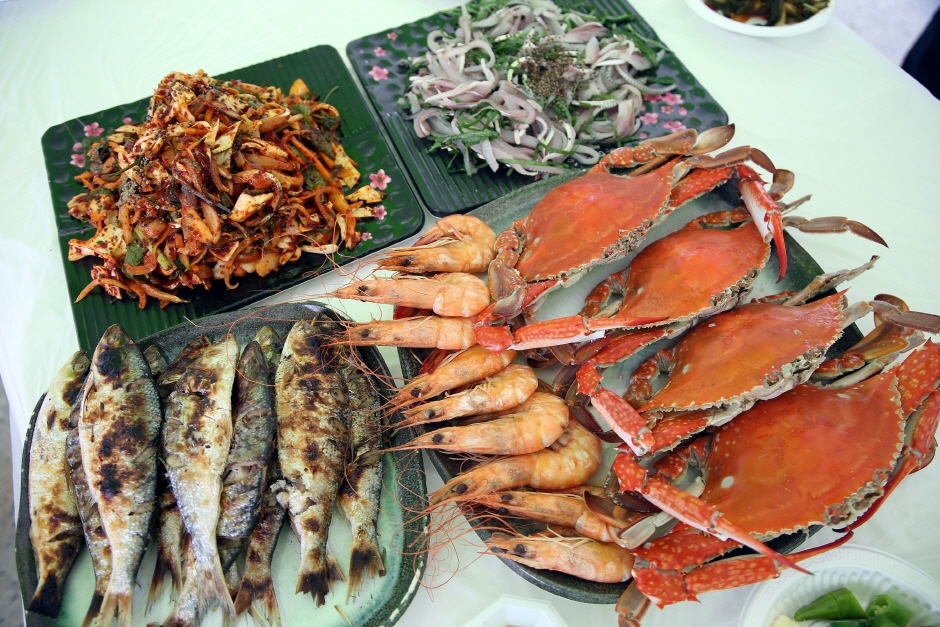
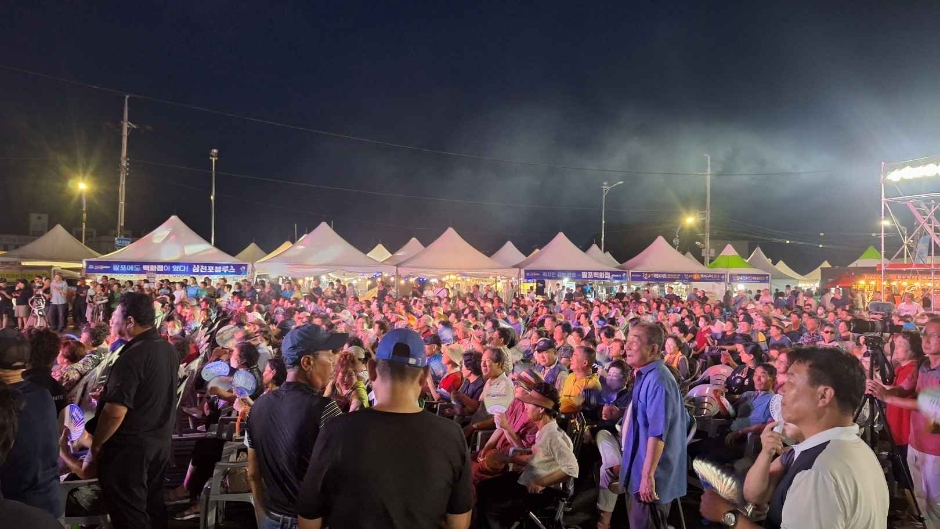
The Seocheon Hongwon Port Wild Gizzard Shad and Blue Crab Festival is a seafood cultural festival centered on two of the west coast’s most prized seasonal catches. It takes place at Hongwon Port, one of the region’s representative harbors, from August 22 to September 6, 2026. Wild gizzard shad, regarded as Seocheon’s top delicacy, and blue crabs at their meatiest are the anchors of the event, offering visitors a chance to taste fresh seafood while surrounded by ocean scenery.

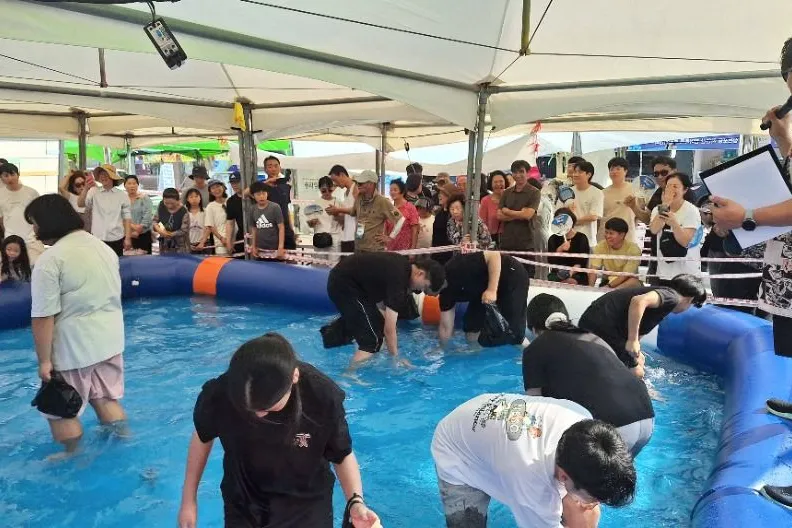
The festival grounds are designed to offer more than just dining. The signature experience is catching gizzard shad by hand, an activity suited to all ages. Treasure hunts are held within the Hongwon Port event grounds, and dedicated photo zones themed around gizzard shad and blue crabs let visitors capture the occasion. Folk games are also organized, giving the festival a lively, community-oriented character. Among the regular events is the Hongwon Port seafood market, where the local catch is available directly.

Admission to the festival is free, and the experience programs are paid separately. The hand-catching gizzard shad experience costs 15,000 won. For those traveling from outside the area, accommodations are available nearby, and the festival’s official website provides additional information.

  • 🗓️ 2026.08.22 ~ 2026.09.06
  • 📍 Address: 88 Hongwon-gil, Seocheon-gun, Chungcheongnam-do
  • 🛏️ Accommodations near the event
  • 💰 Fee: Free admission (Experience programs are paid: Catching gizzard shad by hand 15,000 won)
  • 📞 Inquiry: 041-950-4414
  • 🖥️ Website: https://www.seocheon.go.kr

Seocheon Hongwon Port Wild Gizzard Shad and Blue Crab Festival

What is gizzard shad?

Gizzard shad is a silvery, deep-bodied fish found in fresh and brackish waters. Its common name comes from a muscular stomach resembling a gizzard, which helps grind the plant and animal matter it eats. It is hardy, often travels in large schools, and is a common catch in rivers, reservoirs, and coastal areas where fresh and salt water meet.

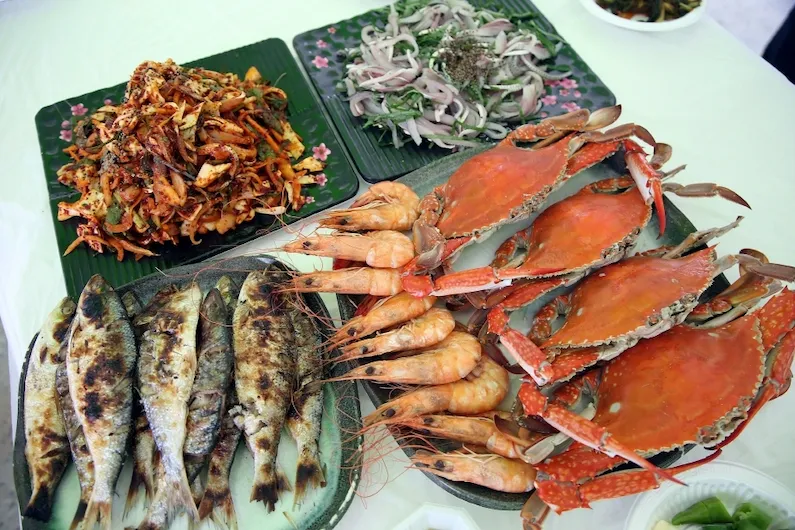
At the Seocheon Hongwon Port Wild Gizzard Shad and Blue Crab Festival, the fish is presented as a seasonal local food. It has many small, soft bones and a distinctive savory flavor. Common preparations include grilling, frying, and simmering in stews—cooking methods that suit its texture. The festival also offers a hand-catching event: visitors wade into shallow water and scoop fish up with their bare hands. This is one way to take part in a local fishing practice that predates modern gear.

For local cooks, the appearance of wild gizzard shad is a sign of the season. The firm flesh pairs well with blue crab, which is also featured at the festival. Knowing a little about the fish explains why it is prepared the way it is and why it has remained part of the area’s food culture. That background is useful for first-time visitors and experienced anglers alike.

2026 Yeongdeok National Heritage Night Tour: Free 3-Day Immersive 1920s History Festival at Yeonghae Market Street

2026 Yeongdeok National Heritage Night Tour: Free 3-Day Immersive 1920s History Festival at Yeonghae Market Street

Yeongdeok National Heritage Night Tour

🗓️ 2026.08.21 ~ 2026.08.23

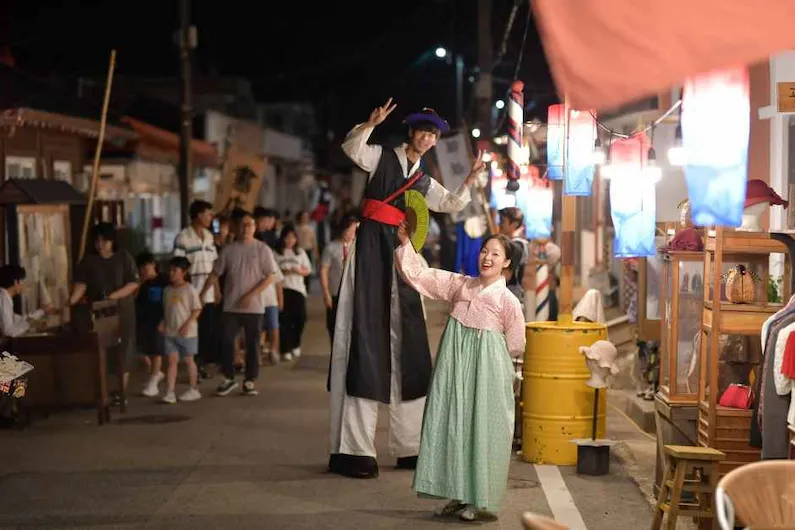
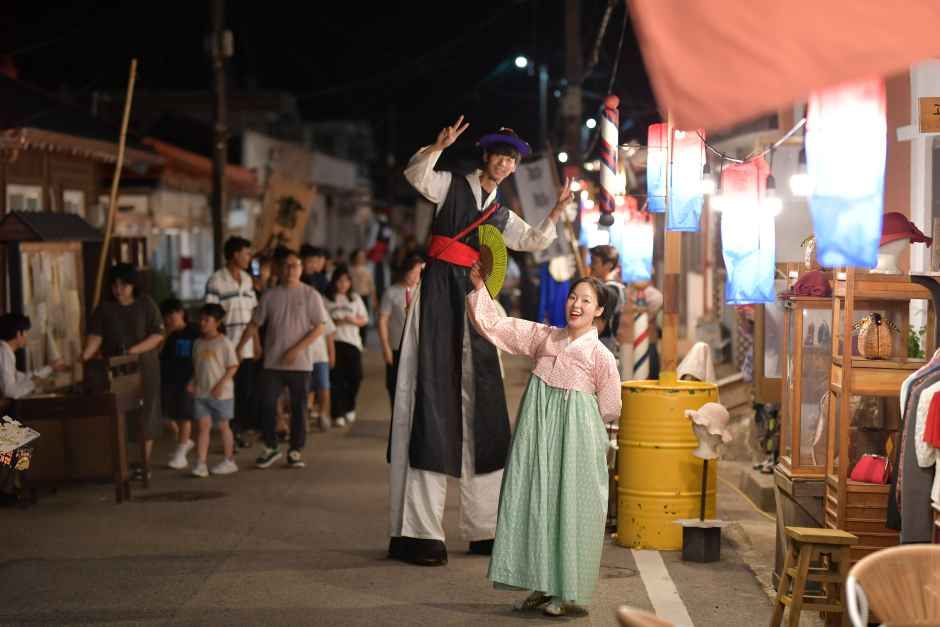
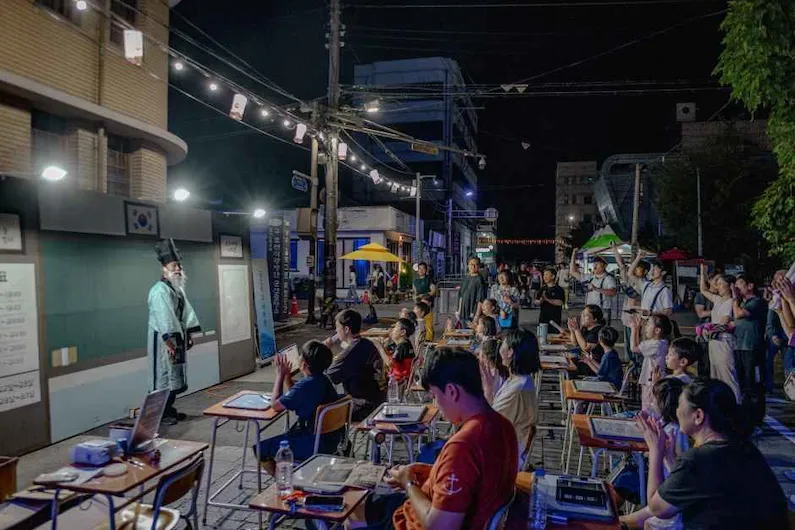
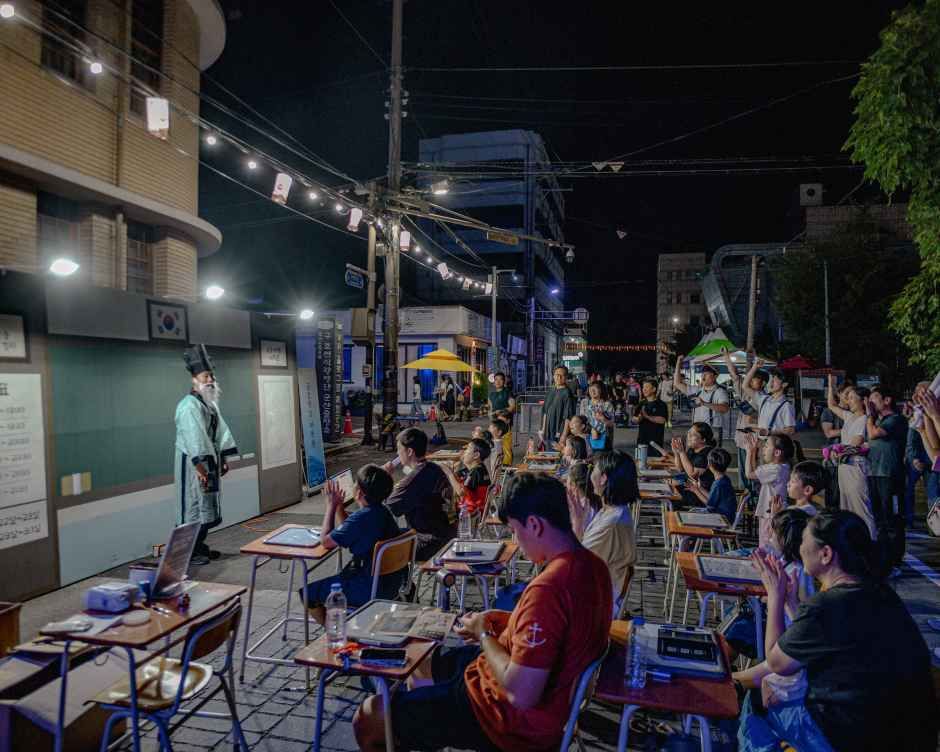
The 2026 Yeongdeok National Heritage Night Tour, subtitled “Yeonghae 1926, Walking Through That Night,” transforms the Modern History and Culture Space of Yeonghae Market Street into a three-day immersive portal to the past. Running from August 21 to 23, 2026, this nightly history and culture festival invites visitors to wander through alleys meticulously revived to reflect Yeonghae as it appeared one hundred years ago.

The significance of the location itself warrants attention. Yeonghae Market Street holds designation as state-registered cultural heritage at the myeon (township) level—a distinction shared by only five other regions across the nation. This scarcity amplifies what the Night Tour offers: not a generic heritage experience, but one rooted in a genuinely rare surviving urban fabric.

What Sets This Apart

Where many heritage festivals content themselves with static displays, this event pursues full environmental storytelling. The year 1926 functions as more than a decorative motif; it structures every programmatic choice, from the musical repertoire to the food vendors’ preparations. Visitors encounter not exhibits about history, but history reconstructed as navigable space.

Program Overview

All events operate from 7 PM to 11 PM across eight thematic categories—Night View, Night Path, Night History, Night Story, Night Legend, Night Food, Night Stay, and Night Market—with forty programs running daily. Admission is free.

Category Offerings
Main Performances Site-specific musical Yeonghae 1926, Gokmadan Circus, cabaret performances, modern costume parade, National Heritage Media Facade, intangible heritage including Yeongdeok Wolwolyicheongcheong and Onggi artisan demonstrations
Experience & Exploration Night Tour sticker map tour, rickshaw experience, modern costume experience, silent cinema, hands-on workshops for lanterns, Taegeukgi keyrings, and rubbing prints
Food & Market Yeonghae Club (tavern recreation using Yeongdeok specialties), food trucks, linked events with Yeonghae Manse Market, Yeongdeok peach specialty sales
Accommodation Partner Hanok guesthouses at Goesi Folk Village, Wongu Traditional Village, and Inryang Traditional Theme Village

Practical Information

📍 Address: 10 Yeju 2-gil, Yeonghae-myeon, Yeongdeok-gun, Gyeongsangbuk-do

🛏️ Accommodation near the event

💰 Fee: Free

📞 Inquiry: 054-730-5852

⭐️ Instagram: https://www.instagram.com/festival.yd

🖥️ Homepage: http://yahaeng.ydstay.kr/

Yeongdeok National Heritage Night Tour

What is Yeonghae Market Street?

Yeonghae Market Street is a commercial district in Yeongdeok’s old town, built during the 1920s when the Japanese colonial administration developed the area as a regional fishing and trade center. The street connects inland mountain villages with the coastal economy, historically trading in marine products, medicinal herbs, and imported goods.

The name combines “Yeong” (영, 永) from Yeongdeok with “hae” (海), meaning sea. The architecture shows what happens when Japanese colonial commercial design meets Korean practical needs: two-story wooden buildings with curved tile roofs, projecting upper floors, and covered walkways that kept traders dry through winter storms and summer rains. The scale is smaller than colonial markets in major cities—narrow lanes branch from the main street where specific trades settled. Copper smiths, net menders, rice wine brewers, and fortune tellers worked in designated sections.

Yeongdeok’s geographic isolation kept this market intact while comparable sites elsewhere were demolished during Korea’s rapid development or rebuilt as tourist approximations. The original wooden floors absorbed decades of salt water; fishmongers sold gwamegi (half-dried billfish) through the 1970s; layered signage in hangul and kanji accumulated without deliberate curation. The 2019 designation as a National Registered Cultural Property acknowledges this continuity rather than freezing the street as a museum piece.

Today about 180 structures remain across twelve alleys, with roughly forty percent retaining original elements from the 1920s-1940s. Preservation follows an “adaptive authenticity” approach—contemporary businesses operate here, but with requirements to maintain historical materials and spatial relationships. The National Heritage Night Tour works within this framework, using buildings that actually witnessed the economic and social changes of early twentieth-century coastal Korea rather than constructing a theatrical version of the past.

2026 Sacheon-si Samcheonpo Port Wild Gizzard Shad Festival: Enjoy Fresh Seafood and Exciting Hands-On Activities

2026 Sacheon-si Samcheonpo Port Wild Gizzard Shad Festival: Enjoy Fresh Seafood and Exciting Hands-On Activities

Sacheon-si Samcheonpo Port Wild Gizzard Shad Festival

🗓️ 2026.08.20 ~ 2026.08.23

Sacheon-si Samcheonpo Port Wild Gizzard Shad Festival

The Sacheon-si Samcheonpo Port Wild Gizzard Shad Festival is a food festival centered on gizzard shad, a representative seafood item of Samcheonpo Port in Sacheon-si. What started as a local event has grown into a nationwide food festival, drawing continued interest from citizens and foreign tourists. The 2026 festival, now in its 23rd year, will be held from August 20 to 23 and is timed to coincide with the peak gizzard shad season.

The festival has a dual purpose: to introduce the taste of Sacheon-si gizzard shad to a wider audience and to support the local fishing industry. It aims to increase the income of local fishermen and residents working in fisheries-related businesses, while also highlighting the clean waters and seafood products of Sacheon-si. For visitors, the result is a festival that combines eating, performances, and hands-on activities.

Festival Programs

Main Programs

  • Eve festival celebratory performance
  • Opening ceremony
  • Fireworks
  • Celebratory performances

Side Programs

  • Gizzard shad dish sales
  • Invited performance by the Gyeongsangnam-do Intangible Cultural Heritage Mado Galbang-asori
  • Folk market and Pumba performances

Consumer Participation Programs

  • Bare-handed gizzard shad catching experience
  • Free gizzard shad tasting event
  • “I am a Singer” on-site karaoke
  • Etc.

The program list gives visitors several ways to take part. In addition to watching performances and fireworks, attendees can buy gizzard shad dishes, watch the Mado Galbang-asori performance, and browse a folk market. Those looking for a more active experience can try catching gizzard shad with their bare hands, join the free tasting session, or sing at the on-site karaoke stage.

Practical Information

📍 Address: 56-35 Palpo 3-gil, Sacheon-si, Gyeongsangnam-do (Donggeum-dong)

🛏️ Accommodations near the event

💰 Fee: Free

📞 Inquiry: 055-832-8565

🖥️ Homepage: http://www.3004palpo.co.kr

Wild gizzard shad is a small, silver-skinned fish in the herring family. It is migratory and usually travels in large schools through shallow coastal waters, occasionally entering the brackish zones where rivers meet the sea. Wild-caught shad feed on natural plankton and tiny crustaceans, and this diet gives the meat a firmer texture and a more concentrated flavor than farmed fish.

The fish is modest in size—typically twenty to thirty centimeters long—but its flavor is substantial. The meat is rich, slightly oily, and mildly sweet, with a clean finish. In Korean coastal cuisine, wild gizzard shad has long been a seasonal staple. It is often salted and grilled whole, or sliced thin and served raw with sesame oil and a little salt. The fish also has fine, soft bones that turn crisp and fully edible when cooked properly. For that reason it can be eaten whole, and it is a common item at seaside festivals and harborside restaurants.

Because the fish is wild, its availability changes with the seasons and the tides. The best-known season is early autumn, when the fish have fattened before spawning. At this time the flesh is more tender and juicy, and grilling whole over a flame is the most common preparation. The skin crisps up well, and the bones become part of the dish rather than an obstacle. Local cooking styles vary: some ports simply salt the fish and cook it over charcoal, while others slice it raw and serve it with sesame oil. For anyone visiting a coastal market during the autumn season, wild gizzard shad is a straightforward regional specialty.

2026 Gimhae Gaya Theme Park Light Festival: Experience a Magical Voyage of Light and History

2026 Gimhae Gaya Theme Park Light Festival: Experience a Magical Voyage of Light and History

Gaya Theme Park Light Festival: Voyage Toward the Light

🗓️ 2026.08.14 ~ 2026.08.23

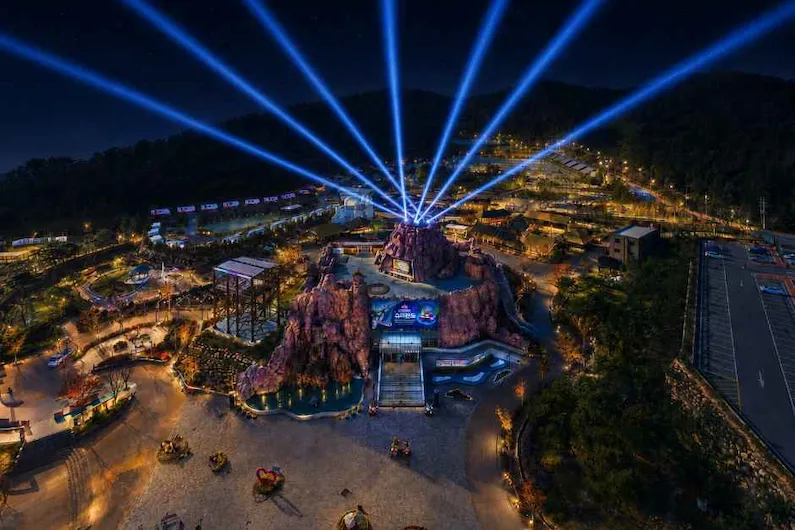
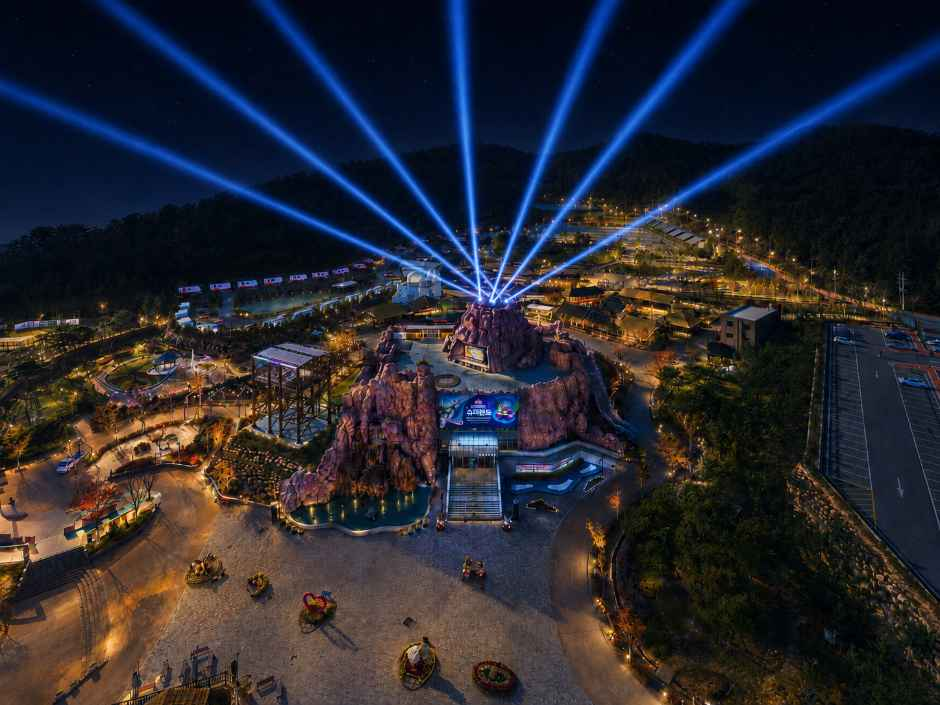
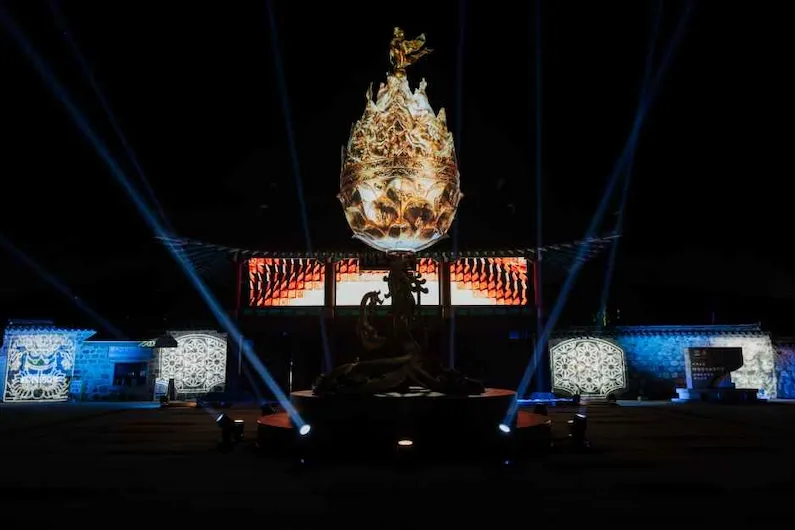
Gimhae’s summer nights will be lit by the 3rd Gimhae Light Festival, “Voyage Toward the Light.” Held at Gimhae Gaya Theme Park from August 14 to 23, 2026, the festival revives the sea route that Queen Heo took from Ayodhya, India, to Gaya two thousand years ago. Through light sculptures, illuminations, media art, and photo zones, the festival tells a story of departure, voyage, and the encounter with Gaya. Visitors can walk along a path of light inspired by the blue sea and the night sky, discovering the historical connections between Gaya and India.

The festival is open daily from 5:20 PM to 10:00 PM. Last admission is at 9:00 PM, and admission costs 2,000 won per person.

Light festival content

The light festival content includes:

  1. Sea of Light
  2. Light Rangoli
  3. Waves in the Sky
  4. Flash of Gaya
  5. Lanterns of Light
  6. Constellations of Light
  7. Rangoli Road
  8. Hongsalmun (Red Spike Gate) of Light
  9. End of the Voyage

Programs and performances

  • Opening Ceremony: LED performance and fireworks show. During the opening event on August 15, Ogomu, K-POP Tron performances, and a multimedia fireworks show with about 3,000 shells will decorate the night sky.
  • Night Stage “Melodies Flowing Along the Light”: A free concert for citizens held in front of the waterway performance venue.
  • Moonlight Gugak Stroll: Gugak performances featuring daegeum, gayageum, and gosu in front of the Gaya Royal Palace.

On weekends and public holidays, the festival adds a local food zone, a regional creators’ art market, and outdoor performances featuring jazz, fusion gugak, and acoustic music.

Food and art market

  • Food Zone: Food zone and food trucks featuring famous bakery cafes in the Gimhae area and foods using Gimhae ingredients.
  • Gakkum Art Market: An art market where you can find local specialties of the Gimhae area.

Come and experience Gimhae’s special summer night, where light, history, performances, food, and art harmonize.

Visitor information

📍 Address: 161 Gayathema-gil, Gimhae-si, Gyeongsangnam-do (Eobang-dong)

🛏️ Accommodations near the event

💰 Fee: Paid (2,000 won)

📞 Inquiry: 055-340-7900~1

⭐️ Instagram: https://www.instagram.com/gimhae_gayapark

🖥️ Homepage: https://gtp.ghct.or.kr/home/main

Gaya Theme Park Light Festival: Voyage Toward the Light

What is Gaya?

Gaya was a confederacy of city-states in the southern Korean Peninsula, active from roughly the 1st to the 6th century CE. Its constituent polities were concentrated in the Nakdong River basin, an area with enough arable land and access to coastal routes to support a shared material culture built on agriculture, iron production, and maritime trade.

The early center of this network was Geumgwan Gaya, usually associated with modern Gimhae. The founding legend of Geumgwan Gaya tells of King Suro, said to have descended from a golden egg on Mount Guji. That story is preserved in local tradition and remains part of how Gimhae presents its history.

Gaya’s iron ore deposits were among its most valuable resources. Iron ingots and finished goods were exported widely, including to Japan, in exchange for luxury items such as glass beads and precious stones. Gaya workshops also produced pottery, horse-shaped ornaments, and gold and bronze regalia; several such pieces have been recovered from royal tombs in Gimhae.

Politically, Gaya was never unified as a single state, and this limited it in dealings with its larger neighbors. To the north was Goguryeo, to the west Baekje, and to the east Silla. Over the 5th and 6th centuries, Gaya’s member states were gradually absorbed by Silla, ending the confederacy by around 562 CE. Though the political entity disappeared, the archaeological record and local sites retain evidence of Gaya’s material culture and regional influence.

Today, the Gimhae Gaya Theme Park Light Festival uses illuminated installations to present images and motifs associated with Gaya. The display draws on the historical setting and archaeological finds connected to the area, with the park itself located near the Nakdong River. The festival is a modern adaptation of that material, not a re-creation of a specific event, but it gives visitors a way to engage with the historical landscape of Gimhae.

Gunsan National Heritage Night Tour 2026: 8-Day Summer Festival Guide (August 14–22) – Free Light Shows, Night Markets & Heritage Workshops

Gunsan National Heritage Night Tour 2026: 8-Day Summer Festival Guide (August 14–22) – Free Light Shows, Night Markets & Heritage Workshops

Gunsan National Heritage Night Tour

🗓️ 2026.08.14 ~ 2026.08.22

The Gunsan National Heritage Night Tour returns for its 2026 edition with an expanded format: eight consecutive days split across two weekends, running from August 14–16 (Friday–Sunday) and August 21–22 (Friday–Saturday). Held in the national heritage district of Gunsan’s old city center—including the former Joseon Food Supply Corps Gunsan Office—this nighttime cultural event transforms historic streets into an open-air museum where illumination, performance, and participatory programming converge.

Unlike conventional heritage tours that operate during daylight hours, this event exploits the atmospheric potential of midsummer nights, using light installations to recontextualize colonial-era architecture and modernist streetscapes. The 2026 program introduces eight thematic categories organized around the Korean character 夜 (night), comprising 46 distinct activities ranging from guided walks and hands-on workshops to night markets and acoustic performances.


Program Overview

1. Night View (夜景) — 2 Programs

Light-based installations reframe the built environment after dark: the Garden of Light and Playground of Light invite unstructured exploration of illuminated heritage spaces.

2. Night Road (夜路) — 7 Programs

Pedestrian routes structure discovery through narrative and game mechanics:

  • Strolling through Modernity
  • Gunsan History Detective Agency
  • Footprint Tour
  • Extra Boy
  • Modern Surprise Quiz
  • Our Gunsan of That Era
  • Please Take Care of the 2027 Night Trip

3. Night History (夜史) — 21 Programs

The educational core of the event, combining craft workshops with historical investigation:

Activity Description
Kumho School Language School Educational reconstruction
Daeya Photo Studio Period photography experience
Lanterns Lighting the Night Trip Traditional illumination craft
Making National Heritage Keyrings Souvenir creation
The Gunsan National Heritage I Drew Drawing workshop
Long Live Korean Independence Toward Liberation Independence movement history
Making Haemang Tunnel Together Collaborative construction project
Making Sock-neck Straw Mats Traditional weaving
Contraband Hidden in Grain Smuggling history interactive
Making Gunsan Night Trip Modern Bankbooks Financial history craft
Making Gunsan Night Trip Currency Numismatic workshop
Listening to National Heritage Stories Oral history sessions
National Heritage Introduced by Gunsan Children Youth docent program
Independence Activists of Gunsan Biographical presentations
History of Electricity in Gunsan Industrial heritage
The Cry of Okgu on That Day 99 Years Ago Specific historical commemoration
Understanding the History of Gunsan General orientation
Gaekju Story Merchants’ history
Gunsan Special Report Investigative format program
Support the Independence Army Hidden in Haemang Tunnel! Role-play activity
Overlapping 100 Years of Time in Haemang Tunnel Centennial reflection

4. Night Talk (夜說) — 4 Programs

Evening gatherings combining performance and discourse:

  • On a Starry Night
  • Opening Event: Walking the Street of Light
  • Intangible Heritage of Gunsan (Honam Neokpuri Gut) — Shamanic ritual performance
  • Melody of History and Excitement

5. Night Art (夜畵) — 5 Programs

Curated access to heritage interiors and exhibitions:

  • National Heritage of Gunsan
  • Interior Commentary of the Japanese-style House in Sinheung-dong
  • Intangible Heritage of Gunsan (Chimseonjang) — Traditional mattress-making demonstration
  • Night Opening of National Heritage and Cultural Facilities
  • Gunsan Modern History Photo Exhibition

6. Night Market (夜市) — 2 Programs

Commercial component with local vendors: Market Square and Various Booths.

7. Night Food (夜食) — 3 Programs

  • Gunsan Night Trip Coexistence Alley — Integrated with permanent local businesses
  • Gaekju Night Market
  • A Cup of Coffee and Music

8. Night Stay (夜宿) — 2 Programs

Extended engagement options: Invitation to the Street of Light and Good Morning Night Trip.


Practical Information

📍 Address: 43 Guyeong 2-gil, Gunsan-si, Jeonbuk Special Self-Governing Province (Yeonghwa-dong)

🛏️ Accommodations near the event

💰 Admission: Free

📞 Inquiries: 063-453-2447

⭐️ Instagram: https://www.instagram.com/2026_gunsan_night_trip

🖥️ Website: https://gsnightculture.com/

Gunsan National Heritage Night Tour

What is Gunsan’s national heritage?

Gunsan’s national heritage consists of the built environment and infrastructure developed during Korea’s late 19th and early 20th century modernization, when the port city served as a hub for international trade. The Korean government has designated significant portions as Important Folklore Cultural Heritage and registered cultural properties.

The heritage is concentrated in the Modern History Museum district and Sinheung-dong neighborhood, where over 100 historic buildings remain standing: the former Hirotsu Hotel, Gunsan Customs House, and numerous Japanese-style residences. The Saemangeum seawall and Gunsan Port record large-scale engineering works that reshaped the region. Jinpo Maritime Theme Park contains the remnants of submerged warships.

Several factors explain why this collection matters. The density of preserved wooden-frame Japanese buildings, red-brick warehouses, and modernist municipal structures forms an unusually intact urban landscape for Korea, where comparable neighborhoods typically underwent redevelopment or wartime destruction. The preservation is not absolute—some structures have been modified, others restored—but enough fabric remains to read the spatial logic of a colonial port city: the waterfront customs infrastructure, the grid of residential streets, the separation of Japanese and Korean commercial quarters.

The 2026 Night Tour opens normally restricted interiors after dark, including Dongguksa Temple and the Wolmyeong-dang villa. The lighting design emphasizes structural details that daylight obscures—roof joinery, plaster textures, the proportions of tatami rooms—without dramatization. The purpose is observation, not atmosphere.

2026 National Heritage Media Art Korea: 12 Historic Sites Transformed by Cutting-Edge ICT Technology (Full Schedule & Locations Guide)

2026 National Heritage Media Art Korea: 12 Historic Sites Transformed by Cutting-Edge ICT Technology (Full Schedule & Locations Guide)

National Heritage Media Art

🗓️ 2026.08.14 ~ 2026.11.08

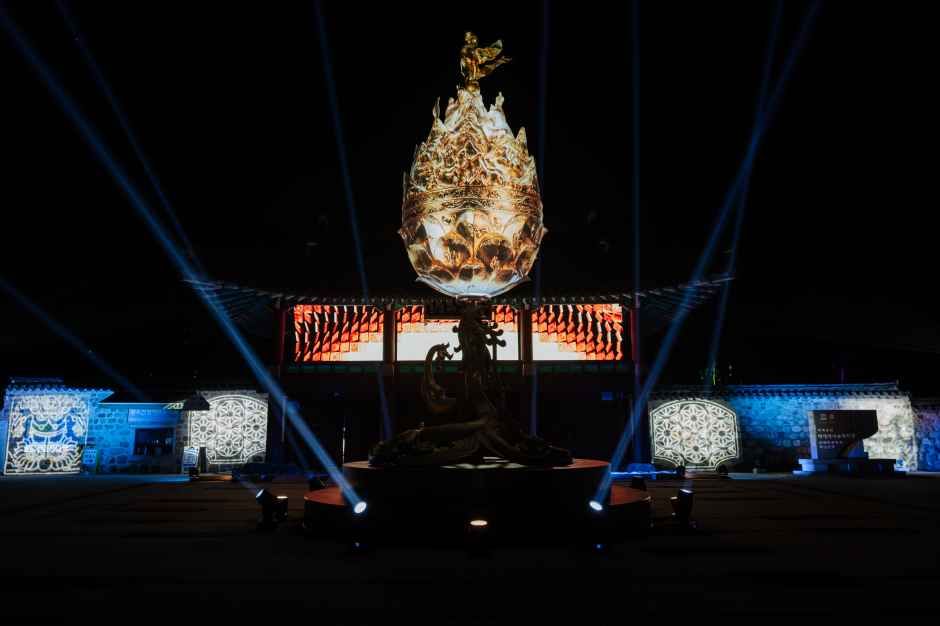
National Heritage Media Art is a cultural heritage festival held annually in various regions across the country using our ‘national heritage’ as a theme, hosted by the National Heritage Administration and organized by the Korea Heritage Service. Since its start in 2021, <2026 National Heritage Media Art>, now in its 6th year, plans to beautifully adorn the national heritage of 12 regions through various programs utilizing the latest ICT technology.

In 2026, media art that re-examines the history and maximizes the value held by each cultural heritage site will unfold against the backdrops of the ‘Goryeo Palace Site’ in Ganghwa and ‘Labor Party Office’ in Cheorwon in the [Gyeonggi/Gangwon region]; ‘Daereungwon’ in Gyeongju, ‘Tongdosa Temple’ in Yangsan, ‘Jinju Fortress’ in Jinju, and ‘Samdo Sugun Tongje-young’ in Tongyeong in the [Gyeongsang region]; ‘Former Gunsan Customs Main Building’ in Gunsan, ‘Jinnamgwan’ in Yeosu, and ‘Mireuksa Temple Site’ in Iksan in the [Jeolla region]; and ‘Jeongnimsa Temple Site’ in Buyeo, ‘Yi Chungmu Gong Yuheo’ (Hyeonchungsa Shrine) in Asan, and ‘Yongdusaji Iron Flagpole’ in Cheongju in the [Chungcheong region]. Through <National Heritage Media Art>, you can encounter moments where the heritage of the past connects to present life and shines brightly.


What Makes This Festival Worth Your Time

Unlike conventional heritage tours that rely on static displays and explanatory plaques, National Heritage Media Artdeploys cutting-edge ICT—projection mapping, interactive installations, and immersive sound design—to transform centuries-old sites into living canvases. You are not merely observing history; you are standing within it as light, motion, and sound reconstruct the intentions of kings, the strategies of generals, and the spiritual aspirations of monks across twelve distinct narratives.


Regional Programs

1. [Gyeongsang] Jinju ‘Jinju Fortress’

Event Period 2026. 8. 14.(Fri) ~ 9. 6.(Sun)
Event Location Jinju Fortress, Jinju
Event Content Media art connecting the past, present, and future will be implemented at ‘Jinju Fortress’, one of the three major battle sites of the Imjin War.

2. [Jeolla] Gunsan ‘Former Gunsan Customs Main Building’ etc.

Event Period 2026. 8. 28.(Fri) ~ 9. 20.(Sun) / *Closed every Monday
Event Location Former Gunsan Customs Main Building, Gunsan Inner Port History and Culture Space, Former 18th Bank of Japan Gunsan Branch, Former Bank of Chosen Gunsan Branch, etc.
Event Content The memories and values of modern Gunsan are newly illuminated against the backdrop of modern national heritage such as the ‘Former Gunsan Customs Main Building’.

3. [Gyeongsang] Gyeongju ‘Daereungwon’

Event Period 2026. 9. 4.(Fri) ~ 9. 27.(Sun)
Event Location Daereungwon, Gyeongju
Event Content The brilliant history and cultural spirit of Silla are modernly reproduced against the backdrop of ‘Daereungwon’, where Silla royal tombs such as Cheonmachong are concentrated.

4. [Jeolla] Iksan ‘Mireuksa Temple Site’

Event Period 2026. 9. 4.(Fri) ~ 9. 27.(Sun)
Event Location Mireuksa Temple Site, Iksan
Event Content The wishes and harmony of King Mu and the people of Baekje, who dreamed of the unification of the Three Kingdoms at the Baekje royal capital ‘Mireuksa’, are presented through a modern reinterpretation.

5. [Chungcheong] Buyeo ‘Jeongnimsa Temple Site’

Event Period 2026. 9. 7.(Mon) ~ 9. 27.(Sun)
Event Location Jeongnimsa Temple Site, Buyeo
Event Content The doctoral system and their professional skills that led the golden age of Sabi Baekje culture are reinterpreted through media art, implementing a mysterious journey that transforms Jeongnimsa Temple Site into a media art space.

6. [Gyeonggi] Ganghwa ‘Goryeo Palace Site’

Event Period 2026. 9. 11.(Fri) ~ 10. 4.(Sun)
Event Location Goryeo Palace Site, Ganghwa
Event Content The spirit of protecting the nation contained in Ganghwa, where the capital was moved to resist the Mongol invasions, is revived through media art centering on the ‘Goryeo Palace Site’.

7. [Gangwon] Cheorwon ‘Labor Party Office’

Event Period 2026. 9. 11.(Fri) ~ 10. 11.(Sun) / *Closed every Tuesday, Chuseok day
Event Location Labor Party Office, Cheorwon
Event Content A message of freedom and peace is delivered through media art at the ‘Labor Party Office’, a historical site that remembers the Korean War and the history of division.

8. [Chungcheong] Asan ‘Yi Chungmu Gong Yuheo’

Event Period 9. 18.(Fri) ~ 10. 11.(Sun)
Event Location Yi Chungmu Gong Yuheo (Hyeonchungsa Shrine), Asan
Event Content The patriotism, leadership, and spirit of sacrifice of Yi Sun-sin are intended to be inherited through media art at ‘Yi Chungmu Gong Yuheo (Hyeonchungsa Shrine)’, the site of Yi Sun-sin’s legacy.

9. [Gyeongsang] Tongyeong ‘Samdo Sugun Tongje-young’

Event Period 2026. 9. 18.(Fri) ~ 10. 11.(Sun)
Event Location Samdo Sugun Tongje-young, Sebyeonggwan, etc., Tongyeong
Event Content ‘Samdo Sugun Tongje-young’, which served as the southernmost fortress of the Joseon Dynasty and a hub for maritime logistics, as well as a center of craft culture through the production of military supplies and tributes, is expressed through light.

10. [Gyeongsang] Yangsan ‘Tongdosa Temple’

Event Period 2026. 9. 28.(Mon) ~ 10. 18.(Sun)
Event Location Tongdosa Temple, Yangsan
Event Content At ‘Tongdosa Temple’, one of the UNESCO World Heritage ‘Sansa, Buddhist Mountain Monasteries in Korea’, an immersive experience of reaching the inner state of ‘silence’ is provided through media art.

11. [Chungcheong] Cheongju ‘Yongdusaji Iron Flagpole’ etc.

Event Period 2026. 10. 3.(Sat) ~ 10. 24.(Sat)
Event Location Yongdusaji Iron Flagpole, Mangseonru, Chungcheong-do Byeongma-jeong Do-sa-yeong Gate, Cheongnyeonggak, etc., Cheongju
Event Content The historical value and original functions of national heritage in the city are re-examined through media art, from the Goryeo Dynasty cultural heritage ‘Yongdusaji Iron Flagpole’ to the natural monument ‘Apkgaksu’.

12. [Jeolla] Yeosu ‘Jinnamgwan’

Event Period 2026. 10. 9.(Fri) ~ 11. 8.(Sun)
Event Location Jinnamgwan, Yeosu
Event Content The history of ‘Jinnamgwan’ as a central naval base that led the Imjin War and the Jeongyu Jae-ran to victory is reconstructed through media art.

Practical Information

📍 Address: 42 Bukmungil, Ganghwa-eup, Ganghwa-gun, Incheon

🛏️ Accommodations near the event

💰 Fee: Free (Paid programs may be available depending on the venue)

📞 Inquiry: 02-3011-7781

⭐️ Instagram: https://www.instagram.com/k.heritage.mediaart/

🖥️ Homepage: https://www.kh.or.kr/
National Heritage Media Art

What are Korea’s 12 National Heritage Sites?

The 2026 National Heritage Media Art Korea initiative has selected twelve historic sites spanning the peninsula, each chosen for its cultural significance and suitability for digital interpretation. These locations range from Bronze Age cemeteries to Joseon dynasty palaces.

Goguryeo Tombs (Ji’an and Pyongyang regions) — Though primarily in present-day North Korea, the exhibition incorporates documentation of these UNESCO-listed mural tombs, with projection mapping of the celestial and daily life paintings from 5th–7th century noble burial chambers.

Bulguksa Temple and Seokguram Grotto, Gyeongju — The artificial stone grotto’s granite Buddha serves as centerpiece for augmented reality experiences suggesting original polychrome and gilding.

Baekje Historic Areas: Gongju and Buyeo — Capital sites of the southwest kingdom, including the mountain fortress at Busosan and the royal palace at Gongsanseong, with holographic reconstructions of vanished wooden architecture.

Hwangnyongsa Temple Site, Gyeongju — Location of Korea’s tallest wooden pagoda (nine stories, approximately 80 meters), destroyed during the Mongol invasions, presented through LED terrain visualization.

Gyeongju Historic Areas: Daereungwon Tumuli — The Silla burial ground, where dome-screen installations allow visitors to experience interior chambers without physical entry.

Changdeokgung Palace and Huwon, Seoul — The Joseon royal “Secret Garden,” with sensor-responsive projections that shift with seasonal and diurnal cycles.

Jongmyo Royal Shrine, Seoul — Confucian ancestral ritual space, using spatial audio and light to evoke the Jongmyo Jeryeak court music performances.

Suwon Hwaseong Fortress — Late 18th-century military architecture designed by King Jeongjo, with drone-coordinated nighttime illuminations tracing its 5.7-kilometer wall.

Gyeongbokgung Palace, Seoul — The primary Joseon royal palace, with media installations in Geunjeongjeon Hall and Gyeonghoeru Pavilion during evening programs.

Haeinsa Temple and Tripitaka Koreana, Hapcheon — The 13th-century woodblock printing treasury, using micro-CT visualization and haptic interfaces to explore the 52 million characters without physical handling.

Namhansanseong Emergency Capital, Gwangju — Mountain fortress refuge developed across multiple periods, with GPS-triggered AR overlays reconstructing its 17th-century siege and civilian functions.

Ganghwa Dolmen Sites — Bronze Age megalithic cemetery, with generative visuals responding to astronomical alignment data of the table-form tombs.

The sites operate on seasonal schedules from March through November 2026. Technical specifications and accessibility information follow.

2026 Chuncheon Summer Water Festival: Dates, Attractions & How to Get Tickets

2026 Chuncheon Summer Water Festival: Dates, Attractions & How to Get Tickets

Chuncheon Summer Water Festival

🗓️ 2026.07.17 ~ 2026.08.17

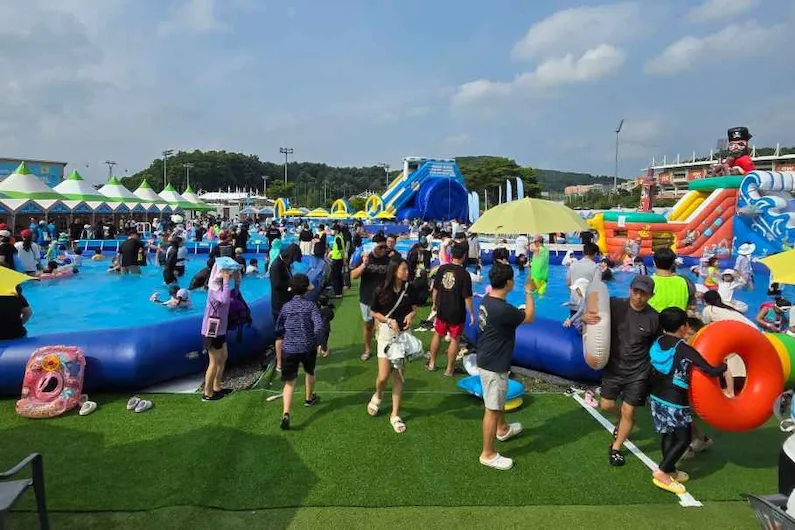
The 2026 Chuncheon Summer Water Festival returns for its second year, occupying the Chuncheon Waterfront Park throughout the height of summer. What distinguishes this event from typical municipal water parks is its deliberate calibration across age groups—toddlers, adolescents, and adults each retain dedicated zones without the compromise of shared overcrowded spaces.

The 30-meter giant slide remains the defining attraction, engineered for velocity sufficient to satisfy thrill-seekers while maintaining controlled descent parameters. New for 2026, the Challenge Bounce introduces obstacle-course mechanics: participants navigate pneumatic structures requiring agility rather than mere speed, a format uncommon in Korean summer festivals where passive tubing or straightforward slides predominate.

Water-play infrastructure includes:

  • Main Pool: Central gathering space for general swimming and group activities
  • Lazy River: Circulating current for low-exertion movement, suited to recovery between more demanding attractions
  • Toddler Pool: Shallow-depth zone with moderated water features
  • Giant Slide: 30-meter length, the festival’s established signature
  • Challenge Bounce: Obstacle-escape installation (2026 addition)

Practical Information

📍 Address: 200-9 Samcheon-dong, Chuncheon-si, Gangwon-do

💰 Admission: 8,000 KRW standard; 6,000 KRW for verified Chuncheon residents (identification required)

📞 Inquiries: 033-250-0920

🛏️ Accommodation near the event

⭐️ Instagram: https://www.instagram.com/ccwf_26

Chuncheon Summer Water Festival

Where is Chuncheon located?

Chuncheon is the capital of Gangwon Province, in northeastern South Korea. It sits in a valley roughly 75 kilometers northeast of Seoul, surrounded by mountains and lakes. The distance makes it manageable for weekend trips, and the elevation brings cooler temperatures that draw people out of the capital during summer months.

The city borders Soyang Lake, Uiam Lake, and Chuncheon Lake. Soyang ranks among Asia’s largest artificial reservoirs. These water bodies shape how the city functions, from water management to recreation. The annual Summer Water Festival, for example, operates directly on these lakes.

Chuncheon marks the entry point to broader Gangwon Province, situated where the Soyang River meets the Han River. The basin topography creates a microclimate with summers milder than Seoul or the southern coast. This temperature difference, combined with accessible water, establishes the conditions for outdoor activity in July and August.

The geography has practical consequences. The surrounding mountains limit urban sprawl, concentrating development along the valley floor. The lakes provide both drinking water and flood control for the region. And the location—close enough to Seoul for commuting, far enough to feel removed—shapes Chuncheon’s role as a secondary city rather than a satellite of the capital.

Analytics