Reiwa 8 Archaeology Fair: Aichi’s Archaeology 2026
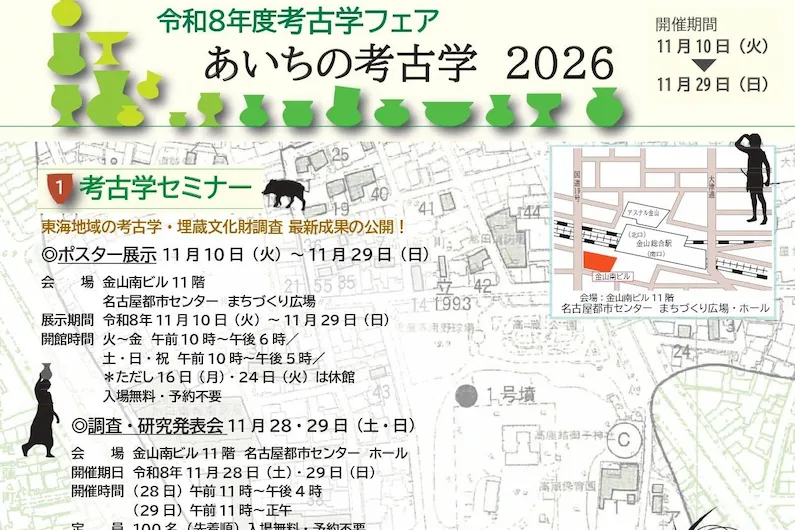
The Reiwa 8 Archaeology Fair—also billed as “Aichi’s Archaeology 2026″—offers an in-depth look at the latest archaeological research from the Tokai region, with a focus on Aichi Prefecture. From November 10 to 29, 2026, visitors to Nagoya’s Kanayama Minami Building can explore a poster exhibition presenting the results of recent excavation surveys and research findings from sites across the region, compiled by archaeological organizations and universities.
The fair is designed to make this research accessible. The poster format allows visitors to move through the material at their own pace, while the surrounding program provides opportunities to go deeper. On November 28 and 29, a Saturday and Sunday, the researchers in charge of the surveys will deliver presentations in the hall, along with lectures and symposia. These sessions give the public a chance to hear directly from the people who led the fieldwork and to learn about the methods and conclusions shaping Tokai archaeology.
The fair also aims to bring new people into the field. The organizers state their goal plainly: to create more archaeology fans. With that in mind, the Archaeology Festa will be held on Sunday, November 15, offering a workshop that both children and adults can enjoy. Participation costs 300 yen to cover materials, while admission to the fair itself is free.
The venue, the Nagoya City Center Machizukuri Hiroba/Hall, is on the 11th floor of the Kanayama Minami Building, just outside the south exit of Kanayama General Station. The fair is closed on November 16 and 24, and open from 10:00 to 18:00 on weekdays, with an earlier close of 17:00 on Saturdays, Sundays, and holidays.
Practical information
- Dates: November 10 (Tue) – 29 (Sun), 2026
- Closed: November 16 (Mon), November 24 (Tue)
- Hours: 10:00 – 18:00 (10:00 – 17:00 on Saturdays, Sundays, and holidays)
- Location: Kanayama Minami Building 11th Floor, Nagoya City Center Machizukuri Hiroba/Hall
- Admission: Free (Machizukuri Hiroba/Hall); November 15 Archaeology Festa: 300 yen material cost
- Access: Immediately from the south exit of Kanayama General Station
- Contact: Aichi Prefecture Education and Sports Promotion Foundation, Aichi Prefecture Buried Cultural Properties Center
- TEL: 0567-67-4163
- Homepage: https://maibun.com
The Tokai region is a geographic and cultural area in central Japan, along the Pacific coast of Honshu. Its name comes from the Tōkaidō, the historic road that connected Kyoto and Edo, now Tokyo. In current usage, the region usually covers Aichi, Gifu, Mie, and Shizuoka prefectures, with Nagoya as its principal city.
Archaeological work in the Tokai region has produced a long record of contact between eastern and western Japan. Jomon pottery found in the area includes local styles that differ from those of the Kanto and Kansai regions. During the Yayoi period, wet-rice agriculture spread through central Japan, and excavations in Aichi and Shizuoka have yielded wooden tools, storage structures, and settlement layouts associated with early paddy farming. Kofun-period burial mounds in Tokai show variation in size and construction, and some contain bronze mirrors and other goods that came from the continent or from the Kinai region around present-day Nara and Kyoto. In the medieval period, ports along the Tokai coast handled trade between Kyoto, Kamakura, and other centers; contemporary documents record shipments of timber, salt, and ceramics.
The region’s position between east and west makes it a useful case study for how material culture changed as it moved across Japan. The exhibitions planned for Visit Aichi’s Archaeology 2026 are expected to draw on this local record and present it alongside comparative material from other parts of the country.
