
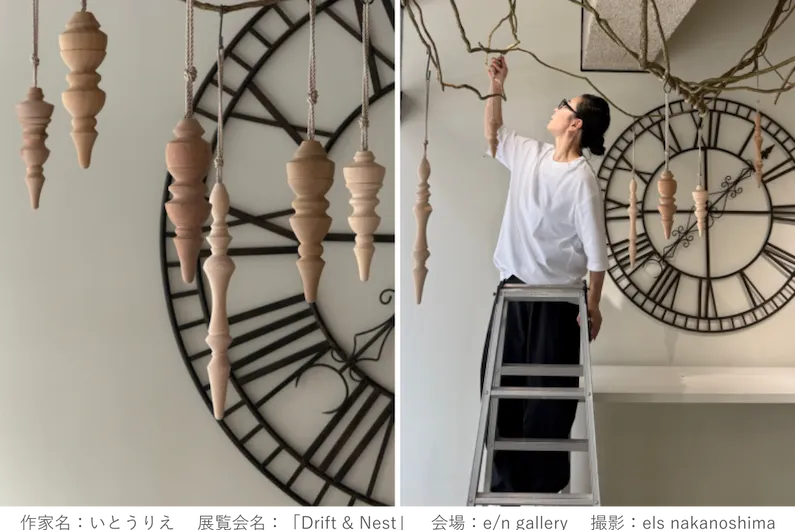
Woodworker Rie Ito’s First Solo Exhibition “Drift & Nest”

Rie Ito, a first-class registered architect and woodworker based in Nara Prefecture, will present her first solo exhibition, “Drift & Nest,” at e/n gallery in Osaka. The exhibition will feature a wide variety of aesthetically beautiful functional vessels made from various tree species, retaining the texture of the wood and unique shapes—including ornaments, long plates, high-stemmed cups, decorative plates, and flower vases.
The title of the exhibition points to two distinct groups of work. The hanging sculptures 《Drift》 are created by shaping fragrant woods such as Japanese cypress and camphor into spindle shapes using a lathe. The functional vessels 《nest》, on the other hand, are palm-sized and remain beautiful even when stacked. Moving between the boundaries of craft and sculpture, and between using and viewing, this is a profound exhibition that contemplates the time it takes for wood to reach our daily lives.
The venue is e/n gallery, located on the first floor of the Riverside Building, a registered tangible cultural property in Nakanoshima, Osaka—a setting that adds a quiet layer of history to the show’s meditation on materials and time.
Exhibition details
- Exhibition period: 2026/10/7 (Wed) – 10/17 (Sat)
- Closed: 10/12 (Mon/Holiday)
- Hours: 11:00 – 19:00 (until 17:00 on Saturdays and Sundays)
- Location: e/n gallery (Riverside Building 1F, 3-1-8 Nakanoshima, Kita-ku, Osaka City)
- Admission: Free
- Inquiries: [email protected]
- Website: en-gallery.com/exhibition
Rie Ito is a Japanese woodcraft artist whose work combines concerns of sculpture, architecture, and traditional woodworking. Based in Japan, she carves, bends, and assembles local hardwoods into forms that are both structural and organic: vessels with the asymmetry of drifting boats, and lattice-like enclosures that resemble birds’ nests. Her process is guided by the material itself. Grain direction, weight, and natural irregularities all influence the final shape, and the pieces tend to look as if they were discovered rather than imposed.
Ito’s central interest is spatial. Her objects are small, but they define interiors and exteriors with architectural clarity. A hollow vessel suggests shelter; an open lattice suggests a boundary; the spaces between slats become as important as the wood itself. This makes her work useful to think about alongside architecture, though it remains firmly within craft.
In Drift & Nest, Ito sets two conditions against each other. The drift pieces are elongated and off-balance, as if caught in motion. The nest pieces are compact, dense, and protective. The pairing does not treat “home” as a fixed idea; instead, it treats shelter as something that can be carried, rebuilt, or abandoned. Wood functions here as a material with its own behavior. It bends, expands, contracts, and retains traces of the tree it came from. Ito’s versions of that behavior are precise but not rigid—objects that hold their shape while still appearing sensitive to the forces around them.
