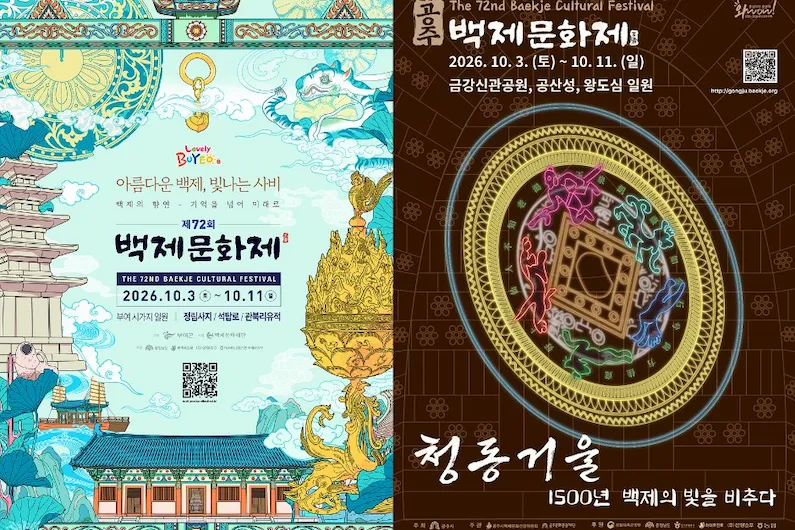
Baekje Cultural Festival
🗓️ 2026.10.03 ~ 2026.10.11
The Baekje Cultural Festival stands as a premier historical and cultural landmark in Korea, tracing its origins back to the inaugural event held in Buyeo-gun in 1955. Now celebrating its 72nd anniversary, this sprawling festival serves as a bridge between the ancient brilliance of the Baekje Kingdom and the modern era, aiming to modernize the cultural heritage of ancestors while fostering a deep sense of regional identity and pride.
For the 2026 iteration, the festival will span nine days—from Saturday, October 3, to Sunday, October 11—and is divided into two distinct regional experiences: the Buyeo and Gongju festivals. Each location offers a unique lens through which to view the history of the kingdom, blending academic preservation with immersive, high-tech entertainment.
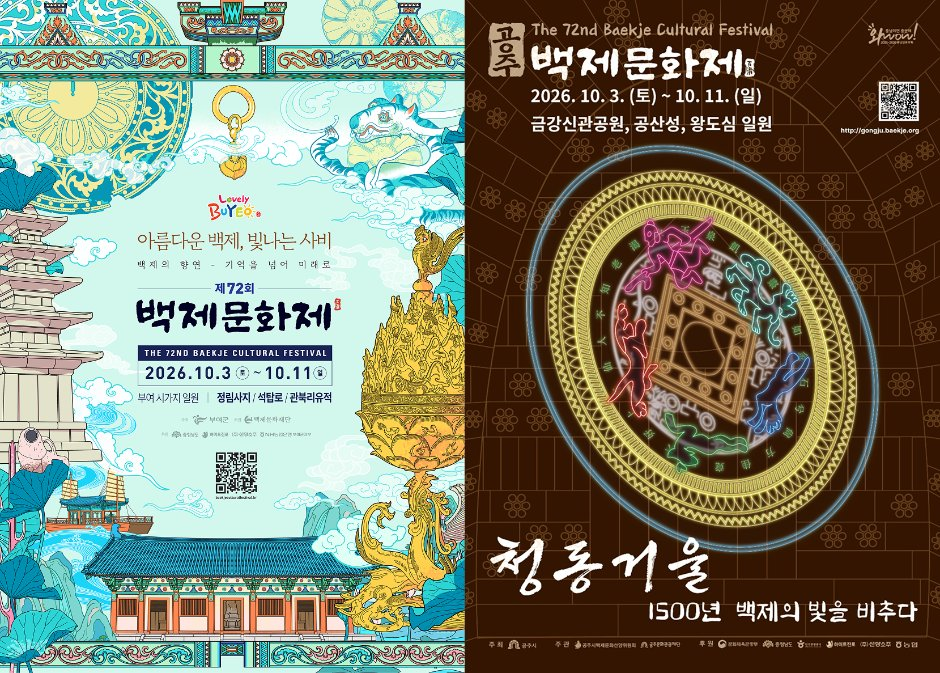
Buyeo Baekje Cultural Festival: “Beautiful Baekje, Shining Sabi”
The Buyeo leg of the festival focuses on the Sabi period, utilizing the city area as an open-air museum. By centering activities around the Gwanbuk-ri Ruins, the Stone Pagoda Road, and the Jeongrimsa Temple Site, the event harmonizes the daily lives of local residents and commercial districts with the grandeur of the past. Visitors can explore approximately 40 programs across seven different thematic fields.
Representative and Main Programs
The festival’s core is anchored by the Sabi Capital Transfer Declaration Ceremony, which features a large-scale procession and the Jeongdo Goyu ritual to justify the historical move to Sabi. The “Promise of the Baekje People” theme exhibition hall allows guests to metaphorically open a door through time to explore the kingdom’s journey.
For those seeking visual spectacle, the festival offers:
- The Baekje Historical Cultural Parade and the Baekje Cultural Night Parade, providing a vivid urban procession.
- Baekje Night Crafted with Light, utilizing media art to transform the Jeongrimsa Temple Site into a glowing nocturnal landscape.
- Sabi Children’s Kingdom, a dedicated space where younger visitors can engage with history through themed playgrounds.
Specialized Activities
The Buyeo experience is further enriched by a variety of niche programs:
- Rituals: The Gocheonje and ten other types of Buddhist services, including the Baekje Honbul Chaehwa.
- Performances: A suite of eight cultural programs, highlighted by the Sabi Baekje Talk Concert.
- Experiences: Nine interactive programs, such as Sabi Roblox and “One Round of Sabi.”
- Landscapes: Atmospheric walks through the King’s Secret Garden and the Night of Sabi.
- Linked Events: The Sabi Little Welcome Group, which connects various tourism resources within Buyeo to the main venue.
Gongju Baekje Cultural Festival: “Bronze Mirror, Reflecting the 1,500-Year Light of Baekje”
While Buyeo focuses on Sabi, the Gongju festival celebrates the era of Woongjin Baekje. The 2026 theme centers on the bronze mirror unearthed from the Tomb of King Muryeong, using it as a motif to reflect the historical value of the kingdom. The festivities are spread across the royal city center, Mireu Island, Gongsanseong Fortress, and Geumgang Singwan Park.
Immersive Performances and Spectacles
Gongju distinguishes itself through high-production convergence performances. The Woongjin Fantasia provides an immersive experience centered on the bronze mirror, while 接(Jeop)·Gyeong: The Night the Queen Crossed utilizes the World Heritage Gongsanseong Fortress as a living stage for music, song, and dance.
Nighttime activities are particularly robust here, featuring:
- The Woongjinseong Parade, a citizen-led procession.
- The Woongjin Baekje Lantern Feast, where traditional sailing boats (Hwangpo-dotbae) and floating lanterns illuminate the water.
- The Woongjin Baekje Starlight Garden and Gongsanseong Media Art, which translate historical narratives into light installations.
Rituals and Academic Engagement
The spiritual heart of the festival is found in the Baekje Honbul Chaehwa, the Woongjin Baekje Five Kings Memorial Service, and the Yeongsan Daejae, which honors the patriotic spirits of the era. For the intellectually curious, the Baekje Cultural Festival Academic Conference discusses the significance of artifacts like the Muryeong Tomb bronze mirror.
Interactive and Local Experiences
Visitors can engage with the community through various experiential and economic programs:
- Education: The Baekje Village Gomachon offers permanent themed events, while the “Bronze Mirror Mission Tour” utilizes mobile devices for a digital stamp tour.
- Games: “Let’s Play Baekje!” introduces traditional games accessible to all generations.
- Commerce: The 22nd National Excellent Market Fair brings together approximately 130 markets from across the country.
- Local Flavors: The “Woongjin-gol Gourmet” area features 13 restaurants and 10 food trucks, complemented by the Chestnut Beef Festival and chestnut processed food sales.
Event Logistics and Entertainment
The festival’s energy is sustained by a heavy lineup of music. The opening ceremonies feature Heo Gak, Yoyomi, and RESCENE, while the closing ceremonies include Kim Eui-young, Nerd Connection, and Haha & Skull, concluding with a fireworks show. Additionally, the Chungnam Symphony Orchestra and local artists at the Gomtap Stage provide a diverse soundtrack to the event.
📍 Address: 83 Jeongrim-ro, Buyeo-eup, Buyeo-gun, Chungcheongnam-do
🛏️ Accommodations near the event
💰 Fee: Free
📞 Inquiry: 041-837-2517
What is Baekje?
Baekje was one of the Three Kingdoms of ancient Korea, together with Goguryeo and Silla. Founded in 18 BCE, it began as a small chiefdom in the Han River basin and eventually came to control the southwestern part of the Korean Peninsula for more than six centuries.
The kingdom is often studied for its cultural and material achievements. Baekje’s rulers invested in agricultural infrastructure, including irrigation systems, and its ports supported active trade routes with China and Japan. Through those networks, Baekje played a central role in the spread of Buddhist practice, temple construction, and craft techniques to the Japanese archipelago, where Baekje artisans and scholars were invited to work.
The later capitals of Gongju and Buyeo remain closely associated with Baekje’s history. Gongju served as the seat of government during the Ungjin period (475–538 CE). Buyeo, then known as Sabi, became the final capital in 538 CE and remained so until 660 CE. The Sabi period produced much of what is now regarded as the kingdom’s most significant surviving art, including stone sculptures, gilt-bronze objects, and royal tomb furnishings. These pieces are held in museums and heritage sites across the region.
Baekje’s political power ended in 660 CE, when an allied force from Silla and Tang China invaded. The kingdom was gone, but its cultural influence did not vanish. In modern South Korea, Baekje is remembered as an era of notable artistic output, diplomatic exchange, and religious life, and its presence is still visible in the historic sites of Gongju and Buyeo. That heritage is the focus of the Baekje Cultural Festival.
