Seorak Cultural Festival
🗓️ 2026.10.02 ~ 2026.10.04
The Seorak Cultural Festival is Sokcho’s representative local cultural festival, one that has continued since the 1st Seorak Festival in 1966. Over the decades, it has come to embody the history and culture that formed around Seoraksan Mountain, as well as the lives and stories of Sokcho’s citizens. This year’s 61st edition, held under the theme “Seorak, Coloring Together,” looks in both directions at once. It reflects on the tradition and history accumulated over the past 60 years, while taking a further step toward becoming a festival in which citizens and tourists participate side by side to create new stories. Inheriting the identity built over that long run, the program places citizens at the center — as protagonists who shape the festival and enjoy it directly.
The festival also returns to its ritual roots. “Seorak Sosa (雪嶽小祀),” the ceremony that has served as the festival’s central rite since the first edition, is being revisited with commentary and storytelling so that participants can understand and connect with it more easily. The “Seorak Climbing Competition” carries forward the mountain culture that accompanied the festival’s beginnings. This year, it involves a Seoraksan climbing competition along a non-open trail of Dalmabong Peak, paired with a Seoraksan concert — an invitation to take in the full autumn landscape of the mountain.
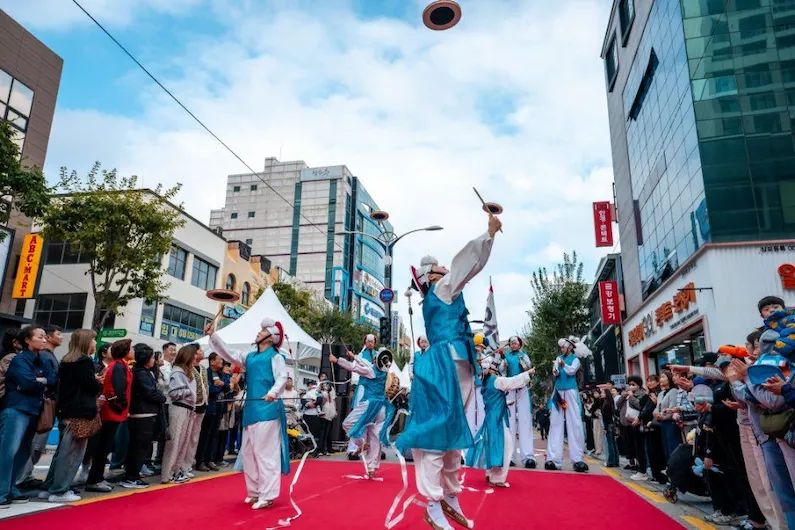
The “Street Parade,” the festival’s signature program, takes the form of a citizen-harmony parade in which local residents, clubs, schools, and cultural arts organizations participate directly. Using Seorak Rodeo Street as its stage, the parade gathers citizens of all generations and regions, embodying the festival’s move beyond a spectacle to be watched toward one that is created and performed by its participants. Sokcho Expo Grass Square will host a concurrent program of citizen harmony events, including the “Sokcho! Cheerful Athletics Meet,” local arts organization performances, fringe performances, and club festivals. Family offerings such as a local culture experience zone and a children’s playground will run alongside these, linked with the “Seorak Rodeo Street Commercial Area Activation Project” and the “Sokcho Cultural City Gourmet Week” to extend the festival’s reach. After 61 years, the Seorak Cultural Festival begins a new time and story.
1. Main Programs
- Opening Ceremony and Congratulatory Performances — A grand declaration of the festival’s opening, followed by celebratory live stages featuring veteran vocalist Yoon Soo-il and singer Yeom Yuri.
- Seorak Sosa (小祀) Traditional Ritual — A modernized presentation of a long-standing local ritual praying for the well-being of the nation and region, comprising Sansinje, Samsinhapdongje, Jojeonje, and Songsinje.
- Representative Local Traditional Performances — Invited demonstrations of Sokcho’s unique intangible heritages: the Sokcho Lion Dance, Domun Nongyo, Dondollari, and Sokcho Arirang.
- Seorak Rodeo Street Parade — A large-scale street march with street performances at each hub, uniting professional art groups from across the country with youth, multicultural teams, and residents from all 8 dongs.
- Closing Ceremony and Fireworks Show — A fireworks finale to crown the festival, along with a closing concert featuring Gummy, Solji, and trot singer Shin Seung-tae.
2. Participation and Competition Programs
- National Song and Dance Competition 〈Seo(樂) Rock Star!〉 — An enthusiastic vocal and dance final featuring 12 teams from across the country that advanced through the preliminaries.
- Sokcho Survival Quiz Show 〈Seorak Golden Bell〉 — A scholarship quiz for adults and youth, with questions themed around Sokcho and the Seorak Cultural Festival.
- Sokcho Citizen Harmony Plaza 〈Cheerful Athletics Meet〉 — A competition among residents of the 8 dongs, with traditional and modern sports events open to any on-site visitor.
- Sokcho Citizen Harmony 〈Hangung Competition〉 — A tournament for the 8 dongs using target boards, alongside a traditional lifestyle sports competition for citizen participation.
- Passionate Stage Go! 〈Club Festival〉 — Relay stages performed by citizen clubs representing the 8 dongs of Sokcho City.
3. Planned and Outdoor Performances
- Our Stage Go! — Special invited performances by 7 middle and high school youth clubs, K-pop boy group YOUNITE, and fusion gugak group Dodri.
- Seorak Fringe Festival — Street art performances such as busking, mime, and magic, held in close proximity to the audience.
- Special Performance for the Whole Family 〈Balloon Magic Show〉 — A balloon and magic performance geared toward children and family visitors.
4. Experience and Side Events
- Local Culture Experience Zone (around 25 booths) — Craft, traditional culture, and art experience booths suitable for visitors of all ages and genders.
- Dream Tree Playground & Mom’s Lounge — An air-bounce playground exclusively for children, along with a shelter and nursing room for families with infants and toddlers.
- Seorak Cultural Festival 61st Anniversary History Promotion Hall — An exhibition of 61 years of historical records, plus an official goods zone.
- Gourmet Linkage — Coordinated operation with the food zone of the 2026 Sokcho Food Festival 〈Masupda! Sokcho〉.
5. Pre-events
- Seoraksan Climbing Competition 〈Dalma! Ridgeline Walking〉 — A 500-person walk along the autumn Seorak ridgeline from Seolhyang Park, over Dalmabong Peak (635m), to the Small Park (Sogongwon).
- Seoraksan Forest Concert — A folk healing concert unfolding in the embrace of Seorak, held in connection with the climbing competition and featuring Shin Hyun-dae.
📍 Address: 72 Expo-ro, Sokcho-si, Gangwon-do (Joyang-dong)
🛏️ Accommodations near the event
💰 Fee: Free
📞 Inquiry: 033-636-0670
⭐️ Instagram: https://www.instagram.com/sokchocf/
🖥️ Website: http://sokchofestival.or.kr/srcf
Seoraksan is a mountain range in Gangwon Province, near Sokcho. Its most prominent feature is Ulsanbawi, a granite formation that stands out clearly from the surrounding ridges. The range is sometimes called the “roof of South Korea” because of its elevation and the early snows that dust the peaks; the name Seoraksan means “Snowy Crags Mountain.” In autumn the forested slopes change color, and the park becomes a popular destination for foliage viewing.
The area is a designated national park and UNESCO Biosphere Reserve. It supports several rare species, including the Siberian musk deer, and contains areas of old-growth pine. The annual Seorak Cultural Festival includes rituals connected to the mountain and its local history. For visitors, the park offers a range of routes: waterfalls, hermitages, and a cable car that provides access to the higher ridges without a long climb.
The mountain is also a practical part of the region’s identity. It provides protected habitat, draws travelers to Sokcho, and hosts traditions that have been maintained over time. Hikers, temple visitors, and autumn sightseers can experience it directly, and it does not need to be described as anything more than what it is.
