
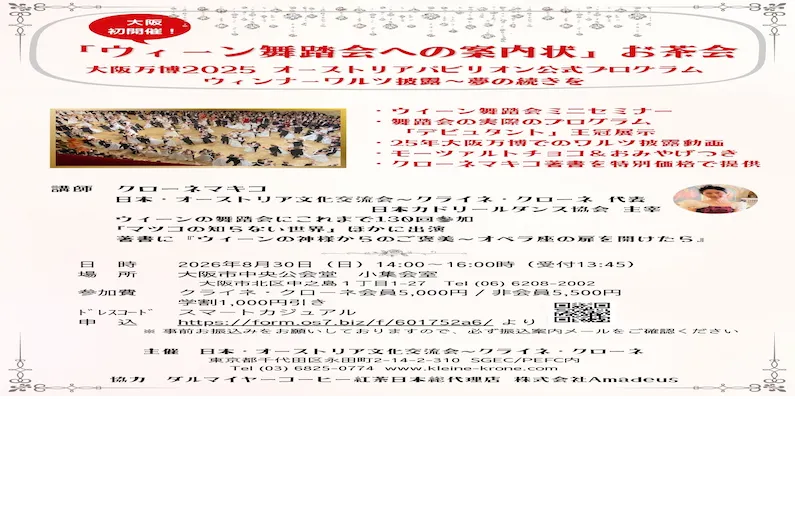
“Invitation to a Vienna Ball” Tea Party: Continuing the Dream from the Osaka Expo

The Vienna Ball Seminar Tea Party introduces the charm of Vienna’s authentic balls, a social tradition that continues today. For the first time, it will be held in Osaka on Sunday, August 30, 2026, at the Osaka City Central Public Hall, a designated Important Cultural Property in the Nakanoshima area. The event is designed for people who are curious about real Viennese ball culture but prefer a relaxed, casual atmosphere over a formal dance floor.
Lecturer Makiko Krone, who has participated in balls approximately 130 times and is known for her appearance on “Matsuko’s Unknown World,” will lead the seminar. Using actual images, videos, and a performance video from the official program of the Austria Pavilion at Expo 2025 Osaka, she will explain the atmosphere of these balls, how they are organized, and how first-time visitors can enjoy them. The title of the tea party reflects this link to the Expo: it continues the dream of the Austria Pavilion’s official program.
The venue will also feature an exhibit of a “debutante” crown, Mozart chocolates, and souvenirs, making the event enjoyable even for those who cannot dance. The dress code is smart casual, so guests do not need formal ball gowns or tailcoats to participate.
Event details
- Date: Sunday, August 30, 2026
- Time: 14:00–16:00
- Venue: Osaka City Central Public Hall, Small Meeting Room (1-1-27 Nakanoshima, Kita-ku, Osaka City)
- Fee: 5,000 yen for members; 5,500 yen for non-members
- Student discount: 1,000 yen off for both members and non-members
- Payment: Pre-payment by bank transfer
- Inquiries: 03-6825-0774
- Website: Vienna Ball Seminar News
What is a Vienna Ball?
A Vienna Ball is a formal dance event held in Vienna during the winter Carnival season. The tradition dates from the 19th century, when the imperial court and the city’s aristocracy held regular dances; after the Congress of Vienna, these gatherings expanded into public balls. Today hundreds are organized each year by professional associations, trades, and cultural institutions, in venues such as the Hofburg Palace, the Konzerthaus, and the Musikverein.
The evening follows a set program. Debutantes and their partners perform a choreographed polonaise and are presented to the audience. The orchestra plays a series of waltzes, after which the conductor announces “Alles Walzer!” — “Everyone waltz!” — and the floor opens to all guests. The dancing continues until the early morning, with waltzes, polkas, quadrilles, foxtrots, and tangos played by live ensembles.
The setting is formal as well. Ballrooms are large and decorated with chandeliers, parquet floors, and rows of tables where guests can sit between dances. Dress is formal: evening gowns for women, dark suits or tails for men. The evening also has a social dimension. Guests greet each other, ask fellow dancers to dance, drink wine or sparkling wine, and eat late-night dishes such as goulash soup and sausages.
Individual balls differ according to their organizing groups. Some are tied to a profession; others are hosted by musical or cultural institutions. What they share is a fixed framework: live music, formal dress, and ballroom dancing.
In Osaka, the 2026 “Invitation to a Vienna Ball” tea party at Osaka City Central Public Hall will offer an afternoon introduction to the tradition, with Viennese music, a historic hall, and a look at the etiquette and dance forms of the Viennese ball.
