Gan’gara Fire Festival: Lighting of the Great ‘Dai’ Character and Daimonji Lantern Offering Event

The Gan’gara Fire Festival is a summer tradition in Ikeda, held every year on August 24th. It is a representative traditional fire festival of Northern Osaka (Hokusetsu), said to have begun in the first year of the Shoho era (1644) in the Edo period, when it was first held to pray for household safety and protection against fire disasters. The festival is now designated as an intangible folk cultural property of the prefecture.

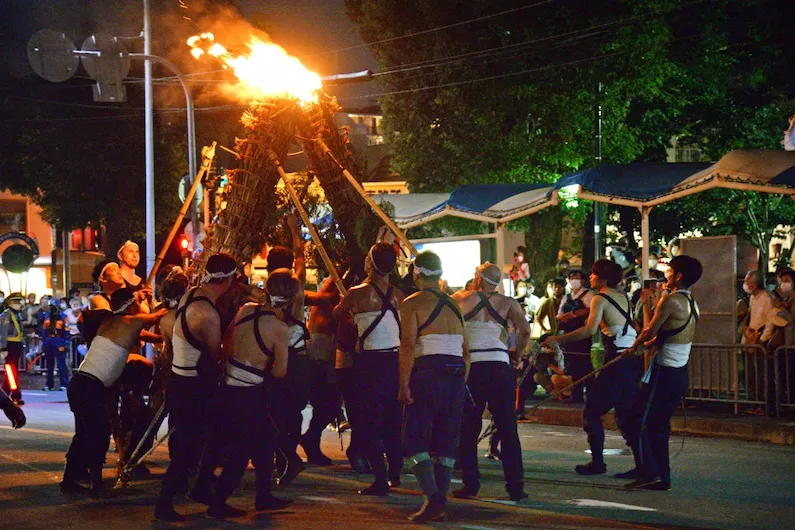
The evening opens with the lighting of the character fires “Dai-Ichi” (Large One) and “Dai” (Large) on the southern slope of Mount Gokaku. After the mountain characters are set alight, pairs of giant torches—each about 4 meters tall and weighing around 100 kg—take to the streets alongside children’s torches. Accompanied by the sound of Hatcho-gong and hand-bells, participants move through the city with lively shouts of “Wasshoi, Wasshoi,” filling the town with a distinctly mystical energy.
The festival is free to view, and the parade routes around Ikeda City Hall and below Gokaku-yama Park offer visitors a close look at the flames, the mountain-side characters, and the torch procession as it passes through the city.
Event details
- Date: August 24, 2026 (Monday), held in light rain
- Time: 19:30–22:00
- Location: Around Ikeda City Hall, below Gokaku-yama Park, and other city parade routes
- Fee: Free viewing
- Contact: 072-754-6272 (Ikeda City City Promotion Division)
- Website: Ikeda City tourism information for the Gan’gara Fire Festival
The Gan’gara Fire Festival is an annual winter rite in Ikeda, a mountain town in Fukui Prefecture, Japan. Residents light large wooden torches and carry them uphill to a sacred site, where the torches are stacked into the shape of the character 大 (dai, “great”). The name Gan’gara is thought to imitate the sound of wooden clappers and burning wood.
The ritual is meant to ask the local guardian deity for a good harvest, protection for the household, and the removal of misfortune. It has been conducted in some form for over four hundred years, and the basic elements of the night have changed little: torches weighing several hundred kilograms are set ablaze, then carried by teams of men along a steep path. At the top, workers arrange the burning poles into the large character. Once the last torch is placed, the character is visible from a distance, and the fire is allowed to burn through the night.
For spectators, the festival offers a chance to see a local religious tradition in a small community, rather than a staged spectacle. Attendance requires walking through snow and standing outside in winter temperatures, but the event draws a crowd each year. Visitors can watch the preparations as early afternoon begins, when the framework for the character is laid out, and the lighting starts only after dusk.
