Festival BBQ Beer Garden Asakusa Ekimise Yatai Village
Directly connected to Asakusa Station on the Tobu Skytree Line, an experiential “Festival x BBQ” space is born on a rooftop in the center of the city!
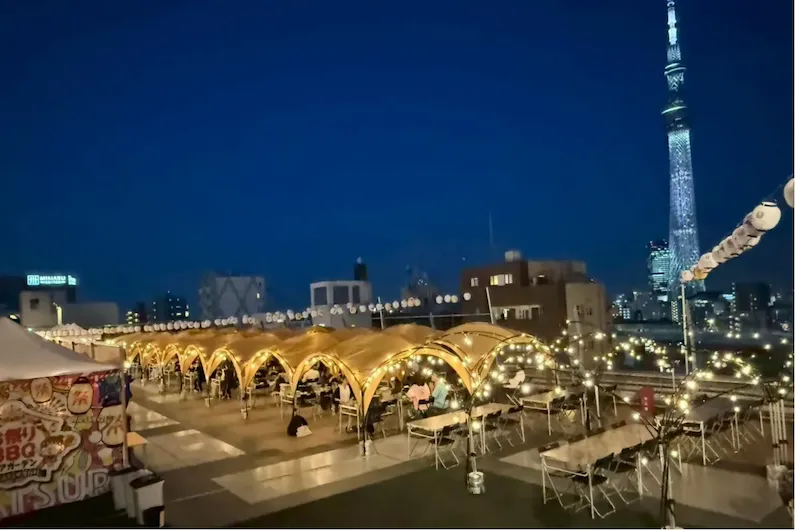
The concept of this facility is “Enjoy the atmosphere of a festival & BBQ in an outdoor space in the city center!” “Festival memories,” such as the sky dyed by the sunset, drifting savory aromas, and lively laughter heard from all around, have been reproduced in the modern urban space.
While gazing at the Tokyo Skytree® from the open rooftop, you can enjoy an experiential beer garden that can only be tasted here, where the fun of authentic BBQ and festival stalls intersect. Why not visit and experience a festival-like space that can be enjoyed in the heart of the city?
A rooftop festival space that is “nostalgic yet new”
Spread across the rooftop is a festival scene that somehow tickles the heart. Freshly grilled meat sizzles, and the scent of takoyaki and karaage wafts through the air.
Fries, yakisoba, ice sherbet—stalls with gourmet food that you can’t help but reach for line up, and time flows in a way that makes you realize you’ve returned to your childhood.
Furthermore, we have prepared festival contents that adults also get absorbed in, such as shooting galleries, ring toss, and smart ball.
The moments spent eating, playing, and laughing will eventually turn into special memories.
An extraordinary experience where you can “go without bringing anything”
At this facility, there is no need to prepare ingredients or equipment. The appeal is the casualness of being able to visit empty-handed and enjoy a BBQ right away.
With carefully selected ingredients and a wide variety of all-you-can-drink beverages, you can spend a relaxing time with friends, family, and loved ones.
In addition to the outstanding access being directly connected to Asakusa Station on the Tobu Skytree Line, it is an all-weather rooftop space equipped with tents, so you can enjoy the “festival mood” comfortably without worrying about the weather, even on days with strong sunlight or sudden rain.
(*In the event of strong winds or stormy weather, operations may be cancelled for safety reasons.)
Course Overview
All courses include all-you-can-eat stall menus and are limited to 2 hours.
| Course | Alcohol & Soft Drinks | Soft Drinks Only | Notes |
|---|---|---|---|
| Standard BBQ and All-You-Can-Eat Stall Course | 6,270 yen (tax included) | 5,720 yen (tax included) | BBQ is not all-you-can-eat |
| Deluxe BBQ and All-You-Can-Eat Stall Course | 7,920 yen (tax included) | 7,370 yen (tax included) | BBQ is not all-you-can-eat |
| Casual All-You-Can-Eat Stall Course | 5,500 yen (tax included) | 4,950 yen (tax included) | Stall food only |
| Kids Course (All-You-Can-Eat Stall Menu) | — | 2,200 yen (tax included) | Soft drinks only |
*Please check the official website for detailed contents.
Basic Information
| Location | EKIMISE Asakusa Station |
| Address | 〒111-0033 1-4-1 Hanakawado, Taito-ku, Tokyo MAP |
| Venue | Asakusa Ekimise Rooftop |
| Period | 2026/05/27 (Wed) ~ 2026/10/18 (Sun) |
| Hours | Weekdays: 12:00–22:00 (Last entry 20:00)<br>Weekends/Holidays: 11:00–22:00 (Last entry 20:00) |
| Official Website | https://bbq.urban-earth.jp/asakusa/ |
*The listed content may have changed. Please check the official website of the venue or organizer for the latest information.
What is Ekimise?
The Japanese term ekimise combines eki (station) and mise (shop), describing a department store or commercial facility built directly into or above a major train station. This architectural form emerged from practical necessity: in dense Japanese cities, valuable real estate around transit hubs made horizontal expansion difficult, while vertical construction allowed stations to serve multiple functions without consuming additional street-level space.
Tokko’s examples illustrate the concept’s range. Matsuya Ginza, adjacent to Ginza Station, represents the traditional department store model with its 1920s facade and luxury retail. Shinjuku and Shibuya stations demonstrate the sprawling, multi-building complexes where several ekimise structures cluster around major interchanges, creating self-contained commercial districts. The Asakusa Ekimise, opened in 2012 above Tobu Asakusa Station, occupies a middle position—modern construction replacing older facilities, with ten floors combining transit functions, retail, restaurants, and a rooftop terrace engineered for significant public use.
The format addresses specific constraints in historic neighborhoods like Asakusa, where narrow streets and protected building stock limit new development. By concentrating commercial activity vertically, ekimise preserves street-level character while meeting contemporary needs. The Asakusa building’s rooftop exemplifies this efficiency: infrastructure designed for capacity crowds supports programming—such as the seasonal Yatai Village—that extends the building’s utility well beyond standard retail hours, drawing evening visitors to a space that would otherwise sit dormant.
This integration of transit and commerce is not unique to Japan, but the ekimise’s scale and institutionalization distinguish it. Where Western stations often treat retail as ancillary, Japanese operators and department store chains developed formal partnerships to maximize both foot traffic and revenue. The result shapes daily behavior: travelers pass through commercial space as a matter of course, and locals treat the station building as a destination in itself rather than merely a point of departure.
