Odor Exhibition in Space Travelium TeNQ
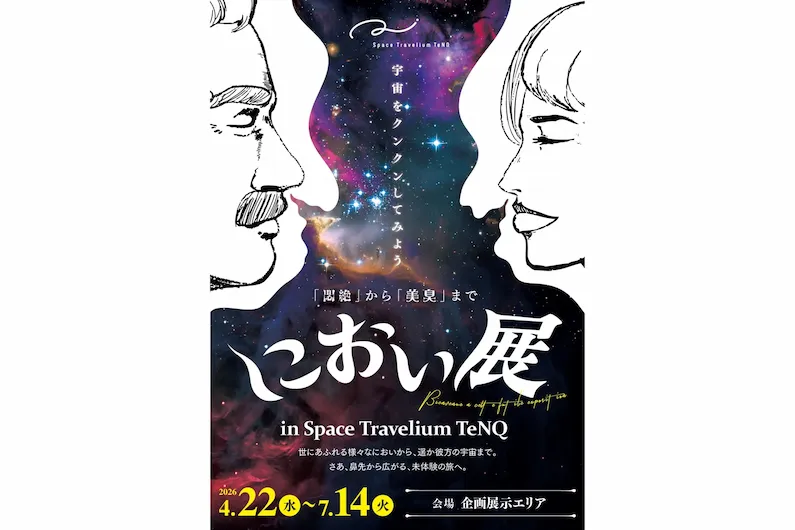
The "Odor Exhibition in Space Travelium TeNQ" is set to arrive at the special exhibition area of Space Travelium TeNQ, a dedicated space experience facility located on the 6th floor of the Yellow Building in Tokyo Dome City. This event marks the first appearance of the traveling "Odor Exhibition" at this specific venue—an event that has already generated significant conversation across the country by challenging visitors to experience a spectrum of scents ranging from the exquisitely beautiful to the profoundly repulsive.
While the touring exhibition is known for its eclectic olfactory variety, this iteration is unique due to its integration with the space-themed environment. To bridge the gap between Earth and the cosmos, the organizers have developed two original scents imagining the smells of "Aliens" and "Planets," allowing guests to engage with the concept of deep space through a sensory medium rarely utilized in scientific exhibits. Beyond these cosmic additions, visitors can explore a curated selection of scents, including the infamous "extreme stench" corner featuring Surströmming, widely regarded as the world’s smelliest food. To complement the experience, the venue plans to offer original Space Travelium TeNQ merchandise and a themed cafe menu throughout the event period.
Main Exhibition Contents
The exhibition is organized into three distinct areas, each designed to evoke different emotional and physical responses through scent.
Area 1: Standard scents of the "Odor Exhibition"
This section presents a diverse world of aromas, beginning with a chronological progression of flower scents spanning twelve months. The curation extends to the biological world with the smells of various insects and animals, and even delves into the historical realm with "scents related to great figures," such as Sakamoto Ryoma and Oda Nobunaga. Furthermore, a specialized corner reproduces the "life of an insignificant man," offering an exhibit where the odor serves as a primary tool to convey the atmosphere of a specific living space.
Area 2: 4 types of extreme stenches
For those seeking a more intense experience, this area features four of the most potent odors known to man, each housed within dedicated boxes to contain the scent. These include:
- Surströmming: The Swedish canned fish cited as the smelliest food globally.
- Stinky Tofu: A fragrance so pungent it has historically caused foul-odor commotions that resulted in the halting of trains.
- Foot odor: A familiar, yet extreme, example of human scent.
- Kusaya: A specialty product of the Izu Islands renowned for its unique and powerful aroma.
Area 3: Scents related to space
This area blends the permanent offerings of Space Travelium TeNQ with exclusive event additions. Visitors can experience the "Scent of the Moon’s Surface" and the "Scent of Space(R)" (a registered trademark of Promo Tool Co., Ltd.), alongside the two aforementioned exclusive scents imagining "Aliens" and "Planets."
Related Exhibition: Daily Necessities of Space Life
Adjacent to the main olfactory displays is an exhibition focused on the practicalities of maintaining hygiene and comfort in the void of space. This section features product exhibitions—rather than interactive trials—provided by Lion Corporation, IRiS Tokyo Co., Ltd., and Sansei Pharmaceutical Co., Ltd.
Notable exhibits include:
- Lion Corporation "relaXspace A": A skin-application stick designed to mitigate concerning odors or provide a pleasant fragrance. The specific scents proposed for astronauts were developed using an AI diagnosis algorithm that analyzed over 900 combinations to determine preferred fragrances.
- IRiS Tokyo Co., Ltd. / Sansei Pharmaceutical Co., Ltd. "Eye mask incorporating scented capsules": An eye mask engineered for the unique environment of space. This technology was launched to the International Space Station (ISS) on August 24, 2025, for use by astronauts.
Interactive Corner
To engage visitors of all ages, the venue will host an interactive quiz. Participants are tasked with identifying a "mysterious odor" placed at the venue by searching for the matching scent among the various displays within the special exhibition area. This activity encourages guests to rely on their own olfactory perception while touring the exhibits.
For further details regarding the specific content of the quiz and exhibitions, visitors are encouraged to check the official website.
Basic Information
Location / Nearest Station
Space Travelium TeNQ
- Suidobashi Station (3 min walk)
- Korakuen Station (7 min walk)
Address
〒112-0004
6F Yellow Building, 1-3-61 Koraku, Bunkyo-ku, Tokyo
MAP
Venue
Special Exhibition Area within Space Travelium TeNQ
Period
2026/04/22 (Wed) ~ 2026/07/14 (Tue)
Fee / Cost
Included in the facility admission fee
Inquiry
Tokyo Dome City Waku-Waku Dial
03-5800-9999 (Reception hours: 10:00~17:00)
Official Website
https://www.tokyo-dome.co.jp/tenq/event/exhibition-stt-6.html
Note: Posted content may be subject to change. Please verify the latest information via the official website of the venue or organizer.
Space Travelium TeNQ opened in July 2014 on the upper floors of Tokyo Dome City’s Yellow Building. It is operated under the concept of “Museum × Entertainment,” which here means pairing educational content with interactive media and theatrical presentation rather than conventional glass-case display. The name TeNQ derives from the Japanese word for sky, ten, combined with “Question” and “Queue”—suggesting both the upward gaze and the sequence of inquiry that astronomy tends to generate.
The building is organized around Theater 23-5. The auditorium contains an 11-meter domed screen and 145 reclined seats, with programming that cycles through high-resolution satellite imagery, rover telemetry, and full-dome visualizations of stellar fields. Because the screen occupies the ceiling and the seats face upward, the theater is designed to remove the framing devices of ordinary cinema; the image simply occupies the viewer’s peripheral vision.
Beyond the theater, the museum maintains several exhibition zones. The Science Area, developed with JAXA, presents flight hardware, material samples, and structural components from actual satellite missions. The Imagination Area, in contrast, invites artists and designers to respond to space exploration through installation work, sound, and non-literal cartography. Across roughly 1,800 square meters on two floors, the institution has historically relied on visual and auditory means to convey its material.
The 2026 Odor Exhibition introduces scent as a further channel of information. Working with chemists, the museum developed olfactory profiles tied to specific environments: the sharp metallic and ozone residue of a spacecraft airlock, the sulfur compounds detected in Venusian atmospheric data, and the cold hydrocarbon haze associated with Titan. Each station presents the scent alongside its chemical context, treating smell as another measurable property of places most visitors will never enter directly.
