Van Gogh’s Drawbridge and the Impressionists: From the Wallraf-Richartz Museum Collection
This summer, the Abeno Harukas Art Museum hosts a major survey of French Impressionism and its legacy, drawn from the storied collection of the Wallraf-Richartz Museum and the Corboud Foundation (Kolb Foundation) in Cologne, Germany. Housing approximately 70,000 works spanning from medieval panels to Post-Impressionist canvases, the Wallraf-Richartz ranks among Europe’s premier institutions; the Osaka presentation marks a rare opportunity to examine how its holdings trace the theoretical evolution of modern painting.
The Network of Influence
Rather than isolating individual geniuses, the exhibition emphasizes the dialogues that shaped nineteenth-century French art. Through seventy works by forty-two artists—including Édouard Manet, Claude Monet, Pierre-Auguste Renoir, Paul Cézanne, Paul Signac, Maurice Utrillo, Jean-Baptiste-Camille Corot, and Henri Matisse—the presentation maps how aesthetic innovations emerged through generational exchange.
The curatorial progression begins with Manet and Corot, artists who negotiated the fraught territory between academic tradition and emergent modernist methodologies. From this foundational tension, the exhibition moves to Monet and Renoir’s empirical investigations of light and atmospheric conditions, then advances to the systematic color theories of Signac and the geometric underpinnings explored by Cézanne. The trajectory culminates with Matisse and Utrillo, who leveraged these technical developments to liberate purely personal sensibilities through color.
Key Works
Among the seventy canvases, two works anchor the historical narrative. Manet’s Bundle of Asparagus (1880) acquires particular significance from its provenance: commissioned by the collector Charles Ephrussi and acquired by the museum during the critical period when German art criticism and practice were entering a new phase, the still life exemplifies the French avant-garde’s influence on pan-European taste.
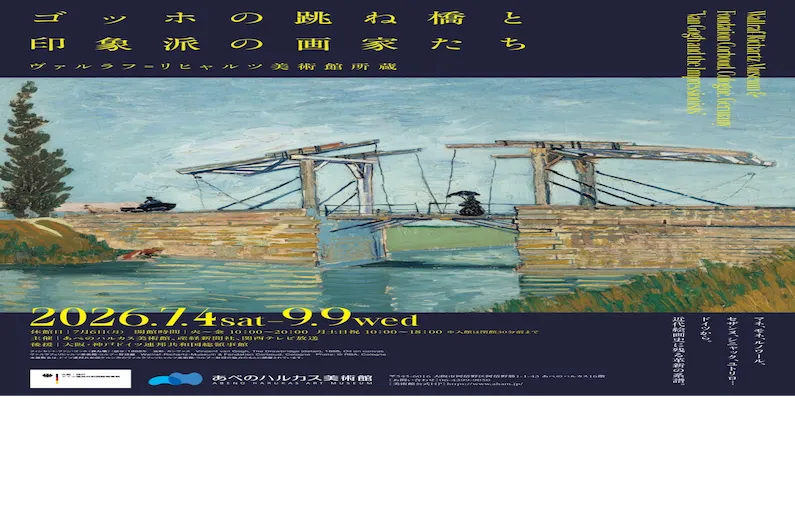
Equally commanding is Vincent van Gogh’s The Drawbridge (1888), painted during the artist’s residency in Arles. The canvas retains a distinctive presence within the Post-Impressionist movement, demonstrating Van Gogh’s transformation of Impressionist chromatic principles into an expressive, architectonic vision of the Provençal landscape. The work’s inclusion highlights the museum’s strength in the period immediately following Impressionism’s height.
Exhibition caption or detail view
Complimentary Ticket Giveaway
Complimentary tickets for this exhibition will be given to 2 pairs (4 people) via lottery. The application page is here.
Visitor Information
Exhibition Period: Saturday, July 4, 2026 – Wednesday, September 9, 2026
Closed: Monday, July 6 (note: the museum typically operates on Mondays; however, July 6 is a designated closing date)
Hours:
- Tuesday–Friday: 10:00–20:00
- Monday/Saturday/Sunday/Holidays: 10:00–18:00
Last admission is 30 minutes before closing.
Location: Abeno Harukas Art Museum (Abeno Harukas 16F, 1-1-43 Abenosuji, Abeno-ku, Osaka City)
Admission:
- Adults: 2,100 yen (1,900 yen)
- High School Students: 1,700 yen (1,500 yen)
- Elementary/Junior High Students: 500 yen (300 yen)
- Preschool children: Free
*Prices in parentheses indicate advance tickets and group rates for 15 or more persons. Advance tickets are available for purchase until Friday, July 3.
★ Special Invitation for Children:
One elementary or junior high school student receives free admission per one general admission ticket. This offer is limited to simultaneous entry with an adult; additional children pay standard student fares.
*Persons holding a disability certificate and one accompanying person receive half off the same-day fare when purchased at the museum ticket counter.
Inquiries: 06-4399-9050 (Abeno Harukas Art Museum)
Website: https://www.ktv.jp/event/gogh_hanebashi
The Wallraf-Richartz Museum opened in Cologne in 1861, founded through the combined bequests of Ferdinand Franz Wallraf and Johann Heinrich Richartz. Wallraf, a canon at Cologne Cathedral, spent decades acquiring works during the Napoleonic secularizations, amassing medieval altarpieces and early German paintings that state collections had overlooked. Richartz, a merchant and civic leader, funded the building and endowment. The arrangement created one of Germany’s first civic painting museums independent of royal or ecclesiastical collections.
The museum built its nineteenth-century French collection through early acquisitions of Impressionist work, beginning before World War I when many German institutions still excluded the style. The sequence includes Monet, Renoir, Pissarro, Sisley, Cézanne, and Gauguin, installed to show the progression from Corot and the Barbizon School through the plein-air innovations of the 1870s to the structural experiments of the 1880s. This layout follows the actual chronology of the movement rather than organizing works by school or donor.
Vincent van Gogh painted The Langlois Bridge at Arles (1888) during his fifteen months in Provence. The canvas shows a working drawbridge crossing the canal that linked Arles to the Mediterranean, with a cart moving across the span and a woman operating the chains. Van Gogh adapted the strong outlines and high horizon lines of Japanese woodblock prints, while the yellow roadway against violet shadows demonstrates his adaptation of Impressionist color theory to the light of southern France. The museum acquired the painting in 1955.
The Osaka exhibition will display this work alongside approximately sixty others tracing the technical development of French painting from 1830 to 1900. The loan occurs while the Cologne museum renovates its galleries, offering Japanese audiences direct access to paintings that have defined the Rhine collection for generations.
