Akigawa Valley Hydrangea Festival 2026
A miraculous floral landscape in early summer Tokyo. The “Akigawa Valley Hydrangea Festival 2026” will be held.
During the blooming season, in addition to the “Instagram Photo Contest #AkigawaHydrangea2026” and the sale of “hydrangea-limited gourmet food & goods,” there are advantageous set plans to enjoy flower sightseeing and BBQ nearby, as well as advantageous set tickets for the skin-beautifying hot spring “Akigawa Valley Sene-no-Yu,” which has previously won 1st place in the “Smooth Skin Category” of the National Hot Spring Election. Furthermore, for the first time this year, a two-day limited “Hydrangea Special Tour” will be implemented. Additionally, coupon pamphlets providing discounts at restaurants and for the purchase of local specialties within Akiruno City will be distributed at the reception of the two hydrangea spots, so why not fully enjoy the Akigawa Valley in early summer?
What distinguishes this festival from other floral events in the Tokyo region is the scale and personal history behind its two signature mountains—one cultivated by a single individual’s 50-year devotion, the other offering rare white hydrangea varieties across a vast 30,000-square-meter landscape. Visitors can combine flower viewing with hot spring bathing, local cuisine, and hands-on workshops rather than confining themselves to a single activity.
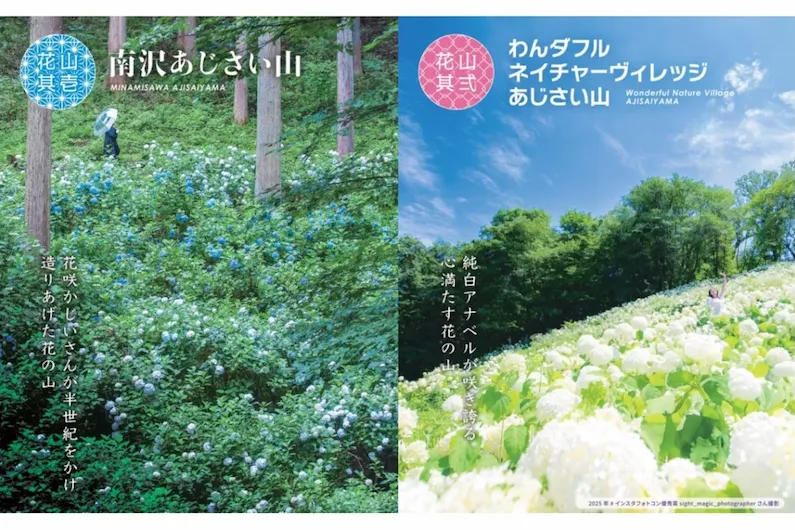
■ Flower Mountain One: A hydrangea paradise where 50 years of passion bloom, “Minamisawa Hydrangea Mountain”
This is a mountain where Mr. Chuichi Minamisawa, who lived in this area, continued to plant hydrangeas with the wish to “fill the path to his parents’ graves with hydrangeas.” Because he wanted to see everyone’s happy faces, he continued planting hydrangeas for 50 years, and now the number of hydrangeas blooming on the mountain exceeds 15,000 plants. There are over 50 types of hydrangeas, including rare varieties that are seldom seen in Japan. Surrounded by tall trees, for about one month from June, vivid hydrangeas in blue, purple, and white bloom in profusion, creating a fantastical atmosphere.
The mountain’s origin as a personal tribute that gradually transformed into a public garden lends it an emotional texture absent from commercially developed attractions. The dense canopy of surrounding trees filters sunlight into dappled patterns across the blooms, producing photographic conditions that change perceptibly across the day.
| Admission | Adults (Junior high school students and older) 600 yen / Children (Elementary school students) 400 yen |
| * Preschoolers are free | |
| * All displayed prices include tax | |
| Inquiries | 090-5540-9100 (Person in charge: Takamizu) |
Access: Please come to the mountain from JR Musashi-Itsukaichi Station by foot, taxi, or the limited-time paid shuttle bus.
Note: Since there is no parking available, if you come by car, please use the coin parking lots around “Musashi-Itsukaichi Station.”
■ Flower Mountain Two: Pure white Annabelles that enchant visitors, “Wan-derful Nature Village Hydrangea Mountain”
The hydrangea mountain is located within the Wan-derful Nature Village, adjacent to Tokyo Summerland. In the hydrangea area of approximately 30,000 square meters, you can enjoy the performance of approximately 60 species and 15,000 hydrangea plants, such as the “Annabelle Snowy Mountain” where pure white Annabelle hydrangeas grow in clusters. At the entrance of the hydrangea area, white and pink Annabelles blooming at the foot of the mountain gently welcome visitors. As you proceed along the hiking course surrounded by colorful hydrangeas, the “Annabelle Snowy Mountain,” which dyes the entire slope in pure white, spreads out before your eyes. Furthermore, from the mountaintop, a magnificent view spreads out, overlooking the grand mountain range of Okutama and the clear stream of the Akigawa River.
The progression from colored varieties at lower elevation to the dramatic monochromatic display higher up creates a structured narrative experience for visitors walking the course. The mountaintop vantage point—unusual for a hydrangea garden—adds topographical variety that justifies the physical effort of ascent.
| Admission | Adults (Junior high school students and older) 850 yen / Elementary school students and younger are free |
| Parking fee | Standard cars 700 yen / Motorcycles 300 yen / Buses 2,000 yen |
| * All displayed prices include tax | |
| Inquiries | 042-558-5861 |
Access:
- By car: Please use the Wan-derful Nature Village parking lot.
- By train: Please take a taxi or local bus from JR Akigawa Station to Tokyo Summerland; from Tokyo Summerland to Wan-derful Nature Village, please use the free shuttle bus.
■ Limited to 2 days! “Savoring Flowers and the Breeze” A luxurious one-day trip to two hydrangea mountains and the satoyama countryside
A special day visiting two hydrangea mountains in the Akigawa Valley in early summer, guided by local staff. Staff who manage the mountains will introduce stories that can only be heard here, such as the behind-the-scenes of pruning and care to make the flowers bloom beautifully. Furthermore, you can experience the “Hydrangea Flower Temari Making” workshop, limited to this tour, making it a program where you can feel the charm of hydrangeas more deeply. Please enjoy a heart-filling healing time along with a satoyama lunch using local ingredients and a hot spring.
This tour addresses a practical challenge many visitors face: the two mountains, while both in the Akigawa Valley, require separate transit arrangements on ordinary days. The guided format eliminates navigation concerns while adding narrative context that solitary visitors would miss. The workshop component—dried flower temari creation—produces a keepsake with longer utility than standard tourist photographs.
| Event Overview | |
|---|---|
| Dates | Saturday, June 20th and Sunday, June 21st |
| Time | 8:45 AM – 3:30 PM |
| Capacity | 20 people per day |
| Minimum participants | 10 people for each day |
| Participation fee | 16,500 yen per person (tax included) |
Itinerary:
| Time | Activity |
|---|---|
| 8:45 | JR Musashi-Itsukaichi Station (Gathering) |
| 9:00–10:15 | Visit to Wan-derful Nature Village Hydrangea Mountain (with local guide) |
| * Limited workshop “Dried Flower Making” | |
| 10:45–12:00 | Visit to Minamisawa Hydrangea Mountain (with local guide) |
| 12:30–13:30 | Private room lunch / Exquisite gourmet using local specialties at Ishifune dining |
| 13:30–15:00 | Akigawa Valley Sene-no-Yu “Shopping / Hot spring bath (Free entry for each individual *separate fee)” |
| 15:30 | JR Musashi-Itsukaichi Station (Dismissal) |
All photos are for illustrative purposes only.
Additional Program Information
- Instagram Photo Contest “#AkigawaHydrangea2026”
- Sale of hydrangea-limited gourmet food & goods
- Minamisawa Hydrangea Mountain × Shizenjin Village BBQ
- Wan-derful Nature Village Hydrangea Mountain & BBQ
Please check the official website for detailed information.
Basic Information
| Location / Nearest Station | Minamisawa Hydrangea Mountain: Musashi-Itsukaichi Station |
| Tokyo Summerland Wan-derful Nature Village: Akigawa Station | |
| Period | 2026/06/06 (Sat) ~ 2026/07/05 (Sun) |
| Time | Start 9:00 / End 17:00 |
| Official Website | https://tokyomountain-tours.jp/ajisaimatsuri/ja/index.html |
The published content may have changed. Please check the official website of the venue or organizer for the latest information.
What is Akigawa Valley?
Akigawa Valley is a gorge in western Tokyo, about 90 minutes from Shinjuku by train. The Akigawa River carved it over millennia, leaving a 20-kilometer stretch of terrain that now sits within Chichibu-Tama-Kai National Park. It is one of the easier natural escapes from the capital.
The valley sits lower than the surrounding hills, which traps cool air and moisture. Hydrangeas grow well here. Limestone cliffs rise on both sides of the river, and the slopes are covered with cedar and broadleaf forest—maples and beeches among them—that redden in autumn. Hiking trails run through the hills, connecting villages, old railway tunnels, and occasional shrines.
The area industrialized briefly during the Meiji era. Limestone mining and silk production brought workers and infrastructure; when those industries faded, the railways were abandoned and the mines closed. What remains—overgrown tracks, stone walls, restored wooden buildings—now forms part of the landscape. The term “satoyama” describes this kind of place, where settlement and forest have coexisted long enough to feel interdependent.
In early summer, when Tokyo’s eastern wards grow humid and stagnant, the valley stays three or four degrees cooler. The river and the elevation keep the air moist. Hydrangeas bloom longer here than in most of the region, and two mountains in particular—Mt. Hinokiboramaru and the western approach to Mt. Takao—draw visitors from the city for the flowers.
